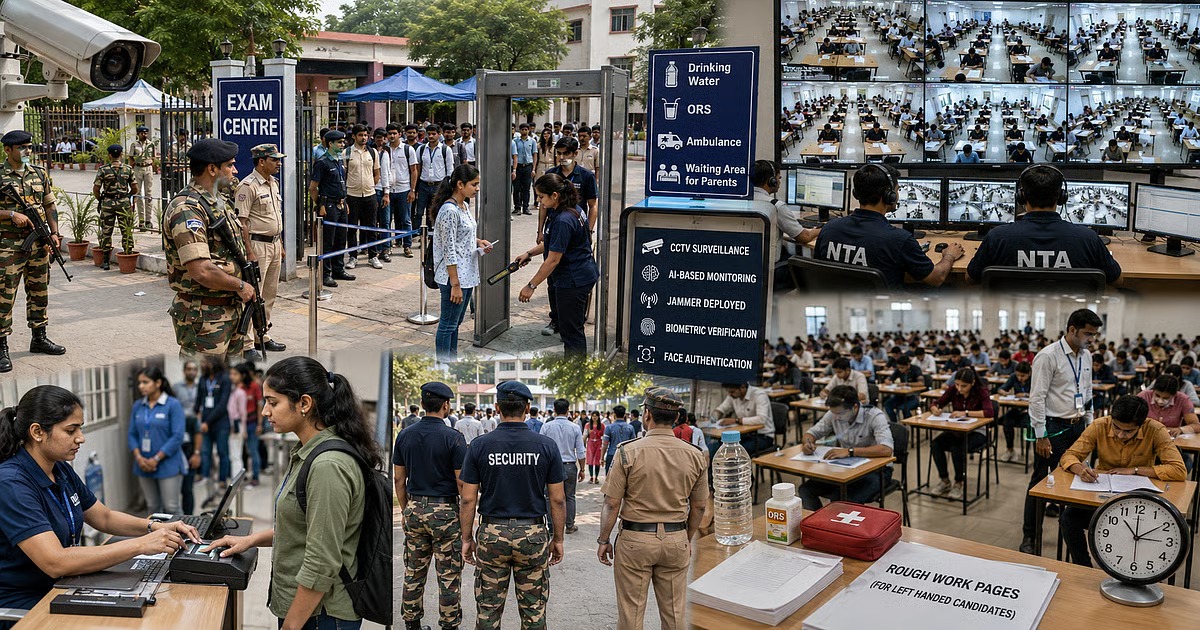
The National Board of Examinations in Medical Sciences (NBEMS) has rolled out robust security measures, including multi-layered encryption for question papers, biometric verification, and signal jammers, for the upcoming NEET-PG 2026 examination. Union Health Minister Jagat Prakash Nadda reviewed these arrangements to guarantee absolute fairness and transparency for the 2,73,183 registered candidates.
Authorities have tightened security protocols for NEET-PG 2026, introducing mandatory Aadhaar-based authentication, iris verification, and real-time electronic surveillance as over 2.73 lakh medical graduates prepare to take the national medical entrance test.
Enhanced Security Infrastructure and Surveillance Measures
In an effort to prevent malpractice, impersonation, and unauthorized access, the Union Ministry of Health and Family Welfare alongside the NBEMS has established a comprehensive security framework for NEET-PG 2026. The examination, scheduled for August 30, will feature advanced technological interventions across approximately 1,300 examination centres in nearly 340 cities nationwide.
The security architecture includes mandatory Aadhaar-based authentication during candidate registration and on examination day, backed by iris-based biometric verification in instances where fingerprint authentication fails. Furthermore, exam halls will be monitored via closed-circuit television (CCTV) cameras and managed with the deployment of signal jammers to block unauthorized electronic communications. Central and regional command centres will exercise live monitoring of proceedings, supplemented by independent observers and real-time algorithmic analysis to flag any unusual answering patterns.
Registration Growth and Single-Shift Logistics
Official data indicates a notable surge in participation, with a total of 2,73,183 candidates registering for NEET-PG 2026, representing an increase of over 12.5 percent compared to the previous examination cycle. To maintain uniformity in difficulty level and evaluation standards, the test will be conducted in a single shift.
To ease logistical challenges for applicants, the government has modified the test city allocation system. Candidates now indicate three preferred states, with their correspondence address serving as the mandatory first preference, replacing the former first-come, first-served model that often forced candidates to travel long distances. Additionally, test city information will be dispatched roughly three weeks prior to the test date to assist with travel planning.
Official Sources and Government Statements
Union Health Minister Jagat Prakash Nadda evaluated the state of preparedness during a high-level review meeting, instructing administrative bodies to maintain the highest benchmarks of integrity and security.
"Organizers stated that the end-to-end question paper preparation and delivery process has been reinforced through multiple layers of encryption, secure offline preparation, time-bound finalisation of the question paper shortly before the examination, and controlled digital decryption only at the scheduled commencement of the test."
The Ministry has explicitly cautioned aspirants against paying heed to rumors or fraudulent claims regarding paper leaks, reiterating that the digital delivery method and stringent protocols render external interference impossible. More than 60,000 examination functionaries will be deployed on-site to ensure smooth operations.
Impact on Medical Aspirants and Test Integrity
The incorporation of strict digital protocols and systemic adjustments carries profound implications for stakeholders:
Medical Graduates: Aspirants benefit from localized test centre allotments and advanced notice of venue locations, reducing transit stress.
Exam Integrity: The elimination of paper-based booklet distribution via digital computer-based testing drastically curtails exposure risks.
Public Trust: Multi-layered biometric tracking and real-time command center oversight reassure candidates of an equitable competitive environment.
Key Facts at a Glance
Total Registered Candidates: 2,73,183 medical professionals.
Examination Date: August 30.
Scale: Conducted across ~340 cities and over 1,300 centers in a single shift.
New Security Controls: Aadhaar authentication, iris scans, signal jammers, and live CCTV command monitoring.
Frequently Asked Questions (FAQ)
What new security measures have been introduced for NEET-PG 2026?
Authorities have introduced mandatory Aadhaar-based authentication, iris-based biometric verification, CCTV monitoring, signal jammers, and centralized live video surveillance across all exam centers.
How many candidates have registered for the exam this year?
A total of 2,73,183 candidates have successfully registered, showing an increase of over 12.5 percent from the previous year.
How are test cities allotted under the updated guidelines?
Candidates select three preferred states, with their home correspondence state set as the mandatory first preference, replacing the older first-come, first-served model.
Will NEET-PG 2026 be held in multiple shifts?
No, the examination will be conducted in a single shift to ensure complete uniformity in evaluation and difficulty levels.
Source:
Ministry of Health and Family Welfare, Government of India Press Releases
National Board of Examinations in Medical Sciences (NBEMS) Official Announcements
Press Information Bureau (PIB)