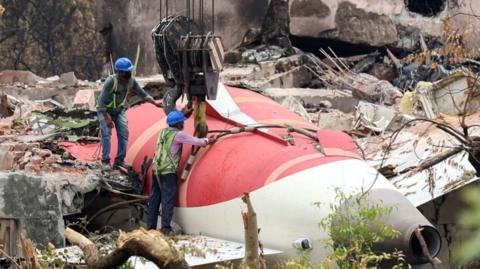
A timeline analysis of the June 2025 Air India Boeing 787 crash in Ahmedabad reveals that both engine fuel switches shifted to "CUTOFF" just three seconds after lift-off. While cockpit recordings show the crew disputed the action, investigators have extended their probe to complete specialized engine forensics in the United States.
AHMEDABAD — One year after the catastrophic June 12, 2025, crash of Air India Flight AI-171, a definitive cockpit factbox has emerged as international investigators miss their formal 12-month deadline to deliver a final report. The London-bound Boeing 787-8 Dreamliner plunged into a medical college hostel complex in Ahmedabad just 32 seconds after lifting off, killing 260 people.
Data tracked by India's Aircraft Accident Investigation Bureau (AAIB) and the US National Transportation Safety Board (NTSB) shows that the fatal chain of events was triggered inside the cockpit when both engine fuel control switches moved from "RUN" to "CUTOFF" almost simultaneously, completely starving the aircraft's powerplants of aviation fuel during the critical initial climb phase.
Technical Chronology of the 32-Second Flight
Forensic telemetry extracted from the aircraft's forward flight data recorder has allowed international safety teams to reconstruct the exact timeline inside the cockpit of the twin-engine jetliner (Registration: VT-ANB).
According to official data logs reviewed by Bloomberg News, the short flight progressed through the following sequence:
The Initial Climb and Power Loss Timeline
00:00 Seconds: Flight AI-171 lifts off successfully from Sardar Vallabhbhai Patel International Airport.
00:03 Seconds: Just three seconds after landing gear retraction, the primary fuel control switches for Engine 1 and Engine 2 transition from the "RUN" position to "CUTOFF." The gap between the two switch movements is recorded at less than one second.
00:04 Seconds: Thrust indicators register an immediate collapse in engine rotational speed. The cockpit voice recorder captures the captain asking the first officer why he cut the fuel supply. The first officer explicitly replies that he did not touch the controls.
00:15 Seconds: As the main electrical networks go dark due to total engine failure, the aircraft’s automated backup systems deploy the emergency Ram Air Turbine (RAT) to preserve baseline flight control electronics. The crew frantically moves the switches back to "RUN," but the heavy aircraft has already lost too much altitude.
00:32 Seconds: The Boeing 787 strikes the upper concrete structure of the Byramjee Jeejeebhoy Medical College hostels, located 1.7 kilometers from the runway tip.
Human Factor vs. Computational Command Vulnerability
The core battle over the final investigation findings centers on whether the fuel switches were flipped manually or suffered an unprecedented computational command defect. The fuel control switches on a Boeing 787 are mechanically guarded controls located on the central pedestal, designed specifically to prevent accidental mid-flight activation.
The Federation of Indian Pilots has formally written to India's Ministry of Civil Aviation, urging investigators to dig deeper into potential electrical or network failures. The union points to a separate incident in February 2026, where a London-to-Bengaluru Air India 787 crew reported a mechanical fuel-switch latch defect during pre-flight checks.
Conversely, early informal assessments by US officials, based on telemetry and the cockpit audio logs, support the theory of an intentional human action. This has led the captain's family to petition India's Supreme Court for an independent review to prevent a premature finding of pilot suicide.
Official Sources Section
Cockpit audio logs, data recorder timelines, and mechanical configurations are compiled using preliminary safety releases from India's Aircraft Accident Investigation Bureau (AAIB), airframe certification guidelines from the US Federal Aviation Administration (FAA), and technical maintenance circulars tracked by the Directorate General of Civil Aviation (DGCA).
Quote Section
Aviation defense lawyers and pilot associations urge caution against focusing solely on human error before the engine tear-downs are completed in the United States.
According to a formal brief submitted by the Federation of Indian Pilots:
"We request that investigators seek exhaustive, deeper technical telemetry from Boeing and Air India. A definitive interim report must not validate unproven theories of deliberate pilot action without resolving potential underlying systemic electrical or computational network failures. The switches are guarded, and an uncommanded electronic signal must be fully ruled out."
Commenting on corporate liability and ongoing victim care, Air India management stated:
"There is absolutely no deadline or pressure on any family or individual to accept our final compensation offer within a set timeframe. Families are entirely free to wait until the final AAIB investigation report has been released."
Why It Matters
For the global aviation market, the final cause of the AI-171 crash carries immense structural consequences. If the ongoing probe in specialized US laboratories isolates an electronic command bug or a wiring harness short-circuit capable of tricking the engine computers into cutting fuel mid-air, it would trigger mandatory airworthiness fixes across hundreds of active Dreamliners worldwide.
Alternatively, if human factors are verified as the cause, it will force a sweeping overhaul of mental health screening, multi-pilot cockpit protocols, and physical cockpit layout designs across global airline networks.
Key Facts at a Glance
The 32-Second Window: Telemetry confirms the entire fatal flight lasted just over half a minute from lift-off to structure impact.
Fuel Starvation Trigger: Both main cockpit engine fuel control switches moved to "CUTOFF" within a tiny one-second window during initial ascent.
Cockpit Audio Clash: Voice recordings capture one pilot questioning the cutoff, while the second pilot actively denies moving the guarded switches.
Engine Probe Delay: The final AAIB report is delayed by at least three months because specialized forensic analysis of the GE Aerospace powerplants remains incomplete in the United States.
FAQ Section
How do the fuel control switches on a Boeing 787 Dreamliner operate?
The fuel control switches are safety-guarded inputs located on the cockpit's central aisle stand. Operating them requires a deliberate "pull-out-and-lift" physical motion, a design meant to ensure they cannot be accidentally bumped or toggled during routine flight.
What did the cockpit voice recorder reveal about the pilot interaction?
The recording captured a brief exchange where one pilot asked the other why he cut the fuel supply. The other pilot responded clearly that he did not perform the action, highlighting the mystery facing investigators.
Why are the engines being examined in the United States instead of India?
The deep-level physical teardown and forensic stress analysis of the GE Aerospace engines require highly specialized diagnostic infrastructure. These specialized testing tools are currently available in only a handful of aviation facilities globally.
Source: Aircraft Accident Investigation Bureau (AAIB) India, Directorate General of Civil Aviation, National Transportation Safety Board (NTSB) Technical Archive, Bloomberg News Aviation Wire.