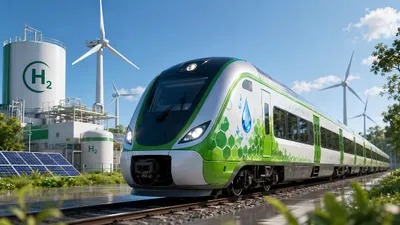
India’s first hydrogen-powered train, launched in Jind, Haryana, uses Proton Exchange Membrane (PEM) fuel cells to convert hydrogen and oxygen into electricity. This indigenous technology provides a clean, zero-emission alternative to diesel engines, supported by a dedicated hydrogen refuelling infrastructure and multi-layer safety systems for safe, efficient regional rail transit.
India’s first hydrogen fuel cell-powered train transforms rail travel by generating electricity onboard through a chemical reaction that produces only water vapour and heat.
JIND, HARYANA – The recent launch of India’s first hydrogen-powered passenger train marks a significant milestone in the country’s sustainable mobility goals. Flagged off by Prime Minister Narendra Modi on July 17, 2026, the train operates on the 89-km Jind-Sonipat section of the Northern Railway, serving as a pilot project to validate the feasibility of clean-energy mass transit.
Unlike traditional diesel locomotives that burn fuel for mechanical power or electric trains that rely on overhead wires, this indigenous trainset operates as a self-sufficient power plant. It represents a shift toward the "greenest form of rail propulsion," utilizing Proton Exchange Membrane (PEM) fuel cell technology to eliminate carbon emissions entirely during operation.
How It Works: The Chemistry of Propulsion
At the heart of the hydrogen train is the Proton Exchange Membrane Fuel Cell (PEMFC). The system operates through a straightforward electrochemical process:
Electrochemical Reaction: Hydrogen stored in high-pressure cylinders on the train combines with oxygen drawn from the surrounding atmosphere.
Electricity Generation: This reaction occurs across a proton-conducting polymer membrane, separating electrons to create a steady flow of electrical current.
Zero-Emission Output: The only by-products of this process are pure water vapour and heat. There is no combustion, smoke, or tailpipe carbon emission.
Hybrid Power Architecture: The trainset utilizes a hybrid design where the fuel cells provide the primary power for traction motors. For acceleration or high-power requirements, integrated Lithium Iron Phosphate (LFP) batteries provide additional energy, while also storing surplus electricity captured during regenerative braking.
A Robust Hydrogen Ecosystem
The project is more than just a train; it is India’s first integrated hydrogen railway ecosystem. To support operations, the Indian Railways established the country’s largest railway hydrogen storage and refuelling facility at Jind. This facility can store nearly 3,000 kg of hydrogen, which is compressed and dispensed into the train's storage cylinders. The infrastructure includes advanced chiller plants that cool the hydrogen gas to -15°C to ensure safe, dense storage and efficient refuelling at 350 bar pressure.
Multi-Layer Safety Systems
Given the nature of hydrogen, the project incorporates "defence in depth" safety principles to ensure passenger and operational security. According to officials, the safety framework includes:
Continuous Monitoring: The train and refuelling station are equipped with sensors to detect leaks, heat, flames, and smoke within seconds.
Automated Shutdown: If any abnormality is detected, the system can automatically isolate the hydrogen supply to prevent risks.
Dilution and Ventilation: Non-stop ventilation systems ensure that even in the unlikely event of a leak, hydrogen is immediately diluted and carried away into the open air.
Independent Certification: The entire hydrogen ecosystem underwent independent safety assessments by TÜV SÜD, Germany, ensuring compliance with international standards such as NFPA-2 and ISO 19880.
Official Sources
The development of this project was a coordinated effort by the Ministry of Railways and Northern Railway, with equipment supplied by Hyderabad-based firm Medha Servo Drives and fuel cell technology sourced from Ballard Power Systems. The safety frameworks and operational protocols were developed in accordance with regulations set by the Petroleum and Explosives Safety Organisation (PESO).
Why It Matters
This hydrogen-powered train represents a scalable solution for non-electrified or short-haul rail corridors, supporting the National Green Hydrogen Mission. By eliminating dependence on fossil fuels and overhead infrastructure, the project demonstrates how India can modernize its rail network while meeting net-zero carbon emission goals. For the broader public, it validates a future where regional passenger transport is quieter, cleaner, and more energy-efficient.
Key Facts at a Glance
Configuration: A 10-coach trainset comprising two Hydrogen Driving Power Cars (DPCs) and eight trailer coaches.
Performance: A combined output of 3,200 HP, designed for a top speed of 110 km/h with an initial operational speed of 75 km/h.
Capacity: Each trainset is designed to carry approximately 2,600 passengers.
Safety Standards: Built on international ISO and NFPA standards with multi-layer leak detection and automatic shut-off systems.
Frequently Asked Questions
Does the train require overhead electrical wires?
No. Unlike conventional electric trains, this hydrogen-powered train generates its own electricity onboard, making it ideal for non-electrified routes.
Is it safe to store hydrogen on a passenger train?
Yes. The train is built with multi-layered safety systems, including leak sensors, flame detectors, and automatic supply cut-off mechanisms, all verified by third-party safety assessments.
What is the main advantage of hydrogen over diesel?
Hydrogen is a clean fuel that produces zero direct carbon emissions, whereas diesel burns fossil fuels and releases smoke and pollutants. Hydrogen also provides high energy density, requiring less fuel by weight for power generation.
Source: Press Information Bureau (PIB), The Economic Times, The Hindu, DD News