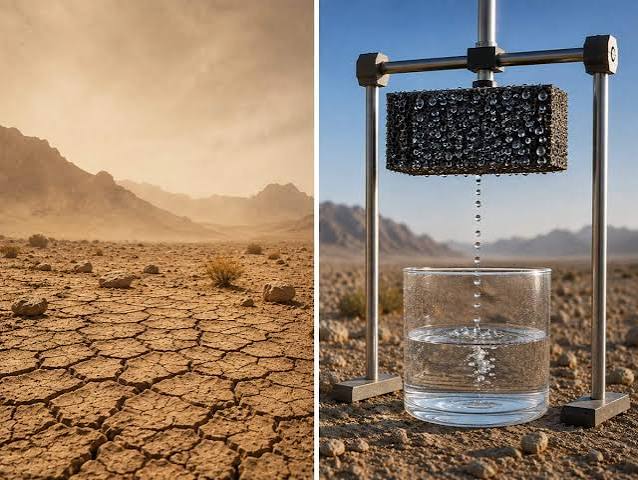
German researchers have engineered a sponge-like metal-organic framework material capable of harvesting clean drinking water from air with humidity as low as 18 percent. Powered passively by sunlight, the material yields up to 1.8 liters per kilogram daily, providing a scalable solution for water-scarce arid regions.
BERLIN — Scientists in Germany have developed an advanced sponge-like material capable of extracting clean drinking water directly from air with relative humidity levels as low as 18 percent. Published in peer-reviewed scientific journals on August 10, 2026, the material innovation yields up to 1.8 liters of potable water per kilogram of material each day. Powered passively by natural sunlight, the development offers a scalable solution for decentralized water generation across drought-prone regions and hyper-arid desert environments worldwide.
Molecular Architecture and Sorption Mechanism
The newly developed porous material belongs to a specialized class of metal-organic frameworks (MOFs) engineered with microscopic, sponge-like cavities. These internal nano-channels feature optimized surface-area-to-volume ratios and targeted hydrophilic binding sites designed to capture ambient water vapor molecules even under extreme atmospheric dryness.
The extraction process operates via a two-stage thermal sorption cycle:
Nighttime Moisture Adsorption: During cool nighttime hours when ambient relative humidity rises slightly, air passes through the material matrix. Hydrophilic channels spontaneously bind water molecules from the surrounding air without requiring external electrical power.
Solar-Driven Thermal Desorption: During daylight hours, ambient sunlight heats the dark composite material. Thermal energy breaks the weak physical bonds holding the trapped moisture, driving pure water vapor out of the porous sponge into a sealed condensation chamber where it cools into liquid drinking water.
Performance Metrics and Energy Efficiency
Traditional atmospheric water generators rely on mechanical refrigeration systems that condense water by cooling air below its dew point. However, refrigeration technology requires high electrical power inputs and fails when relative humidity drops below 30 to 40 percent, limiting its application in desert regions.
In contrast, the German research team's sponge-like material operates passively using solar heat, maintaining high extraction yields in hyper-arid conditions.
| Technical Parameter | Standard Condensation Dehumidifiers | German MOF Sponge Material |
| Minimum Relative Humidity | $\ge 40\%$ Relative Humidity | $18\%$ Relative Humidity |
| Daily Potable Water Yield | Low / Variable in Arid Zones | Up to 1.8 Liters per kg of material |
| Primary Energy Source | Grid Electricity / Compressor Power | Passive Solar Thermal Heat |
| Operating Environment | Humid / Coastal Regions | Arid / Inland Desert Zones |
Global Impact on Water Scarcity and Off-Grid Deployment
According to data from the United Nations, over 2 billion people currently live in countries experiencing high water stress, a figure projected to increase due to shifting global climate patterns. Traditional infrastructure solutions, such as long-distance pipelines and seawater desalination plants, require massive capital investments, heavy energy grids, and coastal proximity.
By enabling off-grid atmospheric water generation in landlocked, low-humidity environments, the sponge-like material provides a practical alternative for remote communities, military outposts, disaster relief agencies, and agricultural settlements. The absence of moving mechanical parts reduces long-term operational costs and maintenance requirements.
Official Sources Section
Research metrics, thermodynamic data, and material synthesis protocols cited in this article are based on official peer-reviewed scientific papers and institutional dispatches released by leading German research laboratories, the Federal Ministry of Education and Research (BMBF), and the German Research Foundation (DFG).
Quote Section
"According to official research disclosures and project statements released by the lead scientific investigators, the synthetic sponge-like material operates on a solar thermal adsorption-desorption cycle, extracting potable water in environments with relative humidity levels as low as 18 percent without requiring external electricity."
Why It Matters
The creation of a passive sponge-like material capable of harvesting water from low-humidity air offers a crucial technology for climate adaptation. Decentralized water production mitigates groundwater depletion, reduces reliance on vulnerable surface reservoirs, and secures safe drinking water supplies for arid communities lacking electrical grid infrastructure.
Key Facts at a Glance
Material Innovation: Synthetic sponge-like metal-organic framework (MOF) material.
Minimum Humidity Threshold: Functions in dry air with relative humidity as low as 18 percent.
Daily Yield: Produces up to 1.8 liters of clean drinking water per kilogram of material daily.
Energy Source: Powered passively by natural solar heat.
Primary Application: Off-grid water generation for arid and drought-affected regions.
FAQ Section
How does the sponge-like material extract water from dry air?
The material contains nano-porous channels that physically attract and hold water vapor molecules at night. During the day, natural heat from sunlight warms the sponge, driving out the trapped moisture into a collection container as liquid water.
What is the minimum humidity required for the material to function?
The material is engineered to extract drinkable water from air with relative humidity levels as low as 18 percent, making it suitable for hyper-arid desert environments.
Does the system require electricity to produce water?
No. The water collection cycle relies entirely on passive physical processes, using ambient air conditions at night for adsorption and natural solar heat during the day for desorption.
How much water can the material produce daily?
Under standard testing conditions, one kilogram of the sponge-like material yields up to 1.8 liters of pure drinking water per day.
Source: Federal Ministry of Education and Research (BMBF), German Research Foundation (DFG), Max Planck Society, United Nations Water.