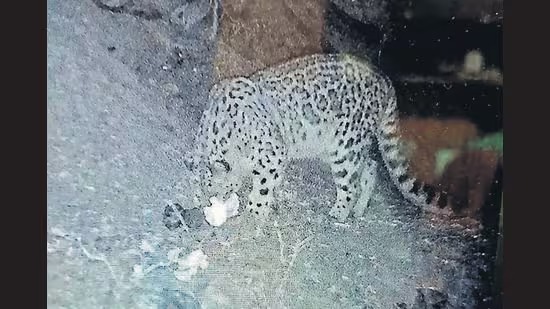
Wildlife authorities and researchers have recorded the first-ever photographic evidence of a snow leopard within the Dhauladhar Wildlife Sanctuary in Himachal Pradesh's Kangra district. Captured at an altitude of 2,836 meters, the discovery marks a historic milestone for high-altitude ecological research, confirming that four apex predators share the protected landscape.
Camera traps have captured the first confirmed photographic evidence of a snow leopard in Himachal Pradesh's Dhauladhar Wildlife Sanctuary.
Landmark Photographic Evidence in Kangra District
The elusive snow leopard (Panthera uncia), widely known as the "Ghost of the Mountains," has been officially documented for the first time via camera traps inside the Dhauladhar Wildlife Sanctuary. According to official statements from the Himachal Pradesh Forest Department, the rare image was captured at an altitude of 2,836 meters above sea level.
The breakthrough is the result of an extensive mammalian wildlife survey conducted jointly by the wildlife wing of the state forest department and the Zoological Survey of India (ZSI). Between 2023 and 2026, researchers deployed a network of 117 camera traps across rugged ridges, high mountain passes, and natural wildlife movement corridors, accumulating thousands of survey days to map the region's rich biodiversity.
Coexistence of Four Apex Predators
The confirmed presence of the snow leopard significantly elevates the ecological status of the 944-square-kilometer sanctuary. Officials noted that the Dhauladhar Wildlife Sanctuary is now formally recognized as one of the elite protected landscapes in the Western Himalayas where four distinct apex predators—the snow leopard, the Himalayan brown bear, the Asiatic black bear, and the common leopard—coexist.
Researchers analyzing the data suggest that the photographed animal was likely a dispersing individual navigating beyond its core range. The sanctuary serves as a vital high-altitude biological corridor, connecting isolated habitats and facilitating safe movement for wide-ranging mountain fauna across the Himalayan ecosystem.
Implications for Himalayan Wildlife Conservation
For conservationists, policymakers, and environmental scientists, tracking rare megafauna provides critical insights into the health of fragile alpine habitats. State forest officials emphasized that scientific monitoring efforts will continue to focus on safeguarding these natural movement corridors against anthropogenic pressures and habitat fragmentation.
The finding also aligns with broader state-wide assessments across Himachal Pradesh, which have pointed toward stable and resilient snow leopard populations spanning high-altitude districts like Lahaul, Spiti, and Kinnaur. The photographic validation from Dhauladhar reinforces the success of long-term conservation protocols implemented across the region.
Official Sources Section
Details regarding the camera-trap survey, altitudinal data, and ecological assessments cited in this report are sourced from official announcements and technical briefs issued by the Himachal Pradesh Forest Department and the Zoological Survey of India (ZSI). Additional context draws from regional administrative records maintained in the Kangra district.
Quote Section
"According to officials, the confirmed presence of the snow leopard significantly enhances the conservation importance of the Dhauladhar Wildlife Sanctuary, marking a historic milestone in scientific wildlife documentation for the Western Himalayas."
Why It Matters
Documenting endangered species in previously unconfirmed habitats helps wildlife authorities refine protected area boundaries and strengthen anti-poaching measures. For researchers and environmental planners, maintaining intact wildlife corridors is essential to ensuring genetic diversity and long-term survival rates for vulnerable high-altitude species under changing climatic conditions.
Key Facts at a Glance
Species: Snow Leopard (Panthera uncia), classified as Vulnerable.
Location: Dhauladhar Wildlife Sanctuary, Kangra district, Himachal Pradesh.
Altitude of Capture: 2,836 meters above sea level.
Survey Methodology: Joint camera-trapping initiative by the Himachal Forest Department and the Zoological Survey of India (ZSI).
Ecological Significance: Confirms the coexistence of four major apex predators within the same sanctuary.
FAQ Section
Where was the snow leopard photographed?
The snow leopard was photographed inside the Dhauladhar Wildlife Sanctuary located in Himachal Pradesh's Kangra district.
At what altitude was the camera trap triggered?
The rare image was captured by a camera trap installed at an altitude of 2,836 meters above sea level.
Which organizations conducted the wildlife survey?
The comprehensive camera-trap survey was conducted jointly by the wildlife wing of the Himachal Pradesh Forest Department and the Zoological Survey of India (ZSI).
How many apex predators now inhabit the Dhauladhar Wildlife Sanctuary?
With the confirmed presence of the snow leopard, the sanctuary is home to four apex predators: the snow leopard, Himalayan brown bear, Asiatic black bear, and common leopard.
Source: Himachal Pradesh Forest Department, Zoological Survey of India (ZSI)