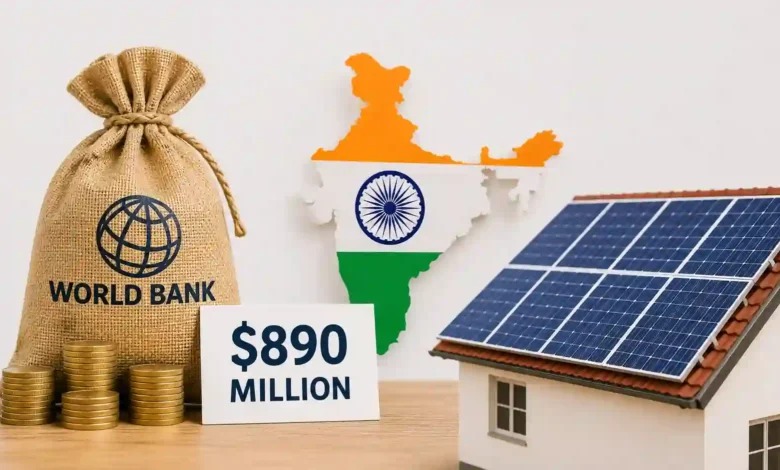
The World Bank approved an $890 million financing package to back India's PM Surya Ghar solar rooftop program, targeting 10 million households. The intervention will mobilize $4.2 billion in private capital through commercial loans, lower consumer credit barriers, and generate 1.7 million clean energy jobs.
WASHINGTON — The World Bank Board of Executive Directors officially approved a sweeping $890 million financing package to accelerate India’s national solar rooftop program. Announced directly from the organization's headquarters, the institutional intervention is specifically engineered to expand decentralized clean energy access across millions of homes, optimize regional distribution grids, and stimulate massive job creation within the domestic supply chain. This landmark financial injection is designed to back the Government of India's flagship PM Surya Ghar: Muft Bijli Yojana, an expansive initiative aiming to integrate grid-connected solar rooftops across 10 million urban and rural households nationwide.
Blended Finance Architecture Unlocks Private Investment
The freshly structured economic intervention relies on a multi-tiered blended financing model engineered to share risk and incentivize deep participation from the private sector. Rather than deploying public capital alone, the multilateral package uses specialized debt instruments to make affordable, collateral-free commercial credit widely available to everyday homeowners.
According to official project disclosures published by the international lender, the foundational $890 million framework consists of three core components:
Crucially, this core capital structure is projected to mobilize an additional $4.2 billion in external private financing. The mobilized capital will move directly into local commercial credit channels, removing the steep upfront cost barriers that historically limited residential renewable energy installations to high-income demographics.
Generating Green Jobs and Enhancing Local Manufacturing
Beyond basic carbon mitigation, the scaled expansion of India's solar rooftop infrastructure acts as an active catalyst for regional economic growth. The rapid transition from centralized utility-scale solar farms to decentralized rooftop arrays demands a robust, localized workforce. World Bank analysis projects that the program will generate approximately 1.7 million job opportunities across the full domestic value chain. These labor roles span solar module manufacturing, hardware logistics, regional sales networks, specialized installation operations, and long-term system maintenance services.
| Strategic Initiative Metrics | Target Milestones & Capital Allocations |
| Multilateral Financing Base | $890 Million ($820M IBRD, $60M CTF, $10M LPF) |
| Private Capital Mobilized | $4.2 Billion in domestic commercial lending |
| Household Integration Target | 10 Million rural and urban dwellings nationwide |
| Projected Labor Expansion | 1.7 Million jobs across supply and service chains |
| National Macro Target | 60% non-fossil electricity generation mix by 2035 |
The initiative directly aligns with the broader 'Make in India' industrial policy by encouraging localized production lines for photovoltaic modules, high-efficiency inverters, and basic structural mounts. By stabilizing domestic demand through a 10-million-household pipeline, the government seeks to safeguard local industries from international supply bottlenecks while lowering aggregate component costs.
Official Sources Section
Operational monitoring parameters, implementation logs, and technical capacity building frameworks are archived through the official World Bank Projects Database and managed in close coordination with the Ministry of New and Renewable Energy (MNRE) of the Government of India.
Quote Section
Lender representatives emphasize that removing long-term financial friction at the consumer level remains the single most critical factor for widespread adoption.
"The program will transform the residential solar market by removing financial barriers and building the capacity of distribution companies, banks, and vendors to deliver integrated service solutions," noted Moez Cherif, World Bank Task Team Leader for the program. "Through collateral-free financing, households can install solar power and significantly reduce their monthly electricity bills."
According to officials, the long-term collaboration between multilateral development organizations and Indian state regulators has successfully expanded overall capacity from 500 megawatts to over 27 gigawatts during the past decade.
Why It Matters
For residential consumers, the deployment of cheap, collateral-free credit provides a direct pathway to escape volatile, fluctuating grid utility pricing. For state-level electricity distribution companies (DISCOMs), the sudden integration of decentralized rooftop power decreases transmission line loads and reduces operational line losses. Globally, the program accelerates India's progress toward its updated climate commitments, which include reaching net-zero carbon emissions by 2070 and ensuring non-fossil energy forms 60% of the country's generation mix by 2035.
Key Facts at a Glance
Direct Funding: $890 million total package from the World Bank to support the PM Surya Ghar initiative.
Investment Leverage: Unlocks an estimated $4.2 billion in private financing via commercial banking pipelines.
Employment Multiplier: Projected to create 1.7 million field and manufacturing jobs across India.
Target Audience: Prioritizes lower- and middle-income residential segments through collateral-free solar loans.
FAQ Section
Q1: What is the primary objective of the PM Surya Ghar: Muft Bijli Yojana?
A1: It is a national solar rooftop program established by the Government of India designed to incentivize rooftop photovoltaic installations for 10 million households, cutting monthly electricity overheads and reducing reliance on fossil fuels.
Q2: How does this World Bank financing package directly assist everyday consumers?
A2: The package works with local commercial banks to build risk-mitigation facilities, enabling financial institutions to offer affordable, collateral-free consumer loans so middle- and lower-income families can fund upfront solar installation costs.
Q3: In what specific fields will the 1.7 million projected job opportunities open?
A3: Employment expansion will concentrate across solar component manufacturing plants, regional logistics, field sales operations, system technical installation, and ongoing engineering maintenance services.
Source: World Bank Press Office, Ministry of New and Renewable Energy Document Portal, Clean Technology Fund Project Registry