Joshua Lippiner, founder of Nampons, launched America's first consumer-accessible hospital-grade nasal insert for nosebleeds in 2021 from his home in Charlotte, North Carolina. Made from oxidised cellulose with a proprietary clotting agent, the product absorbs ten times more blood than tissue and stops bleeding in seconds. With $3.4 million in 2024 sales, 1,200 Walmart stores, 3 million-plus nosebleeds stopped, and a $350,000 deal from Robert Herjavec and Michael Strahan on Shark Tank Season 17 Episode 8, Nampons is redefining first aid.
A Personal Problem, a Running Joke, and a Hospital-Grade Insight That Nobody Had Acted On
Joshua Lippiner is an entrepreneur with a background in building tech platforms and travel websites. Before Nampons, he pitched several ventures, developing the commercial instincts that would later shape his most successful company. But the founding idea for Nampons did not come from a market analysis. It came from personal pain.
Joshua suffered from nosebleeds regularly throughout his life, and every time he did, the only solution available was tissue, cotton, or the uncomfortable head-tilt technique that stops nothing and starts embarrassment. The idea initially struck as a joke: what if you used something like a tampon for a nosebleed? But the more he thought about it, the more he realised the joke contained a genuine insight.
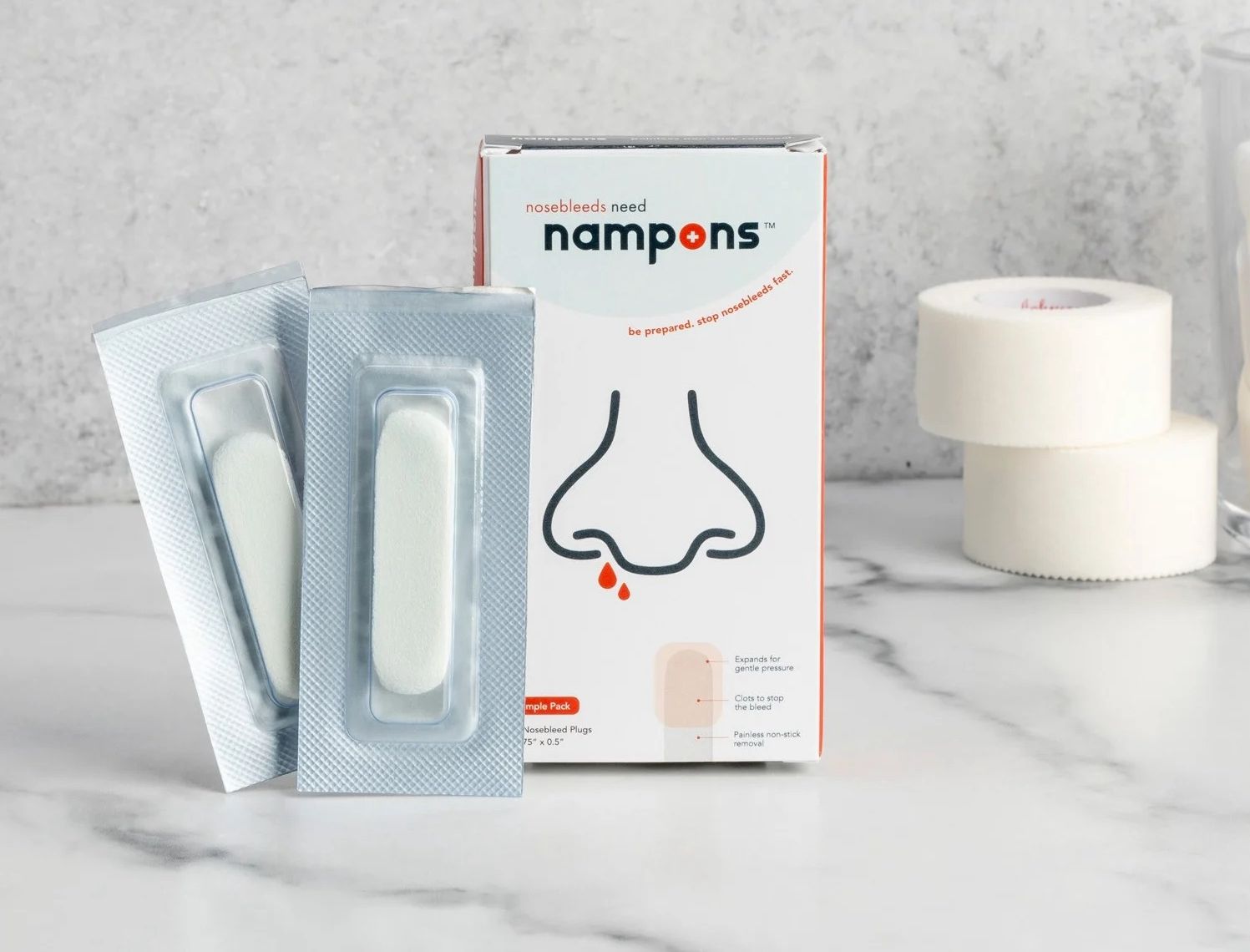
Oxidised cellulose, a hospital-grade absorbent material long used in clinical settings to stop bleeding, already existed. The innovation was not the material. It was making that material accessible, portable, and designed specifically for the nostril, with a proprietary clotting agent that accelerates the process, in a format that any person could use anywhere without training, without mess, and without tilting their head back.
Nampons are small nasal inserts that users place in the nostril during a nosebleed. Upon contact with blood, the product expands within seconds, absorbs up to ten times more blood than tissue, applies pressure at the source, and stops bleeding rapidly using the proprietary clotting agent. Once bleeding stops, the product can be removed without restarting the bleed, a critical advantage over cotton or tissue alternatives.
He launched from his home in Charlotte, North Carolina in 2021. The product is FDA-compliant, backed by a medical advisory board of ENTs and haematologists, and currently has no direct market competitor.
Hospital Grade, No Competition, 1,200 Walmart Stores, and a Pipeline That Keeps Expanding
The boldest product decision Nampons made was to take a material exclusive to clinical settings and bring it to the consumer first aid market in a format requiring zero medical training.
A six-pack costs $3.61 to manufacture and retails at $15.99. A twelve-pack costs $7.86 to produce and retails at $24.99. The margins are healthy and the product is designed for first aid kits, medicine cabinets, sports bags, and emergency use, positioning it for placement in every household and institution in America.
The brand expanded into 1,200 Walmart stores, one of the most significant retail distribution milestones available to any consumer health product in the United States. A large wholesale order from a global first aid kit company boosted 2024 revenue, confirming institutional demand alongside consumer demand. The brand also sells through Amazon and direct-to-consumer channels.
The product pipeline is equally ambitious. Nampon Sport, a version designed with a built-in airway mesh that allows athletes to keep breathing through the nose while playing, extends the category into sports performance and confirms that Nampons is building a platform, not just a product. Trademarks and branding are fully owned, creating defensible market positioning even without a core patent.
By the time Joshua appeared on Shark Tank, more than 3 million nosebleeds had already been stopped by Nampons, a figure that speaks entirely for itself.
Blue Water Demo, Shocked Sharks, and Two Investors Say Yes
Joshua Lippiner appeared on Shark Tank Season 17 Episode 8 seeking $350,000 for 5% equity at a $7 million valuation. He opened the pitch by showing famous faces with nosebleeds, an instantly disarming creative choice. He then demonstrated the product by asking Sharks to drop blue water onto a Nampon and watch it expand and absorb in real time.
The financial numbers shocked the room. Launched in 2021, Nampons generated $3.4 million in 2024 and projected $3.8 million for 2025. Kevin O'Leary raised concerns about the lack of patent protection. Robert Herjavec opened aggressively at $350,000 for 25% equity. When Joshua introduced a royalty structure, Michael Strahan leaned in.
The final deal closed at $350,000 for 10% equity plus a $0.10 royalty per unit sold until the investment was recouped, from Robert Herjavec and Michael Strahan jointly. Post-Shark Tank, Nampons saw a significant sales surge, appeared on the Las Vegas Morning Blend in April 2026, and continued expanding retail and institutional distribution.
1.Founding & Product R&D (2021):Launched from Charlotte, NC, adapting hospital-grade oxidised cellulose into an FDA-compliant nasal insert.
2.Retail & Wholesale Expansion:Scaled distribution into 1,200 Walmart stores, Amazon, DTC, and global first aid kit wholesale orders.
3.Shark Tank Investment Success:Secured $350,000 for 10% equity plus a $0.10 royalty from Robert Herjavec and Michael Strahan.
4.Product Category Growth (2026):Expanded into sports performance with Nampon Sport while maintaining active media and retail momentum.
Scale and Real-World Impact
| Enterprise Parameter | Key Metrics & Operational Details |
| Founder | Joshua Lippiner (Charlotte, North Carolina) |
| Year Founded | 2021 |
| Financial Growth | $1.1M (Year 1) → $3.4M with $800k profit (2024) → $3.8M projected (2025) |
| Estimated Net Worth | $4.4 Million in 2026 |
| Unit Economics | 6-Pack: $3.61 cost / $15.99 retail | 12-Pack: $7.86 cost / $24.99 retail |
| Retail & Reach | 1,200 Walmart Stores, Amazon, Direct-to-Consumer |
| Product Performance | Absorbs 10x more blood than tissue; 3M+ nosebleeds stopped |
| Shark Tank Investment | $350,000 for 10% equity + $0.10 royalty per unit (Robert Herjavec & Michael Strahan) |
| Regulatory & IP | FDA-compliant, Medical Advisory Board backed, zero direct market competitors |
The Most Powerful Healthcare Products Are the Ones That Take What Hospitals Already Know and Give It to Everyone
The sharpest lesson from Nampons' journey is this: the most defensible consumer healthcare innovations often take something that already works in a clinical setting and make it genuinely accessible to the person who needs it in the real world.
Hospitals have used oxidised cellulose to stop bleeding for decades. Joshua Lippiner looked at that material and asked why it was only available in a hospital. The answer was not science. It was packaging, design, and distribution. And those three problems are exactly the ones entrepreneurs are best equipped to solve.
What started as a joke became a solution. What began in a Charlotte home became 1,200 Walmart stores. And a man who spent his life tilting his head back during nosebleeds built the product that means nobody else has to.
Sources: Shark Tank Recap, AOL Finance, Shark Tank Blog, Shark Tank Companies, Shark Tank Insights, YouTube