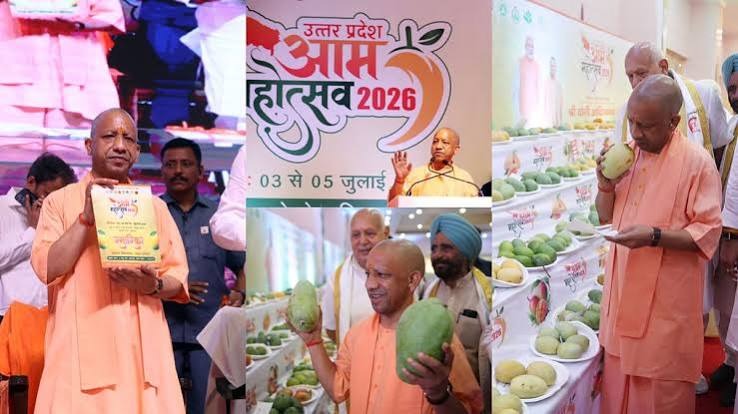
Chief Minister Yogi Adityanath inaugurated Aam Mahotsav 2026 in Lucknow, highlighting Uttar Pradesh's 26% contribution to India's mango production. With exports surging tenfold in the last year, the state is focusing on global branding, advanced pack-house infrastructure, and technological adoption to make its mangoes globally competitive and boost farmer incomes.
The state government is pivoting toward global branding and advanced processing to solidify Uttar Pradesh’s position as a leader in international mango trade.
LUCKNOW – Uttar Pradesh Chief Minister Yogi Adityanath inaugurated the three-day Aam Mahotsav 2026 (Mango Festival) today at the Indira Gandhi Pratishthan in Lucknow. The event, which runs from July 3 to July 5, showcases over 800 varieties of mangoes, underscoring the state’s agricultural prominence and its strategic shift toward export-oriented growth.
Addressing the gathering, Chief Minister Adityanath emphasized that Uttar Pradesh contributes approximately 26% of India’s total mango production. He stated that the state’s focus must transition from merely increasing production volumes to achieving global competitiveness through sophisticated branding, value-added processing, modern packaging, and rigorous product traceability.
Scaling Global Reach for UP Mangoes
With mango cultivation spanning 3.27 lakh hectares across all 18 divisions of the state, the government is intensifying efforts to tap into international markets. According to data provided by the Agricultural and Processed Food Products Export Development Authority (APEDA), exports of mangoes and mango pulp from Uttar Pradesh have seen a significant surge, rising to 3,563 metric tonnes—valued at over Rs 12.67 crore—in the 2025-26 fiscal year, up from 404 metric tonnes in the previous year.
The Chief Minister highlighted that Uttar Pradesh currently exports its produce to several nations, including the United Kingdom, the United Arab Emirates, Saudi Arabia, Malaysia, Singapore, Kuwait, New Zealand, Belgium, Japan, Italy, Qatar, and Russia. To sustain this trajectory, the state is operationalizing modern pack houses in Saharanpur, Varanasi, Lucknow, and Amroha. Furthermore, an Integrated Testing and Treatment Park is under development near the Noida International Airport (Jewar) to streamline export logistics.
Advancing Agri-Entrepreneurship and Infrastructure
The Aam Mahotsav 2026 serves as a platform for more than just a display of horticulture; it is an economic initiative. The state government is promoting the transition of traditional farmers into "agri-entrepreneurs" by encouraging the adoption of drone-based farming, AI-driven crop monitoring, and advanced nursery techniques.
Officials noted that the festival includes a "Mango Buyer-Seller Conference," scheduled for July 4 at Jan Bhavan, Lucknow, which aims to facilitate direct engagement between orchardists and international exporters. To further support the quality of the yield, the state has distributed 1.50 crore fruit-protection bags to farmers and is offering a 40% subsidy for the canopy management of older, less productive orchards.
Official Statements and Industry Support
Dinesh Pratap Singh, Minister of State (Independent Charge) for Horticulture and Agricultural Marketing, noted that the event brings together progressive orchardists and representatives from across the country, including Madhya Pradesh, Uttarakhand, Chhattisgarh, Rajasthan, Gujarat, and Maharashtra.
"The festival is a vital platform to recognize farmers and project Uttar Pradesh’s horticultural potential," organizers stated. They further emphasized that the inclusion of diverse varieties—from the iconic Dussehri of Malihabad to Langra from Varanasi and Rataul from Baghpat—highlights the rich biodiversity of the state’s soil. The government has also initiated efforts to secure Geographical Indication (GI) tags for additional mango varieties to protect their regional heritage and market value.
Why It Matters
The strategic push toward export-oriented production has tangible implications for the local economy. By investing in cold-chain infrastructure, ripening centers, and food processing units, the state aims to reduce post-harvest losses and increase farmer profitability. For consumers and international buyers, the modernization of these supply chains ensures higher standards of food safety, traceability, and consistency, making Uttar Pradesh’s mangoes a preferred choice in the global market.
Key Facts at a Glance
Production Dominance: Uttar Pradesh produces 61.96 lakh metric tonnes of mangoes, accounting for 26.22% of India’s total output.
Export Growth: State mango exports jumped from 404 metric tonnes (2024-25) to 3,563 metric tonnes (2025-26).
Event Scope: The festival showcases 800+ varieties across seven categories and 56 classes.
Strategic Infrastructure: New pack houses are active in four districts, with a major testing facility under construction near Noida International Airport.
Frequently Asked Questions
1. What is the objective of the Aam Mahotsav 2026?
The festival aims to promote Uttar Pradesh's mango diversity, connect local farmers with global buyers, and highlight the state's potential for export-led growth through branding and processing.
2. Where are the main mango-producing belts in Uttar Pradesh?
Major production occurs in Lucknow, Saharanpur, Meerut, Moradabad, Varanasi, Ayodhya, and Prayagraj divisions.
3. What steps are being taken to help farmers export their mangoes?
The government is facilitating connections with exporters via APEDA, establishing modern pack houses, providing fruit-protection bags, and building specialized testing and treatment facilities.
4. How can farmers participate in the export market?
Farmers are encouraged to join Farmer Producer Organisations (FPOs) and utilize the state’s new post-harvest infrastructure to meet international quality protocols.
Source: Agricultural and Processed Food Products Export Development Authority (APEDA), Government of Uttar Pradesh Horticulture Department, Chief Minister’s Office (Uttar Pradesh)