Around 2,500 women in Delhi received approval letters under the Delhi Lakshmi Yojna on Wednesday, with ₹2,500 monthly disbursements commencing September 1. Backed by a ₹5,110-crore budget, the structured welfare initiative integrates locked savings and digital wallet transfers to support low-income households across the national capital.
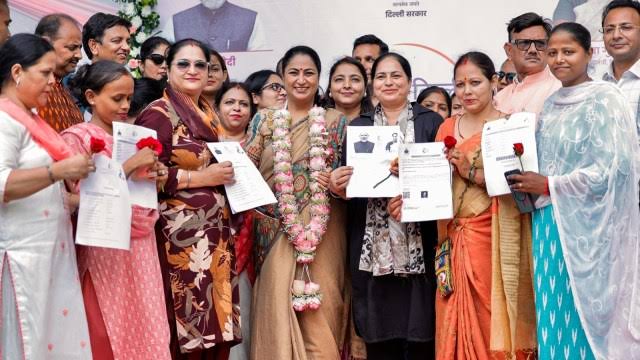
NEW DELHI — Around 2,500 women across the national capital received official approval letters under the Delhi Lakshmi Yojna on Wednesday during a ceremonial launch at Talkatora Stadium, setting the stage for monthly financial assistance of ₹2,500 to be credited directly starting September 1. Handing over the initial batch of certification letters, Delhi Chief Minister Rekha Gupta confirmed that the flagship welfare initiative has transitioned into active execution following comprehensive administrative verification of hundreds of thousands of applicants.
Direct Benefit Transfer Architecture and Phased Disbursal
Under the operational framework notified by the Department of Women and Child Development, eligible beneficiaries will begin receiving their statutory monthly assistance from September 1. The initiative combines direct income support with a structured household savings mechanism designed to prevent immediate fund depletion and build long-term capital reserves for lower-income women.
The disbursal mechanism offers beneficiaries two distinct financial options:
Blended Savings and Digital Currency: Beneficiaries receive ₹1,500 deposited into a recurring deposit (RD) or fixed deposit (FD) account subject to a lock-in period until July 31, 2029, while the remaining ₹1,000 is credited to a Central Bank Digital Currency (CBDC) digital wallet for approved essential household spending.
Full Savings Accumulation: Beneficiaries may opt to deposit the entire ₹2,500 monthly sum into an RD or FD account, allowing the funds to compound until the 2029 maturity threshold.
To prevent misuse, the CBDC wallet component incorporates programmatic restrictions prohibiting transactions involving alcohol, tobacco products, lottery tickets, and gambling services.
Registration Numbers and Scale of Administrative Scrutiny
Since online registrations opened through the dedicated portal on August 1, the Delhi government has logged 913,495 registrations, with 652,223 applicants submitting fully documented files. District-level verification panels have been instructed to expedite application checks to ensure eligible women receive payments during the first disbursal cycle.
With a total budgetary provision of ₹5,110 crore allocated for the 2026–27 financial year, the scheme is projected to cover over 1.7 million women across the National Capital Territory (NCT). The annualized payout of ₹30,000 per recipient represents one of the largest state-level direct benefit transfer commitments in India.
Stringent Eligibility and Exclusion Benchmarks
The administrative guidelines establish rigorous socio-economic criteria to ensure targeted delivery to economically weaker households:
Residency and Family Hierarchy: The applicant must be the eldest eligible female member of the household, a registered voter in Delhi, and a continuous resident (or have a spouse or parents resident) in the capital for at least 10 years.
Income Cap: Household annual earnings must not exceed ₹2,50,000.
Exclusions: Households with government employees, income-tax payees, GST filers, existing state or central pension recipients, owners of four-wheelers, families consuming over 2,400 units of electricity annually, or families with more than three living children are strictly ineligible.
Official Sources
According to official notifications issued by the Government of NCT of Delhi, the Department of Women and Child Development, and data published on the Delhi Lakshmi Yojana Official Portal, verification drives are continuing across all revenue districts. The event at Talkatora Stadium was held in the presence of Delhi Lieutenant Governor Taranjit Singh Sandhu, Delhi BJP President Harsh Malhotra, and members of the Delhi Cabinet.
Quote Section
"Addressing the gathering at Talkatora Stadium, Delhi Chief Minister Rekha Gupta stated that women are at the core of governance priorities, emphasizing that the financial assistance will strengthen household independence and support children's education and basic livelihood needs."
"According to official statements from the Women and Child Development Department, administrative audits will be conducted routinely, and any improper drawal of benefits will trigger immediate cancellation and statutory recovery proceedings."
Why It Matters
The rollout of the Delhi Lakshmi Yojna establishes a major shift in urban social security by linking welfare transfers with programmatic savings and central bank digital currency. By insulating part of the transfer in locked term deposits, the policy fosters institutional financial inclusion, prevents informal household debt accumulation, and ensures direct economic empowerment for female heads of underprivileged households.
Key Facts at a Glance
Beneficiary Milestone: 2,500 women received formal approval letters on August 26 at Talkatora Stadium.
Disbursal Date: Monthly payouts of ₹2,500 commence from September 1.
Application Scale: Over 9.13 lakh registered applicants and 6.52 lakh completed submissions recorded within 25 days.
Fiscal Outlay: ₹5,110 crore allocated in the Delhi Budget 2026–27 to support up to 17 lakh eligible women.
Frequently Asked Questions (FAQ)
What is the Delhi Lakshmi Yojna?
It is a targeted financial welfare scheme by the Delhi government providing ₹2,500 per month to eligible women aged 21 to 60 from low-income families.
When will the monthly financial aid be credited?
The first monthly installment will be disbursed directly starting September 1, 2026.
Can the ₹2,500 assistance be withdrawn entirely in cash?
No. Beneficiaries must either allocate ₹1,500 into locked savings with ₹1,000 in a CBDC digital wallet, or deposit the entire ₹2,500 into a locked recurring/fixed deposit until July 31, 2029.
Who is disqualified from receiving the benefit?
Women from families paying income tax, owning a four-wheeler, consuming more than 2,400 electricity units annually, having government employment, or having more than three children are excluded.
Sources: Delhi Lakshmi Yojana Official Portal, Government of NCT of Delhi, and Department of Women and Child Development Delhi.