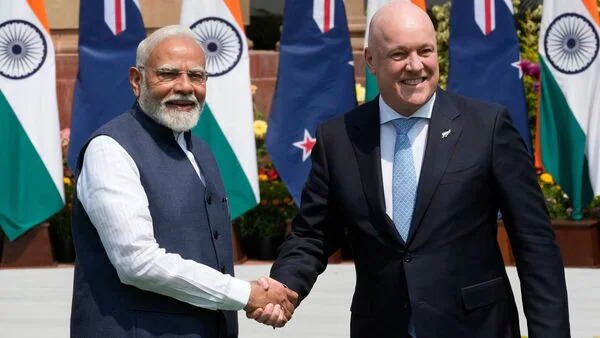
Ahead of PM Narendra Modi’s historic visit to New Zealand, PM Christopher Luxon announced that 57% of New Zealand’s exports to India will be tariff-free from day one under a new trade deal. The visit, the first by an Indian PM in nearly 40 years, aims to boost bilateral trade, defence, and technology cooperation.
New Zealand Prime Minister Christopher Luxon confirms a major trade breakthrough ahead of Prime Minister Narendra Modi’s historic state visit to Auckland.
AUCKLAND — New Zealand Prime Minister Christopher Luxon announced on Thursday that 57% of New Zealand’s exports to India will be tariff-free from the first day of the implementation of the new bilateral trade agreement. The announcement comes just one day before Prime Minister Narendra Modi’s highly anticipated two-day state visit to New Zealand, which begins on July 10, 2026.
This development signals a significant deepening of economic ties between the two nations, providing New Zealand businesses with enhanced access to a massive consumer market of 1.4 billion people. The trade pact is expected to be a central theme during the bilateral talks in Auckland, where Prime Minister Modi and Prime Minister Luxon will review the spectrum of India-New Zealand relations.
Boosting Bilateral Trade Momentum
The proposed trade agreement represents the culmination of resumed negotiations for a Free Trade Agreement (FTA) that began earlier this year. Prime Minister Luxon, sharing the update on the social media platform X, emphasized the potential for growth, stating, "New Zealand businesses are set to boom with our India Trade Deal. 57% of everything we export to India will be tariff-free from day one."
For New Zealand, the agreement is designed to create jobs, lift wages, and provide a competitive edge in one of the world’s fastest-growing economies. For India, the pact secures a strategic foothold in a high-income Pacific economy, aligning with its broader Indo-Pacific economic strategy to diversify supply chains and expand trade routes.
A Historic Diplomatic Milestone
Prime Minister Modi’s visit to New Zealand—the first by an Indian Prime Minister in nearly four decades—is being viewed as a transformative moment for the two countries. During his stay in Auckland, the leaders are scheduled to explore expanded cooperation across several critical sectors, including agriculture, technology, defence, and maritime security.
Beyond the formal trade discussions, Prime Minister Modi is slated to engage with prominent business leaders and sports figures, further strengthening the "people-to-people" connection. He will also address a large gathering of the Indian diaspora, a community that has played a vital role in bridging the cultural and economic gap between the two nations.
Official Sources
According to official government releases and statements from both Prime Ministers, the bilateral relationship has gained "significant momentum in recent years." The Indian government has reiterated that the visit will focus on reviewing the full gamut of relations, with particular attention to how trade and commerce can be leveraged to ensure mutual prosperity.
Why It Matters
The implementation of this trade agreement serves as a vital economic catalyst. By cutting tariffs on over half of all New Zealand exports, the deal is expected to drive down costs for exporters, improve profit margins for small-to-medium enterprises, and stimulate job creation in both nations. For India, the partnership provides a reliable source of high-quality goods and services, while simultaneously strengthening the economic architecture of the Indo-Pacific region.
Key Facts at a Glance
Tariff Relief: 57% of all New Zealand exports to India will be tariff-free from the first day the agreement takes effect.
Historic Visit: PM Narendra Modi is making the first state visit to New Zealand by an Indian Prime Minister in nearly 40 years.
Strategic Focus: The bilateral talks will prioritize trade, commerce, defence, and technology cooperation.
Economic Goal: The pact is intended to unlock fresh opportunities for businesses, create jobs, and lift wages in both economies.
Frequently Asked Questions (FAQ)
1. What does the "tariff-free from day one" announcement mean for businesses?
It means that 57% of goods currently exported from New Zealand to India will no longer be subject to import duties as soon as the trade agreement officially comes into effect, making them more competitive in the Indian market.
2. When is the India-New Zealand trade agreement effective?
The specific implementation date will follow the formal ratification of the deal, which is expected to be a primary point of discussion during the upcoming state visit.
3. Why is this visit considered historic?
This is the first visit by an Indian Prime Minister to New Zealand in almost four decades, marking a renewed commitment to diplomatic and economic ties.
4. What are the key sectors covered under the new trade partnership?
The trade agreement and ongoing bilateral talks cover a wide range of sectors, including agriculture, services, technology, defence, and maritime cooperation.
Source: Government of New Zealand, Ministry of External Affairs (India), The Hindu, ANI News