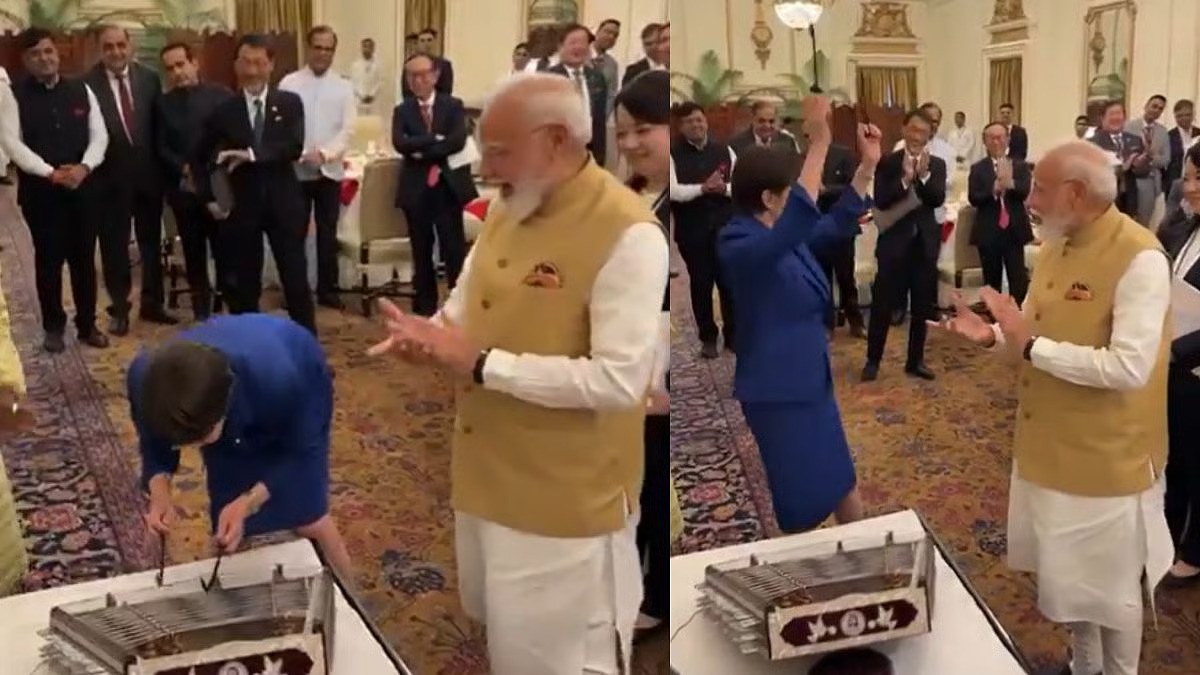
Japanese Prime Minister Sanae Takaichi shared a viral cultural moment during her first state visit to India, trying her hand at the traditional santoor alongside Prime Minister Modi. The 16th Annual Summit secured landmark pacts, establishing new economic partnerships, defense hardware co-development, and resilient semiconductor supply lines.
NEW DELHI — Japanese Prime Minister Sanae Takaichi participated in a unique moment of cultural diplomacy on Thursday, July 2, 2026, when she tried her hand at playing the traditional Indian musical instrument, the santoor, during an official luncheon hosted by Prime Minister Narendra Modi. The lighthearted event took place at Hyderabad House in New Delhi during Takaichi’s inaugural three-day state visit to India for the 16th India-Japan Annual Summit. The viral musical exchange has quickly become the defining visual symbol of a high-stakes diplomatic mission that successfully unified the two largest democracies in the Indo-Pacific behind major semiconductor and defense integration frameworks.
A Cultural Interlude Inside Hyderabad House
The musical demonstration unfolded shortly after the conclusion of high-level delegation talks. During a cultural luncheon featuring traditional Indian classical musicians, Prime Minister Takaichi expressed curiosity about the santoor—a trapezoid-shaped hammered dulcimer prevalent in classical Hindustani music.
Video footage captured by state media pools showed Prime Minister Modi stepping forward to guide his Japanese counterpart, illustrating how to correctly balance the delicate wooden mallets (mezrab) across the instrument's numerous strings. Takaichi was seen smiling as she successfully struck a series of resonant rhythmic notes, drawing immediate applause from the gathered delegations of both nations, which included External Affairs Minister S. Jaishankar and National Security Advisor Ajit Doval.
"Choti Behen" Metaphor Solidifies Bilateral Ties
The relaxed musical exchange highlighted an unusually warm, family-oriented tone that characterized the official summit proceedings. During a joint press conference following the bilateral meetings, Prime Minister Modi departed from standard diplomatic terminology, endearingly addressing Takaichi as “meri chhoti behen” (my younger sister). He noted that Takaichi, as Japan's first female prime minister, originally hails from Japan's Nara Prefecture—a region deeply historical to the shared Buddhist heritage connecting the two sovereign populations.
According to briefings released by Toshihiro Kitamura, Press Secretary and Official Spokesperson for the Japanese Prime Minister, the cultural gesture was warmly received. Takaichi actively reciprocated the sentiment in her subsequent address, stating that the two heads of state had fundamentally agreed to move the India-Japan Special Strategic and Global Partnership forward "as brother and sister," establishing a powerful layer of personal trust.
Semiconductor Supply Chains and Defense Accords
Beyond the cultural diplomacy showcased by the santoor, the summit delivered significant economic and structural outcomes. The leaders formally unveiled a comprehensive Economic Partnership Framework focused on securing resilient semiconductor supply chains, directly protecting industries from global microchip bottlenecks. Additionally, the defense ministries concluded a hardware co-development pact targeted at building collaborative maritime security tech.
The agreements hold concrete implications for businesses and tech investors in both countries, accelerating cross-border software investments and funding an "Industrial Value Chain" designed to tie Japan's manufacturing grid directly into India's emerging Northeastern logistics hubs.
Official Sources Section
The administrative frameworks, direct transcriptions, and cultural events outlined in this news report are compiled via:
Executive Statements
"I am delighted to welcome Prime Minister Takaichi on her first visit to India for the India-Japan Annual Summit. She is also Japan's first female Prime Minister, and a visionary and popular leader. Your Excellency, and 'meri chhoti behen' (my younger sister), Namaskar!"
— Narendra Modi, Prime Minister of India
"According to officials accompanying the Japanese delegation, establishing a profound baseline of personal trust early in Prime Minister Takaichi's term is essential to executing complex defense hardware co-development agreements over the coming decade."
Why It Matters
The symbolic and technical alignment achieved during the state visit influences key sectors:
For Tech Investors: The newly established semiconductor framework provides regulatory backing for joint supply chain factories, safeguarding global chip manufacturing.
For Global Logistics: The commitment to an industrial supply corridor between the Bay of Bengal and Northeast India opens up new, tariff-optimized trade routes.
For Geopolitical Stability: The defense hardware pact strengthens joint maritime security, ensuring open trade routes throughout the critical Indo-Pacific region.
Key Facts at a Glance
Cultural Exchange: Japanese PM Sanae Takaichi tried playing the santoor during a formal luncheon hosted by PM Modi at Hyderabad House.
Historic Term: The trip marks Takaichi's first official state visit to India since she made history by assuming office as Japan's first female prime minister.
Strategic Accords: The summit yielded vital agreements spanning semiconductor supply safety nets, safe AI design, and military hardware co-development.
Personal Diplomacy: The formal relationship was publicly reframed around themes of mutual trust, with PM Modi addressing his counterpart as his "younger sister".
FAQ Section
What is a santoor, the instrument played by the Japanese Prime Minister?
The santoor is a traditional stringed instrument of Persian origin that has long been integral to Indian classical music. It features an array of taut strings stretched across a trapezoidal wooden box and is played using light, curved wooden mallets.
What major economic agreements were signed during the summit?
The two nations finalized an Economic Partnership Framework designed to build secure semiconductor manufacturing networks, alongside an extensive joint platform to develop sustainable and human-centric artificial intelligence technologies.
How long was Prime Minister Sanae Takaichi's official visit to India?
Prime Minister Takaichi arrived in New Delhi on Wednesday, July 1, 2026, for a three-day official visit that concluded with her departure on the morning of Friday, July 3, 2026.
Source: Ministry of External Affairs of India, Ministry of Foreign Affairs of Japan, Press Trust of India.