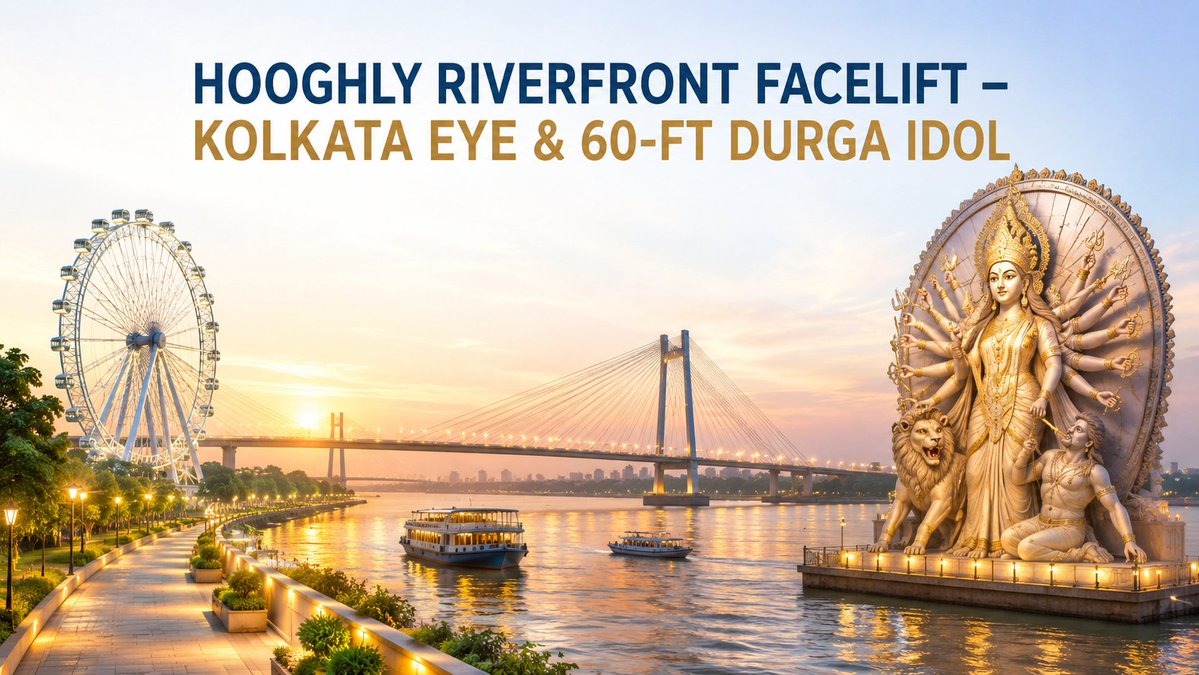
The West Bengal Government, alongside the Kolkata Port Trust, has initiated a ₹1.80 crore riverfront development project in Howrah featuring a permanent 60-feet ashtadhatu metal statue of Goddess Durga at Ramkrishnapur Ghat. Designed to boost tourism, the comprehensive plan integrates lightning safety, viewing decks, and extensive environmental cleanup.
HOWRAH — The West Bengal State Government has finalized plans to construct a monumental 60-feet metal statue of Goddess Durga along the Hooghly riverfront at Ramkrishnapur Ghat in Howrah. Operating under direct administrative directives from Chief Minister Suvendu Adhikari, the project forms the primary core of a multi-phase riverfront redevelopment initiative jointly carried out by the state and the Syama Prasad Mookerjee Port Trust (Kolkata Port Trust).
Announced formally on June 11, 2026, by Umesh Rai, the Minister of State for Urban Development and Municipal Affairs, the structural installation aims to create a highly recognizable socio-cultural landmark. Government planners confirmed that the transformation will establish a high-capacity tourism corridor directly opposite Kolkata’s historic Strand Road, combining regional economic upgrade strategies with extensive environmental public space management.
Architectural Blueprint and Site Infrastructure
The monumental structure, titled the "Durga Shakti" project, is engineered as a 60-feet tall permanent sculpture cast completely out of ashtadhatu—a highly durable, traditional eight-metal alloy formulated to resist severe outdoor atmospheric oxidation.
According to project engineering layouts, the structural framework will be flanked by two oversized metallic ceremonial bows. The installation sits inside a larger waterfront public space blueprint designed by technical experts from the Kolkata Metropolitan Development Authority (KMDA) and the Howrah Municipal Corporation (HMC).
Safety and site operational features built into the primary engineering framework include:
An integrated, heavy-duty industrial lightning protection grid covering the entire concrete foundation pier.
Specially elevated reinforced observation galleries and public seating banks to safely accommodate dense tourist foot traffic.
Dedicated mechanical platforms to manage safely controlled daily ritual offerings, staffed full-time by state-appointed personnel.
Strategic Funding and Construction Phases
The initial fiscal budget allocation for the project has been cleared at ₹1.80 crore ($215,000 USD approx.) to jumpstart the preliminary foundation civil works. Minister Umesh Rai clarified during a site press briefing that total financial outlays are projected to scale up incrementally as subsequent development phases roll out.
The municipal administrative framework has confirmed that the competitive bidding and tender processes are complete, allowing engineering crews to break ground immediately. Government timelines require contractors to finish all structural assembly and landscaping before the official start of the autumn Durga Puja festival cycle.
Broader Urban Renewal and Public Space Impact
The installation at Ramkrishnapur Ghat is part of an overarching environmental cleanup and modernization operation aimed at rectifying long-standing waste problems along the urban banks of the Hooghly River. Historically, this section of Grand Foreshore Road faced heavy pollution issues, industrial discharge, and unmanaged debris accumulation.
Urban planners are designing a phased modernization footprint that will systematically reorder the riverfront. Temporary commercial structures and unorganized markets currently crowding the riverbanks will be relocated to newly designated commercial zones.
The project will also clear the way for long-term hospitality spaces and a large cantilever observation wheel modeled directly after the London Eye, known informally as the "Kolkata Eye" project. Minister Rai confirmed that the beautification master plan is designed to scale extensively northward, eventually upgrading all prominent public ghat networks spanning across Howrah, Belur, and Bally.
Official Sources Section
The statements, dimensions, budget data, and structural metrics outlined in this report are based on official project updates and physical site inspections conducted by the West Bengal Department of Urban Development and Municipal Affairs and structural survey sheets issued by the Syama Prasad Mookerjee Port Trust.
Executive Statements
"Engineers have completed their final physical evaluation of the riverfront foundations, and on-site deployment begins immediately. The visual framework of Howrah is going to shift into a modern, welcoming public asset. Our structural teams are working under strict timelines to fully complete the primary Durga Shakti installation prior to the peak crowds of Durga Puja."
— Umesh Rai, Minister of State for Urban Development and Municipal Affairs
Why It Matters
For citizens and everyday commuters, the project replaces an under-utilized, highly polluted riverbank with clean, safe urban parkland.
Local businesses, street vendors, and retail operators stand to benefit from a significant increase in predictable tourist foot traffic along Grand Foreshore Road.
For global travelers, corporate investors, and regional transport networks, the modern tourism infrastructure establishes a reliable cultural destination, enhancing the economic value of real estate and commercial assets across the Howrah metropolitan area.
Key Facts at a Glance
Total Height: 60 feet permanent structural icon.
Material Base: Authentic ashtadhatu (eight-metal alloy) framework.
Initial Cost: Allocated ₹1.80 crore under immediate state budgetary clearances.
Primary Agencies: Joint execution by West Bengal State, KMDA, HMC, and Kolkata Port Trust.
Target Completion: Scheduled to wrap up construction ahead of the autumn festive season.
Frequently Asked Questions (FAQ)
Where exactly will the 60-feet Durga statue be built?
The statue is being built at the Ramkrishnapur Ghat area along the Hooghly riverfront, situated on Grand Foreshore Road in Howrah.
What material is being used to build the statue?
The sculpture will be cast using ashtadhatu, a highly resilient traditional eight-metal alloy designed to withstand long-term outdoor weather exposure without degrading.
Will the general public have to pay an entry fee to see the monument?
According to current urban development briefings, the site is designed primarily as an open, accessible public riverfront promenade with free admission to the viewing decks.
How will this project affect local vendors and businesses around the ghats?
Unregulated temporary stalls will be organized into structured, dedicated marketplace zones along the riverfront to allow local vendors to capitalize safely on incoming tourist foot traffic.
Source: West Bengal Department of Urban Development and Municipal Affairs, Syama Prasad Mookerjee Port Trust, and municipal filings from the Howrah Municipal Corporation.