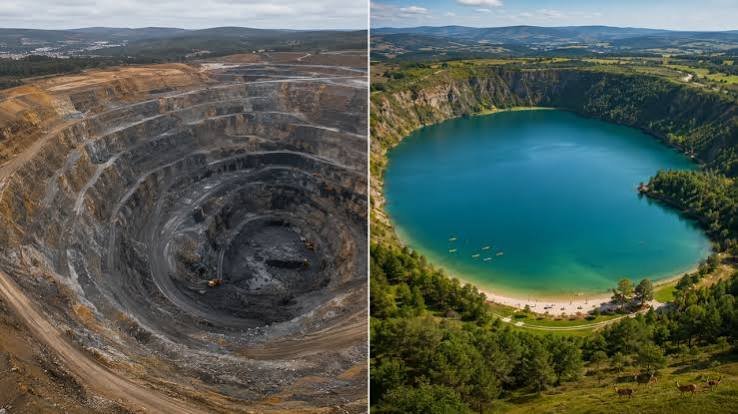
In 2008, Spain initiated a massive engineering project to flood a 300-metre-deep coal mine in As Pontes with 547 billion litres of water. Completed in 2012, the site has evolved into Spain's largest artificial lake, serving as a model for industrial ecological restoration and renewable energy innovation.
AS PONTES, Spain — In a massive ecological restoration milestone, environmental engineers and utility operators in northwestern Spain completed the transformation of a 300-metre-deep open-pit coal mine into a sprawling aquatic ecosystem. Initiated in 2008 by major energy provider Endesa, the multi-year project flooded the massive excavation site in As Pontes, Galicia, with approximately 547 billion litres of water to reverse decades of industrial resource extraction.
The site, which served as the primary source of lignite for Spain’s largest historical thermal power station, ceased operations permanently in 2007 due to tightening European Union air pollution regulations. Rather than abandoning the monumental industrial scar, stakeholders executed an ambitious rehabilitation plan that has converted the defunct strip mine into a certified recreational and ecological hub.
Engineering the Flooding Process and Water Stratification
Filling a pit nearly as deep as the Eiffel Tower required complex hydrological coordination, drawing water from local river systems like the Eume and capturing regional rainfall. According to engineering studies published in the Boletín Geológico y Minero and Mine Water and the Environment, the filling operation reached completion on April 18, 2012.
Research tracking the hydrochemical evolution of the basin revealed unique structural characteristics:
Layered Chemocline: Due to varied water sources and temperature differentials, the lake formed two distinct horizontal strata.
Upper Oxygenated Zone: The top layer remains mildly acidic and rich in oxygen, supporting aquatic life and recreational use.
Deep Anoxic Zone: Hundreds of metres below the surface, the lower layer exhibits minimal oxygen content and higher acidity, preserved by mineral density barriers.
Official Sources Section
Quote Section
According to official project summaries and environmental evaluations released by corporate and academic organizers:
"The rehabilitation of the As Pontes mining complex demonstrates how long-term industrial closures can be systematically repurposed into sustainable ecological assets that benefit regional biodiversity and local economies."
Why It Matters
For industrial regions transitioning away from fossil fuels, the As Pontes project offers a blueprint for post-mining land reclamation. Beyond ecological repair, the site has transformed into a focal point for regional tourism and renewable energy proposals—such as advanced pumped-storage hydroelectric plans—proving that abandoned industrial infrastructure can be successfully reintegrated into modern green economies.
Key Facts at a Glance
Excavation Scale: Roughly 260 million tonnes of lignite extracted over 60 years of operation.
Total Water Volume: Approximately 547 billion litres (547 cubic hectometres).
Completion Date: April 18, 2012, after a four-year controlled filling phase.
Surface Area: Covers 865 hectares, featuring Blue Flag-certified recreational zones.
FAQ Section
How deep is the artificial lake at As Pontes?
The lake occupies a pit that reaches depths of up to 300 metres, making it one of the deepest and largest artificial water bodies in Spain.
Where did the water used to fill the mine come from?
The filling process utilized a combination of local river diversions, specifically from the Eume River, alongside controlled natural rainfall collection.
Is the water safe for public recreation?
Yes. Portions of the lake have earned prestigious Blue Flag environmental certification, supporting swimming, kayaking, and organized water sports alongside established nature trails.
Why was the original coal mine shut down?
The mine and adjacent thermal power station were permanently closed in 2007 to comply with stringent European Union environmental and air pollution regulations.
Source: University of A Coruña, Endesa, Augas de Galicia