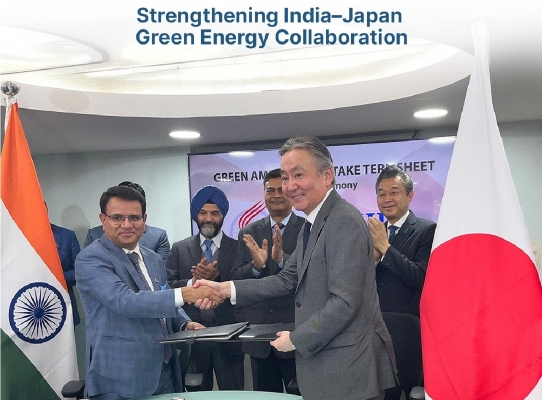
India's ACME Group has finalized landmark clean energy contracts with Japan's IHI Corporation and Mitsubishi Gas Chemical Company. Supported by a $3 billion Japanese government price subsidy, the joint venture will build a facility in Odisha to export 405,000 tonnes of zero-emission fuel annually to Japan starting in 2030.
NEW DELHI — India’s renewable infrastructure developer ACME Group has finalized a series of comprehensive clean energy supply contracts with Japan’s IHI Corporation and Mitsubishi Gas Chemical Company, the Ministry of New and Renewable Energy announced on Thursday, July 2, 2026. The agreements, backed by a massive $3 billion financial price-support subsidy from the Japanese government, establish a formal international corridor for the production and export of zero-emission fuels from India to East Asia.
The strategic alignment comes as major industrial economies in Asia accelerate their transition away from conventional fossil fuels to satisfy rigorous corporate decarbonization mandates.
Japanese Government Certifies Multibillion-Dollar Clean Energy Corridor
The bilateral agreement has received formal cross-border certification under the "Support focusing on the price gap" scheme established by Japan’s recently enacted Hydrogen Society Promotion Act. The official certification was issued jointly by Japan’s Minister of Economy, Trade and Industry alongside the Minister of Land, Infrastructure, Transport and Tourism.
Under this innovative Contract for Difference (CfD) subsidy framework, the Japan Organization for Metals and Energy Security (JOGMEC) will provide financial price support estimated at $3 billion to bridge the cost differential between low-carbon derivatives and traditionally cheaper conventional alternative fuels. This government-backed financial floor ensures immediate revenue certainty for the project, significantly mitigating market volatility risks and allowing the joint venture to secure highly competitive international project financing.
Production Capacities and Infrastructure Allotment in Odisha
The manufacturing base for these exports will be situated at the dedicated green hydrogen and chemical manufacturing complex developed by the ACME Group in the port town of Gopalpur, Odisha. The joint enterprise between ACME and Tokyo-based IHI Corporation involves a direct capital expenditure of ₹295 billion ($3.5 billion) to build out the necessary upstream renewable generation and chemical synthesis facilities.
The facility is engineered to manufacture approximately 405,000 tonnes of green ammonia annually once fully operational. Under the finalized terms of the agreement, IHI Corporation will act as the primary structural offtaker for the entire output. The firm will assume direct operational responsibility for ocean-going maritime transit from the eastern coast of India to primary storage terminals across Japan, with initial commercial shipments slated to commence systematically from fiscal year 2030 onward.
Diversified Consortium Secures Industrial Feedstock and Methanol Assets
Once the fuel reaches Japanese shores, IHI Corporation will distribute the cargo to a diverse consortium comprising six major domestic industrial corporations. This consumption group includes prominent utility providers, metal manufacturers, and agricultural processors:
Hokkaido Electric Power Co. and Kobelco Power Kobe (a subsidiary of Kobe Steel) will utilize the fuel for co-firing technologies inside thermal power generation facilities to lower grid emissions.
Sumitomo Chemical Co., UBE Corporation, and Nippon Beet Sugar Manufacturing Co. will deploy the asset as low-carbon industrial feedstock.
Mitsubishi Gas Chemical Company will incorporate the delivery into its core chemical processing chains to phase out legacy grey ammonia dependencies.
Simultaneously, ACME Group has expanded its chemical synthesis portfolio through a separate standalone agreement with Mitsubishi Gas Chemical Company. The two entities are co-developing a massive green methanol production facility with an annual output capacity of 100,000 tonnes. This parallel clean fuel initiative represents a corporate investment of ₹90 billion ($1.1 billion), targeting the expanding global market for eco-friendly marine transport fuels and sustainable plastic manufacturing materials.
Official Sources Section
According to official administrative notifications from India’s Ministry of New and Renewable Energy and public regulatory declarations published by Mitsubishi Gas Chemical Company, the cross-border value chain represents a major milestone for India's National Green Hydrogen Mission. The program aims to systematically position the South Asian nation as a prominent global manufacturing and export hub for sustainable energy derivatives over the coming decade.
Quote Section
"According to officials from the joint administrative steering committee, these long-term binding offtake frameworks and matching state subsidies provide the commercial blueprint required to construct resilient, cross-border clean energy supply chains capable of operating at a true macroeconomic scale."
Why It Matters
For global energy investors and industrial infrastructure developers, this transaction demonstrates that international clean energy projects can achieve commercial viability when backed by robust government price-gap subsidies like Japan's CfD mechanism. It provides a repeatable financial model for future international infrastructure joint ventures.
For global citizens and environmental advocates, the implementation of this export corridor removes substantial volumes of carbon dioxide emissions from highly polluting heavy industrial sectors, such as electrical power generation and global maritime shipping. The scale of the Gopalpur project signals that the transition toward hydrogen-derived commodities is shifting from localized pilot programs to deeply integrated, international commercial realities.
Key Facts at a Glance
Total Project Investment: ₹295 billion allocated for the primary fuel facility, alongside ₹90 billion for the parallel methanol plant.
Government Price Support: A $3 billion subsidy provided under Japan's Hydrogen Society Promotion Act via JOGMEC.
Manufacturing Hub Location: Hosted entirely at the industrial port zone of Gopalpur, Odisha.
Consortium Buyers: Features seven elite Japanese industrial corporations, including IHI, Mitsubishi Gas Chemical, and Sumitomo Chemical.
Operational Timeline: Production and maritime export schedules are structured to commence in 2030.
Frequently Asked Questions
What is the core function of the Hydrogen Society Promotion Act scheme?
The Japanese government's price-gap scheme is a subsidy mechanism designed to offset the cost difference between clean, low-carbon fuels and cheaper, conventional fossil-based alternatives, helping industrial users transition without incurring severe financial penalties.
Why was the state of Odisha chosen for this production facility?
Gopalpur, Odisha offers strategic maritime access for large-scale shipping, a well-developed port-led industrial ecosystem, and significant land availability required to support matching upstream solar and wind renewable energy generation arrays.
Will the produced fuel be used in India or exported?
The current phase of the ACME-IHI joint venture is designed entirely as an export-oriented corridor, with 100% of the 405,000-tonne annual production committed to Japanese industrial buyers under long-term binding agreements.
Sources: Chemical Industry Digest, Indian Chemical News, The Economic TImes