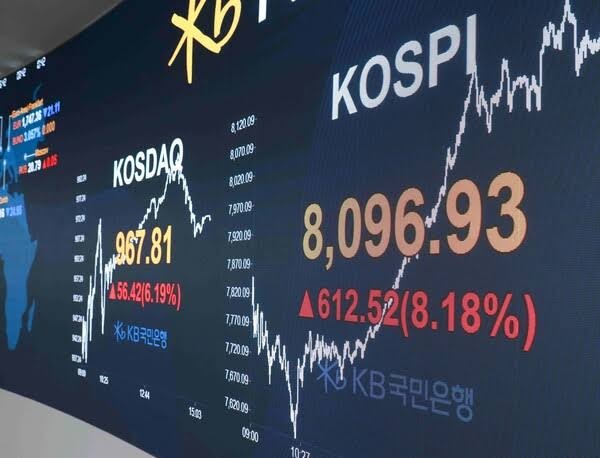
The KOSPI has officially entered a bear market, plunging over 20% from its June 2026 record high. Driven by a significant sell-off in heavyweight semiconductor stocks like Samsung and SK Hynix, investors are reassessing valuations amidst cooling global demand for artificial intelligence hardware, marking a major reversal for South Korean equities.
The South Korean benchmark index has officially entered a bear market following a rapid correction driven by shifting investor sentiment regarding the artificial intelligence hardware supercycle.
SEOUL — South Korea’s benchmark KOSPI index has officially entered bear market territory, marking a dramatic reversal for what was previously the world’s best-performing major stock index in 2026. As of July 8, 2026, the index has plunged more than 20% from its record peak of 9,385.59, reached on June 19, 2026. The sharp decline reflects a cooling in the aggressive AI-driven rally that had propelled the market to historic highs earlier this year.
The downturn has been primarily fueled by a deep sell-off in heavyweight semiconductor stocks. Samsung Electronics and SK Hynix, which together account for approximately half of the KOSPI’s total market capitalization, have led the slide as investors begin to question the long-term sustainability of the AI infrastructure boom.
Semiconductor Sell-Off and AI Valuation Concerns
The sudden correction follows a period of extreme volatility that saw the KOSPI trigger multiple trading circuit breakers throughout June. Market analysts suggest that while Samsung Electronics reported a massive 19-fold surge in second-quarter operating profit, the revenue figures fell short of elevated market expectations. This disparity has sparked a broader reassessment of valuations for South Korea’s tech giants.
According to market data, the rout has been exacerbated by the unwinding of highly leveraged positions. Retail investors, who were instrumental in the index’s meteoric rise earlier in the year, have faced significant pressure as margin trading positions were liquidated. Foreign institutional investors have also shifted toward net-selling positions, signaling a departure from the bullish sentiment that defined the first half of 2026.
Broader Economic Implications
The impact of the KOSPI’s decline extends beyond the technology sector. Other major components of the index, including companies in the automotive and industrial sectors that had previously benefited from AI-related partnerships, have also seen substantial pullbacks.
For the South Korean economy, this transition into a bear market presents significant challenges. The government and financial regulators have been closely monitoring the situation to determine if the volatility poses a systemic risk to the broader financial system. While some analysts maintain that the long-term structural demand for memory chips remains intact, the current correction underscores the risks associated with an index heavily concentrated in a single cyclical industry.
Official Sources and Market Context
Information regarding the KOSPI's status and performance is documented through the Korea Exchange (KRX). Regulatory filings from major constituents, including Samsung Electronics, are available through the Financial Supervisory Service (FSS) of South Korea. Official market data confirms that the index closed at approximately 7,301 points on July 8, 2026, confirming its position well below the technical bear market threshold.
Why It Matters
The descent of the KOSPI into bear market territory serves as a cautionary tale regarding market concentration. Because the index is so heavily dominated by two semiconductor firms, any shift in the global AI hardware narrative creates disproportionate impacts on the entire South Korean equity market. For investors, this correction highlights the importance of diversification and the potential for rapid sentiment shifts in highly valued, tech-centric indices.
Key Facts at a Glance
Bear Market Confirmation: The KOSPI has dropped more than 20% from its June 19 record high of 9,385.59.
Index Composition: Two semiconductor giants, Samsung Electronics and SK Hynix, account for roughly 50% of the index's market capitalization.
Market Volatility: The index experienced multiple circuit breakers in June 2026 due to extreme intraday swings.
Investor Shift: A notable transition from retail buying to foreign net-selling has contributed to the downward momentum.
FAQ Section
What is a bear market?
A bear market is technically defined as a decline of 20% or more from an asset's or index's most recent peak.
What triggered the KOSPI decline?
The decline was primarily triggered by investor concerns over stretched valuations in AI-related semiconductor stocks and weaker-than-expected revenue guidance from major chipmakers.
Are other sectors affected?
Yes, while chipmakers led the sell-off, the volatility has spilled over into other sectors, including automotive and industrials, which had previously rallied alongside AI infrastructure growth.
Will the market recover?
Market outlooks remain divided; while some analysts see the correction as a healthy reset for valuations, others warn of continued volatility as investors reassess the durability of global AI spending.
Source: Korea Exchange (KRX), Financial Supervisory Service (FSS), Trading Economics