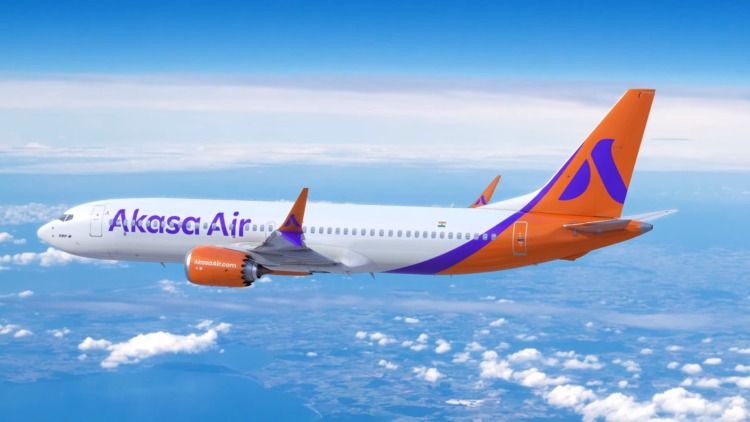
Indian budget carrier Akasa Air has announced an ambitious 30% capacity growth target for FY27, driven by a 37% revenue jump in FY26. Operating 39 Boeing 737 MAX planes, the airline is expanding international routes to 40% while evaluating a government credit support scheme to insulate against geopolitical fuel spikes.
NEW DELHI — Indian low-cost carrier Akasa Air announced on Wednesday, June 24, 2026, that it is targeting a 30% capacity expansion for the current financial year (FY27) ending March 2027. Speaking at a media briefing in the national capital, Chief Financial Officer Ankur Goel confirmed that the airline's long-term fleet growth and international network expansion remain on a firm footing despite rising aviation turbine fuel (ATF) costs and regional geopolitical challenges. To fortify its liquidity position against market disruptions arising from the ongoing West Asia conflict, the airline is actively evaluating participation in the government's multi-crore emergency credit guarantee programme.
Strategic Fleet Expansion and Shifting International Focus
Robust Fiscal Performance and Capacity Growth
The aggressive 30% capacity growth projection follows a strong financial turnaround for Akasa Air in the fiscal year ended March 31, 2026 (FY26). The airline reported a 37% year-on-year surge in operating revenue, backed by a corresponding 30% increase in capacity measured in Available Seat Kilometres (ASKs).
While the privately held company did not publicly disclose its exact top-line revenue numbers, corporate officers revealed that the airline achieved a crucial milestone by turning EBITDA positive during the six-month window from September to March. Unit revenue expanded by approximately 10%, while structural unit costs decreased by 4% over the same operational period.
Scaling Fleet Deliveries and Network Footprint
Akasa Air recently inducted its 39th aircraft, a Boeing 737 MAX 8-200 registered as VT-YBP, marking its eighth factory delivery in the calendar year 2026. The aircraft completed its multi-leg journey from Seattle, Washington, via Iceland and Egypt, before touching down at Kempegowda International Airport in Bengaluru.
With 187 aircraft remaining on its firm order book with Boeing, the airline expects to sustain an annual capacity growth trajectory of 30% to 40% over the next four to five years, aiming to build a fleet of 226 aircraft by 2032. The airline currently connects 27 domestic and seven international destinations, with immediate overseas expansion focused heavily on a five-to-six-hour flight radius encompassing Southeast Asia and the Gulf region.
Evaluating Government Credit Support and Managing Geopolitical Headwinds
Assessing Emergency Liquidity Buffers
As part of its risk management strategy, Akasa Air is currently engaging with commercial banks and the Ministry of Civil Aviation to evaluate the possibility of accessing the central government's ₹18,100 crore credit guarantee programme. The state-backed liquidity protection scheme was engineered specifically to help domestic passenger airlines absorb high operational stress, including elevated fuel price shocks and flight rerouting costs tied to the Middle East geopolitical crisis.
Management clarified that while Akasa Air remains well-capitalized and has not drawn any emergency capital under the scheme as of June 24, 2026, having an active credit corridor serves as an essential financial safety cushion.
Impact on Consumers, Investors, and the Aviation Market
For air travelers and consumers, Akasa Air's steady capacity growth ensures competitive ticket pricing across crucial trunk routes connecting India to destinations like Phuket and upcoming routes like Hanoi. For potential public market investors, the airline's disciplined unit cost reduction and EBITDA performance lay the groundwork for a planned initial public offering (IPO) targeted within the next two to four years. Additionally, the carrier's establishment of a dedicated aircraft leasing division within the International Financial Services Centre (IFSC) at GIFT City is expected to optimize long-term asset-servicing costs and improve tax efficiencies.
Official Sources Section
Company financial metrics, aircraft delivery schedules, and network configurations are compiled from official corporate disclosures and press briefings held by Akasa Air management in New Delhi. Market share metrics are sourced directly from monthly statistical releases provided by the Directorate General of Civil Aviation (DGCA).
Quote Section
"According to company officials, the airline's long-term growth map remains insulated from near-term geopolitical anxieties. The management stated that our trust in Boeing has only increased, and the organization is continuously working with banking partners and the aviation ministry to evaluate state credit guarantee frameworks to optimize our financial flexibility as we transition to a multi-year profitability cycle."
Why It Matters
Akasa Air’s expansion and its concurrent assessment of public credit programs demonstrate how newer low-cost carriers navigate a highly consolidated Indian aviation market dominated by larger players like IndiGo and Air India. By aggressively targeting a 40% international capacity share over the medium term, Akasa Air is positioning its high-density Boeing fleet to capture lucrative cross-border traffic, providing consumers with necessary alternative options and protecting the broader supply chain against localized industrial bottlenecks.
Key Facts at a Glance
Capacity Target: Akasa Air is targeting a 30% capacity growth in FY27, with long-term projections of 30% to 40% annual expansion.
Credit Evaluation: The carrier is working with the civil aviation ministry to evaluate accessing the government's ₹18,100 crore credit support scheme.
Financial Milestone: Operating revenue surged 37% in FY26, with the airline achieving positive EBITDA figures between September and March.
Fleet Milestones: The airline inducted its 39th aircraft, a Boeing 737 MAX 8-200, representing its eighth factory delivery in calendar year 2026.
International Expansion: Overseas operations currently account for 25% of overall capacity, with a targeted increase to 40% over the next few years.
FAQ Section
Q1: Why is Akasa Air evaluating the government's credit guarantee scheme if it is well-capitalized? A1: The airline is reviewing the government's ₹18,100 crore credit programme to establish a liquidity buffer against macroeconomic headwinds, such as fluctuating jet fuel prices and airspace rerouting costs stemming from geopolitical tensions in West Asia.
Q2: What are Akasa Air's future fleet size objectives? A2: Following the delivery of its 39th Boeing 737 MAX aircraft in June 2026, the airline has 187 additional aircraft left to pull from its order book, aiming to operate 226 aircraft by 2032.
Q3: How much of Akasa Air's business is dedicated to international flights? A3: International routes make up 25% of Akasa Air’s capacity as of mid-2026. Chief Financial Officer Ankur Goel indicated that the company aims to scale its international footprint to 40% over the next few years, focusing on routes within a 5-to-6-hour radius.
Source: Akasa Air Corporate Investor Briefing, Directorate General of Civil Aviation (DGCA) India, Ministry of Civil Aviation