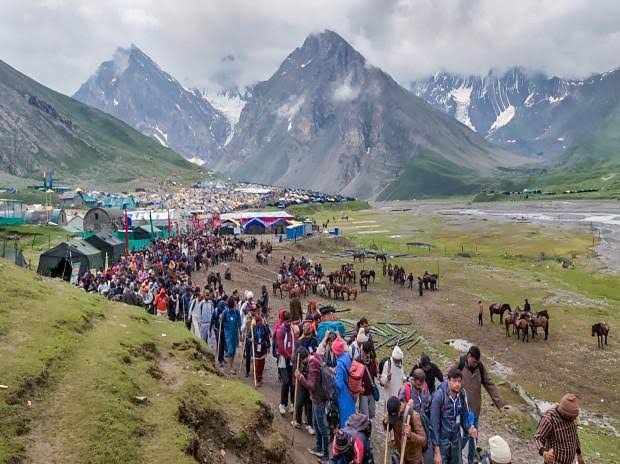
The fourth batch of 6,721 Amarnath Yatra pilgrims departed from Jammu on July 5, 2026, under heavy security. The administration has deployed AI-surveillance, drone monitoring, and a robust medical network—including ten first-aid camps and life-support ambulances—to ensure the safety of devotees throughout the 57-day sacred pilgrimage.
The annual Shri Amarnath Yatra 2026 continues its steady progression, with the fourth batch of devotees leaving Jammu early Sunday morning for the twin base camps of Baltal and Pahalgam in the Kashmir Himalayas. The convoy, consisting of 291 vehicles, included 4,576 males, 1,310 females, 572 sadhus, 154 sadhvis, 22 children, and 87 foreign nationals, according to official reports.
The pilgrimage, which officially commenced on July 3, 2026, is being conducted under a comprehensive security framework designed to protect the thousands of devotees trekking to the holy cave shrine of Baba Barfani.
Multi-Layered Security and Surveillance
To ensure a secure transit, the Jammu and Kashmir administration, in coordination with the Central Reserve Police Force (CRPF) and local police, has implemented a multi-layered security grid. The protective measures include:
Surveillance Infrastructure: The deployment of AI-powered cameras, drone monitoring, and digital surveillance systems to track crowd density and identify potential threats.
Transit Protection: Escorted convoys and rigorous frisking protocols at multiple points along the Jammu-Srinagar National Highway (NH-44).
Bomb Squad Operations: Dedicated dog squads and bomb disposal teams are performing continuous checks on luggage and vehicles entering the base camps to prevent unauthorized entry.
Medical Matrix and Emergency Response
In anticipation of high-altitude health challenges, health authorities have established a “robust medical matrix” stretching along the pilgrimage route. Chief Medical Officer (CMO) of Udhampur, Anil Manhas, confirmed the operationalization of ten stationary first-aid camps at key bottleneck areas on NH-44, specifically covering the sector between Tikri Kali Mata Temple and the Chenani-Nashri Tunnel.
Supporting these camps are six fully equipped, life-support ambulances positioned at strategic intervals to facilitate rapid medical intervention and emergency evacuations. Additionally, voluntary organizations like the Om Shiv Shakti Sewa Langar Committee are hosting 24-hour medical camps stocked with oxygen cylinders and emergency medications to assist pilgrims.
Why It Matters
For the 210,000 pilgrims expected to participate this season, the current arrangements are critical. The annual 57-day yatra, which concludes on August 28, 2026, involves arduous treks through high-altitude terrain. By integrating technology with ground-level medical and security support, authorities aim to mitigate risks from both external threats and the natural hazards of the Himalayan environment.
Key Facts at a Glance
Fourth Batch Size: 6,721 pilgrims.
Convoy Details: 291 vehicles (including 134 buses and 120 light motor vehicles).
Duration: The pilgrimage is scheduled to conclude on August 28, 2026, coinciding with Raksha Bandhan.
Medical Infrastructure: 10 first-aid camps and 6 dedicated life-support ambulances deployed along the NH-44 corridor.
Surveillance: Deployment of AI-powered cameras, drones, and RFID tracking for real-time crowd management.
Frequently Asked Questions
1. Is registration required for the Yatra?
Yes, the J&K administration emphasizes that only registered pilgrims with valid permits are allowed to proceed to the base camps. Unregistered pilgrims are strictly advised against attempting the journey.
2. What should pilgrims do in case of a medical emergency?
Pilgrims are encouraged to utilize the first-aid camps located along the route or approach security personnel who are equipped with communication channels to coordinate with the nearest life-support ambulances.
3. When does the Amarnath Yatra 2026 end?
The annual pilgrimage is scheduled to conclude on August 28, 2026.
Source: ANI News, Greater Kashmir, United News of India (UNI)