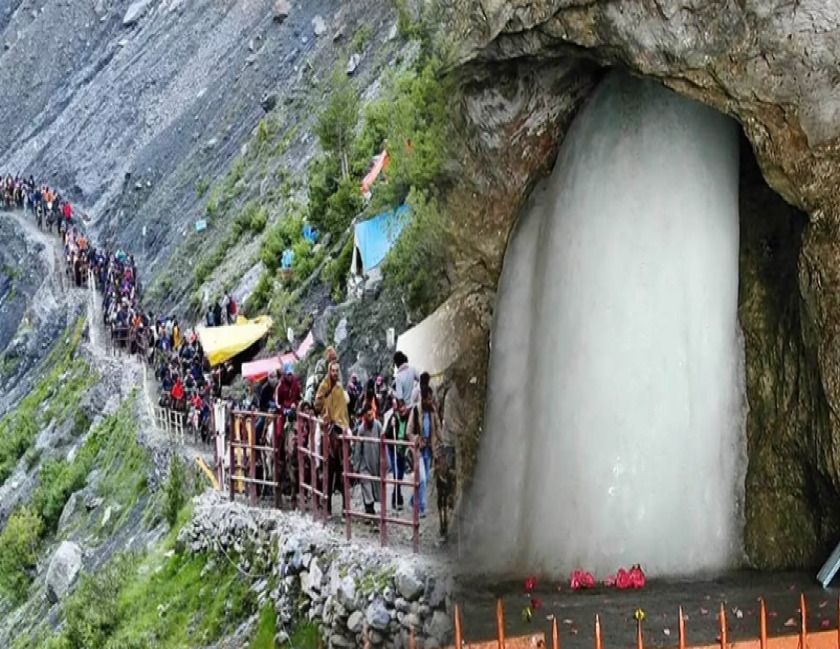
The Amarnath Yatra 2026 has successfully commenced, supported by the largest paramilitary deployment in its history. Running from July 3 to August 28, the 57-day pilgrimage features advanced anti-drone surveillance and expanded transit camps, drawing praise from devotees for the secure and well-organized arrangements provided by the authorities.
The unprecedented deployment of security forces and upgraded transit facilities have ensured a smooth and secure journey for thousands of devotees during the 57-day pilgrimage.
SRINAGAR – The annual Amarnath Yatra 2026 has officially commenced, with the first batches of pilgrims expressing high satisfaction regarding the extensive security and logistical arrangements provided along the Baltal and Pahalgam routes. Beginning on July 3, 2026, and scheduled to conclude on August 28, the 57-day spiritual journey to the holy cave shrine in the Jammu and Kashmir Himalayas involves immense coordination by central and union territory administrations. This development is crucial today as it highlights the successful implementation of the largest paramilitary deployment in the pilgrimage's history, ensuring a safe and well-managed environment amid ongoing regional security concerns.
Situated 3,888 meters above sea level, the revered Amarnath cave houses a naturally formed ice Lingam, drawing devotees from across the nation. Ensuring their safety and comfort across challenging terrains remains a massive logistical undertaking, which officials state is performing smoothly in the early days of this year's pilgrimage.
Unprecedented Security Grid and Aerial Surveillance
A prominent highlight of the Amarnath Yatra 2026 is the robust, multi-layered security grid established across the region. According to the Union Ministry of Home Affairs, over 670 companies of Central Armed Police Forces (CAPFs) have been mobilized, making it the highest deployment of security personnel for the yatra to date.
Security agencies, including the Jammu and Kashmir Police, the Indian Army, and the Central Reserve Police Force (CRPF), are utilizing advanced surveillance technology to mitigate threats. Authorities have established a comprehensive anti-drone network coordinated by the Army Air Defence (AAD). The deployment of the Integrated Drone Detection and Interceptor System (IDDIS) and the Low Level Lightweight Radar (LLLR) ensures real-time monitoring of a 50-kilometer radius around crucial transit camps and base locations.
Furthermore, Srinagar Police have established localized public assistance booths to ensure round-the-clock support. Personnel deployed along the yatra route are facilitating traffic regulation, rapid medical support, and specialized route guidance, particularly for senior citizens, women, and children.
Upgraded Facilities for Devotees
Beyond the security perimeter, the managing authorities have significantly expanded civilian infrastructure to accommodate the influx of pilgrims safely. The Bhagwati Nagar Yatri Niwas in Jammu, acting as the primary mainland transit camp, is fully operational with provisions to house, feed, and medically assist over 2,500 pilgrims daily.
The improved facilities have drawn praise from arriving devotees. With the ongoing heatwaves across the plains and unpredictable Himalayan weather, the provision of safe drinking water, weather-proof shelters, and immediate medical intervention along both the 14-kilometer Baltal route and the 48-kilometer Pahalgam trek has drastically improved the overall experience. Helicopter services connecting the base camps to Panchtarni have also been streamlined for efficiency, though pilgrims must complete the final six kilometers to the shrine on foot or via horseback.
Official Sources Section
Information regarding the pilgrimage schedule, health compliance, and logistical upgrades has been formalized through official announcements by the Shri Amarnathji Shrine Board (SASB). Daily traffic updates, route security clearances, and local assistance advisories are continually provided by the Jammu and Kashmir Police and the Union Ministry of Home Affairs.
Quote Section
"According to officials at the Shri Amarnathji Shrine Board, the integration of advanced surveillance technology with dedicated on-ground personnel deployment has been vital in mitigating risks and facilitating a seamless spiritual journey for all registered devotees."
Why It Matters
For citizens, travelers, and the local economy, the successful and peaceful execution of the Amarnath Yatra 2026 serves as an indicator of enhanced stability and administrative efficiency in Jammu and Kashmir. The smooth flow of pilgrims revitalizes local tourism, transport, and hospitality sectors that rely heavily on the annual influx. Furthermore, the implementation of advanced security grids and digital registration compliance provides a scalable blueprint for managing large-scale public gatherings and religious tourism across India.
Key Facts at a Glance
Pilgrimage Dates: The spiritual journey runs for 57 days, from July 3, 2026, to August 28, 2026, concluding on Raksha Bandhan.
Security Deployment: Over 670 CAPF companies are stationed along the routes, marking the largest deployment in the event's history.
Technological Upgrades: Features the first-time deployment of the Low Level Lightweight Radar (LLLR) and integrated anti-drone systems.
Route Options: Pilgrims approach the shrine via the steeper Baltal route (14 km) or the traditional Pahalgam trek (46-48 km).
Health Compliance: Mandatory Compulsory Health Certificates (CHC) and official Yatra permits are strictly enforced by the SASB.
FAQ
What are the official dates for the Amarnath Yatra 2026?
The official schedule runs from July 3 to August 28, 2026, culminating with the arrival of the ceremonial Chhari Mubarak at the cave shrine.
How can pilgrims register for the journey?
Devotees must register online via the SASB portal or at designated bank branches using a valid Aadhaar card, a passport-size photograph, and a verified Compulsory Health Certificate (CHC).
What security measures are in place this year?
The 2026 pilgrimage features extensive CAPF deployment alongside advanced drone surveillance, anti-aircraft guns, and LLLR systems to completely secure the transit routes and base camps.
Are helicopter services available directly to the holy cave?
Helicopter services are available only from the base camps to Panchtarni. From Panchtarni, pilgrims are required to complete the final six-kilometer stretch on foot, horseback, or via palki.
Source: Shri Amarnathji Shrine Board (SASB), Ministry of Home Affairs