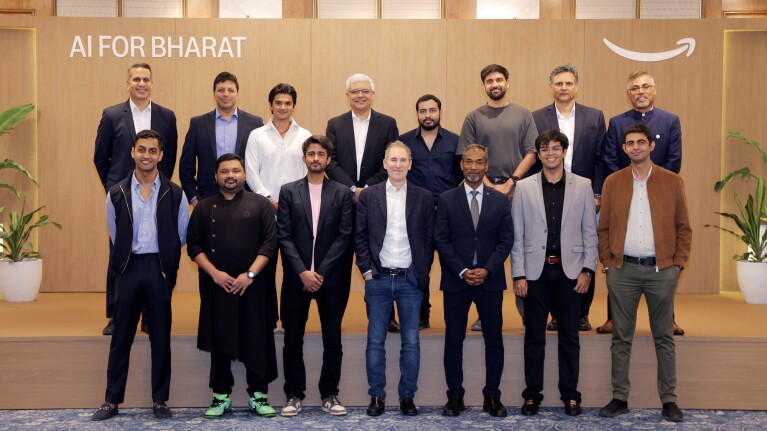
Amazon CEO Andy Jassy met with leading Indian startup founders in New Delhi to coordinate development strategies for the next generation of artificial intelligence. Backing the initiative, Amazon announced an additional $13 billion investment by 2030 to expand AWS cloud infrastructure and specialized AI chip access across India.
NEW DELHI, INDIA — Amazon President and Chief Executive Officer Andy Jassy met with a group of prominent Indian startup founders in New Delhi to outline a collaborative roadmap for the next generation of artificial intelligence (AI) adoption. The closed-door roundtable, held during Jassy's high-profile executive visit to India, focused on utilizing the country's unique digital public infrastructure, deep engineering talent pool, and massive linguistic diversity to build localized AI models capable of scaling globally.
The meeting comes at a critical juncture as Amazon accelerates its regional cloud footprint. Following the startup roundtable, Jassy also met with Prime Minister Narendra Modi, where he announced an additional $13 billion capital infusion specifically earmarked for AI and cloud infrastructure in India by 2030. The comprehensive talks demonstrate how global tech giants are pivoting from viewing India as merely a consumer market to treating it as a primary development hub for foundational AI technologies.
Strategic Shift From AI Consumers to Global Builders
During the executive discussion, Amazon highlighted India’s structural advantages in data scale and entrepreneurial agility. The tech conglomerate emphasized that Indian developers have routinely excelled at building robust applications under tight computational and operational constraints—a skillset that could dictate how the next wave of global AI models are managed and commercialized.
The executive roundtable featured top entrepreneurs from various growing sectors, including voice technology, robotics, edtech, healthtech, and digital public infrastructure. Notable founders in attendance included:
Alakh Pandey (Co-founder and CEO, PhysicsWallah)
Abhijit Kane (Co-founder, Postman)
Keshav Reddy (Founder and CEO, EqualAI)
Vikalp Sahni (Founder and CEO, Eka Care)
Mahanaaryman Scindia (Co-founder and CGO, Ethara.AI)
Suresh Khadakbhavi (CEO, DigiYatra Foundation)
Suvonil Chatterjee (Co-founder and CEO, Manav Robotics)
Sudharshan Kamath (Co-founder and CEO, smallest.ai)
The dialogue centered heavily on how these diverse platforms can scale using the specialized infrastructure layer of Amazon Web Services (AWS), particularly through its custom-built AI chips and managed foundational model suites.
Multi-Billion Dollar Infrastructure Expansion Fueling Indian Startups
To back its strategic roadmap, Amazon's newly announced $13 billion package raises its total planned investment in expanding and supporting AI and cloud infrastructure to more than $21 billion between 2026 and 2030. Cumulatively, across all operational segments including e-commerce, logistics, and digital skilling, Amazon plans to inject $48 billion into the country over the next five years.
According to company statements, the core of this capital injection will fund the physical expansion of AWS data center capacity across major hubs in Mumbai and Hyderabad. By reinforcing regional server architecture, Amazon aims to offer Indian startups low-latency access to high-performance computing resources, including Amazon Bedrock—a fully managed service that offers choice among high-performing foundation models—and Trainium, Amazon’s purpose-built machine learning accelerator chips.
Socio-Economic Impact on the Tech Ecosystem and Businesses
The long-term infrastructure roadmap directly impacts the broader economic landscape for small businesses, software engineers, and digital consumers.
For Startups and Enterprises: Increased availability of localized cloud nodes reduces data transit costs and helps compliance with domestic data sovereignty guidelines, allowing specialized firms to deploy enterprise-grade AI applications faster.
For Technical Talent: Amazon’s commitment includes scaling cloud and AI digital education programs. The firm has already trained over 10 million Indians in cloud computing skills and aims to extend AI education to 4 million government school students by 2030.
For Small Businesses: The digitization pipeline is designed to bring AI-led benefits to 15 million micro, small, and medium enterprises (MSMEs), helping them optimize local logistics, supply chains, and automated customer service.
Official Sources Section
The corporate objectives, investment metrics, and startup attendee details outlined in this report have been sourced directly via official executive dispatches released by Amazon India Press Room and regulatory filing logs detailing AWS expansion frameworks alongside the Ministry of Electronics and Information Technology.
Quote Section
In an official statement detailing the outcome of the startup roundtable, Amazon executives emphasized the unique positioning of the local tech ecosystem:
"The discussion focused on India's opportunity to shape the next wave of AI adoption, backed by its linguistic diversity, population-scale digital infrastructure, deep engineering talent, and fast-growing startup community. Indian founders have mastered constraints that can potentially define the next wave of global AI adoption."
Reflecting on his broader meeting with state leadership and the central government in New Delhi, Amazon CEO Andy Jassy stated:
"We came to India over a decade ago and have since been serving customers, sellers, developers, startups, and enterprises through our different businesses. As we grow Amazon in India, our business priorities continue to align with India's priorities of democratizing access to AI, digitizing small businesses, creating jobs, and enabling exports. We are inspired by the vision of a self-reliant India."
Why It Matters
This collaboration signals that the infrastructure layer undergirding the global AI boom is decentralizing. By deploying custom hardware like Trainium and opening deep infrastructure pipelines to early-stage Indian enterprises, Amazon is positioning India as a primary exporter of AI solutions rather than just an offshore back-office. For global businesses, this means that highly efficient, population-scale AI products will increasingly originate from the Indian startup ecosystem.
Key Facts at a Glance
The Event: Amazon CEO Andy Jassy hosted a strategic roundtable with prominent Indian startup founders spanning robotics, edtech, healthtech, and AI fields.
The Financial Pledge: Amazon committed an additional $13 billion to expand AWS cloud and AI infrastructure in India by 2030, raising the total technology infrastructure layout to over $21 billion.
Hardware & Systems: The initiative focuses on deploying custom Amazon Trainium chips and the Amazon Bedrock framework across expanded data centers in Mumbai and Hyderabad.
Long-Term Targets: By 2030, Amazon aims to enable AI operational benefits for 15 million small businesses and train 4 million students in foundational AI skills.
FAQ Section
What was the main purpose of Andy Jassy’s meeting with Indian startup founders?
The meeting aimed to align Amazon's AWS cloud infrastructure tools with the needs of Indian entrepreneurs who are developing specialized applications in voice tech, robotics, AI, and digital public systems.
Where will the newly announced $13 billion infrastructure investment go?
The capital will be used to heavily expand AWS data center physical capacities and server frameworks in Mumbai and Hyderabad, providing local startups with immediate access to advanced AI processing chips.
Which Indian startup leaders attended the Amazon AI roundtable?
Attendees included the founders and CEOs of prominent digital organizations such as PhysicsWallah, Postman, EqualAI, DigiYatra Foundation, Eka Care, and smallest.ai.
Source: Amazon India Newsroom, Ministry of Electronics and Information Technology, Official AWS Enterprise Stakeholder Briefings.