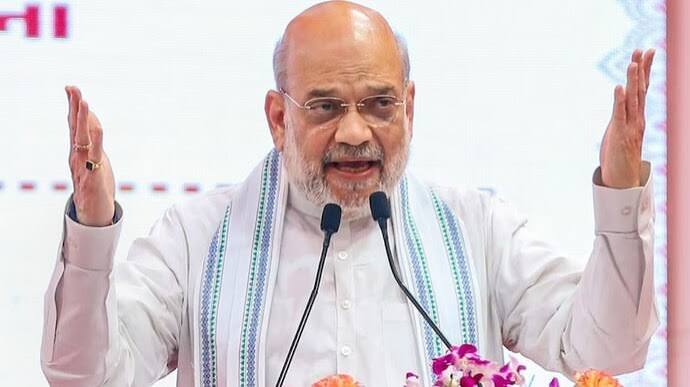
Union Home Minister Amit Shah laid the foundation for a ₹700-crore Amul dairy project in Howrah, West Bengal, set to become the world’s largest curd manufacturing plant. The initiative aims to empower 1.25 lakh farmers, boost rural income, and advance the "Sonar Bangla" development vision through cooperative-led industrial growth.
KOLKATA — Union Home Minister and Minister of Cooperation Amit Shah virtually laid the foundation stone for the Amul Bengal Dairy Project at the Howrah Food Park in Sankrail, Howrah, on July 19, 2026 [1.1.1, 1.2.1]. The facility is set to become the world’s largest curd production plant, representing a significant investment of approximately ₹700 crore aimed at revitalizing the state’s dairy infrastructure and strengthening its cooperative network [1.1.3, 1.2.1, 1.2.4].
During the event, Mr. Shah emphasized that the initiative is part of a broader commitment to realize the "Sonar Bangla" (Golden Bengal) vision—a concept he stated had long been undermined by ideological stagnation and political decline [1.1.2, 1.1.5]. Addressing the gathering, he asserted that the project is not merely an industrial venture but a mechanism to empower local farmers and livestock rearers [1.1.2, 1.2.1].
Boosting the Rural Economy and White Revolution
The Amul Bengal Dairy Project is designed to process approximately 30 lakh litres of milk per day [1.1.3, 1.2.1]. The facility's primary focus will be the production of cultured dairy products, including a daily capacity of 1,000 metric tonnes (10 lakh kilograms) of curd [1.1.3, 1.2.4]. Beyond curd, the plant will process packaged milk, UHT milk, ice cream, paneer, ghee, and sweets, significantly expanding the state's value-added dairy output [1.1.3, 1.1.4, 1.2.4].
Officials stated that the project is expected to benefit over 1.25 lakh small milk producers, including more than 30,000 women farmers, by providing them with a stable, transparent market for their produce [1.1.3, 1.1.4, 1.2.1]. By moving away from outsourced processing to direct asset ownership, the Amul Federation aims to enhance supply chain control and support the goals of "White Revolution 2.0" [1.2.4].
Strengthening Cooperation and Governance
The event also featured the launch of several initiatives aimed at digitizing and expanding the cooperative sector in West Bengal. Mr. Shah inaugurated the e-RCS portal to computerize the office of the Registrar of Cooperative Societies, a move intended to streamline administrative processes [1.1.2, 1.2.3, 1.2.4].
Additionally, the Minister laid the foundation stones for 14 new storage warehouses with a combined capacity of 1,400 metric tonnes across 10 districts, at an estimated cost of ₹5.98 crore [1.1.4, 1.2.3]. These facilities are designed to help farmers store their produce safely and avoid distress sales at low prices [1.1.2, 1.2.4].
Official Sources
Press Information Bureau (PIB): Official press releases regarding the Bhoomi Pujan, project specifications, and cooperative initiatives [1.1.2, 1.1.3, 1.1.4].
Government of West Bengal: Statements provided by Chief Minister Suvendu Adhikari regarding the state's industrial climate and support for the project [1.1.1, 1.2.1].
Gujarat Cooperative Milk Marketing Federation Limited (GCMMF): Project details and capacity projections for the Amul Bengal Dairy Project [1.2.1, 1.2.4].
Quote Section
According to officials, the project marks a significant shift in West Bengal's dairy landscape. Addressing the gathering, Amit Shah said, "I have come to tell the people of West Bengal that whatever we had promised during the elections, the government is implementing the promise of 'Sonar Bangla' on the ground" [1.1.1, 1.1.5]. Organizers stated that the plant, once fully operational, will serve as a cornerstone for agricultural value addition and rural employment in eastern India [1.1.3, 1.2.1].
Why It Matters
The investment highlights a push for industrial resurgence in West Bengal, leveraging the cooperative model to link small-scale farmers to large-scale national supply chains. For local households, the project offers reliable income streams and modern market access. Furthermore, the emphasis on strengthening cooperative warehouses and digital infrastructure signals a broader shift toward modernized rural governance and agricultural self-sufficiency.
Key Facts at a Glance
Total Investment: Approximately ₹700 crore [1.1.3, 1.2.4].
Processing Capacity: 30 lakh litres of milk per day [1.1.3, 1.2.1].
Curd Production: 1,000 metric tonnes (10 lakh kg) daily [1.1.3, 1.2.4].
Beneficiaries: More than 1.25 lakh milk producers, including over 30,000 women farmers [1.1.4, 1.2.1].
Location: Howrah Food Park, Sankrail, Howrah [1.1.1, 1.2.1].
FAQ
What is the Amul Bengal Dairy Project?
It is a ₹700-crore dairy infrastructure project in Howrah, West Bengal, which features the world’s largest curd production plant [1.1.1, 1.1.3, 1.2.1].
How will this project help local farmers?
It provides farmers with a stable market, improved procurement systems, and direct transparent payments, while also offering facilities to increase animal breed quality and milk yields [1.1.2, 1.1.3, 1.2.1].
What is the "Sonar Bangla" vision mentioned by Amit Shah?
The term refers to a vision of a prosperous, culturally enriched, and economically developed West Bengal, which the BJP leadership claims is being actively implemented through these development projects [1.1.2, 1.1.3, 1.2.2].
Source: Press Information Bureau, The Hindu, The Statesman, Indian Express