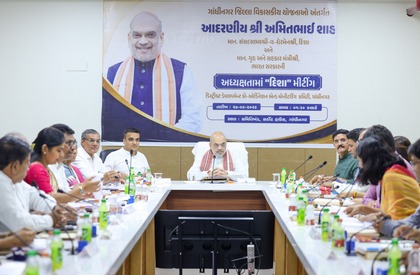
Union Home Minister Amit Shah reviewed the severe monsoon flooding in Gujarat on July 8, 2026, promising full central support. With parts of the state experiencing heavy rainfall, flash floods, and transport disruptions, authorities are prioritizing rescue and evacuation operations, particularly in the hardest-hit districts like Surat.
Home Minister Amit Shah held a high-level review of the severe monsoon flooding in Gujarat and Maharashtra, pledging emergency assistance to state authorities.
NEW DELHI — Union Home Minister Amit Shah conducted a series of telephonic reviews on Wednesday, July 8, 2026, to assess the worsening rain situation across Gujarat and Maharashtra. Amidst reports of severe waterlogging, transport disruptions, and loss of life due to incessant monsoon showers, the Centre has pledged comprehensive support to state administrations to bolster ongoing rescue and relief operations.
The review comes as several districts in southern Gujarat face a crisis following days of torrential downpours. According to official reports, the intense monsoon activity has necessitated large-scale evacuations, with thousands relocated to safer shelters in flood-hit zones.
Severe Monsoon Impact in Gujarat
Southern Gujarat has been particularly hard hit by the recent deluge. Surat district, one of the most affected regions, saw critical infrastructure submerged and significant disruption to daily life. According to local disaster management officials, at least five deaths have been linked to rain-related incidents in the area over the past 48 hours, including cases of electrocution.
In a proactive measure to manage the crisis, over 2,100 people were moved to secure locations from various zones in the Surat district. Educational institutions, including schools and colleges, were ordered to remain shut in districts like Navsari and Surat to ensure public safety as the India Meteorological Department (IMD) continued to issue alerts for extremely heavy rainfall in the region.
Coordination with State Governments
During his conversation with Gujarat Chief Minister Bhupendra Patel, Minister Amit Shah emphasized the need for close coordination between state-level authorities and central agencies. The Ministry of Home Affairs (MHA) has directed the deployment of disaster management teams, including the National Disaster Response Force (NDRF), to be kept on standby for immediate emergency response where required.
The central government is monitoring the weather situation closely as the depression over the region continues to pose risks of flash floods and landslides. The MHA’s Integrated Control Room for Emergency Response (ICR-ER) remains in constant communication with state governments to ensure that relief measures, medical aid, and logistics support reach the most vulnerable populations without delay.
Official Sources
Ministry of Home Affairs (MHA): Provided the advisory and operational oversight for emergency disaster response.
India Meteorological Department (IMD): Issued the heavy rainfall warnings and weather trajectory reports for Gujarat and Maharashtra.
Gujarat State Disaster Management Authority: Reported on relocation efforts and rain-related casualties in Surat and surrounding districts.
Why It Matters
With the monsoon season at its peak, the ability of state and central governments to coordinate emergency responses is vital to preventing further loss of life and property. For residents, businesses, and farmers, the situation underscores the importance of adhering to official weather alerts and evacuation orders as the region remains vulnerable to flooding and infrastructure damage.
Key Facts at a Glance
High-Level Review: Union Home Minister Amit Shah spoke with Gujarat CM Bhupendra Patel on July 8, 2026, to assess flood impacts.
Casualties and Relocations: Officials report five rain-related deaths in Surat; approximately 2,100 residents have been moved to safety.
Extreme Weather Warning: The IMD continues to monitor isolated instances of extremely heavy rainfall across South Gujarat districts.
NDRF Preparedness: Disaster response teams are stationed and ready for rapid deployment to address emergency conditions.
FAQ
What support has the Central Government offered?
Home Minister Amit Shah has assured both the Gujarat and Maharashtra governments of all possible assistance, including the deployment of NDRF teams and emergency logistical support.
Are schools and colleges open in the affected regions?
Due to the persistent downpour, authorities in districts like Surat and Navsari have ordered the closure of schools and colleges to ensure the safety of students and staff.
What should residents do during this weather crisis?
Authorities have advised citizens to avoid unnecessary travel, stay away from waterlogged areas, and follow official guidance from local disaster management offices regarding potential evacuations.
Source: Ministry of Home Affairs (MHA), India Meteorological Department (IMD), Gujarat State Disaster Management Authority