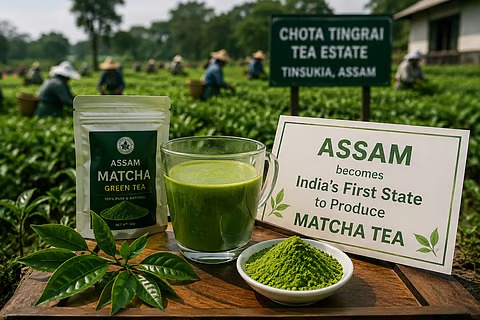
Assam has become India’s first state to commercially produce Matcha tea, following a decade-long partnership with Japanese experts at the Chota Tingrai Tea Estate. The first batch of this high-value, shade-grown powder was sold at the Guwahati Tea Auction Centre, marking a major milestone in diversifying India’s specialty beverage industry.
A decade-long Indo-Japanese collaboration culminates in the historic launch of India's first commercially manufactured Matcha tea in Tinsukia.
GUWAHATI — In a landmark development for India’s beverage industry, Assam has officially become the first state in the country to commercially produce Matcha tea. The milestone was marked on Friday, July 3, 2026, when the inaugural batch of Indian-grown Matcha from the Chota Tingrai Tea Estate in Tinsukia district was sold at the Guwahati Tea Auction Centre (GTAC).
The lot, comprising 5 kilograms of high-quality Matcha, was sold for ₹3,000 per kilogram to Guwahati-based Sheosons Chai Co. The sale, conducted during Sale 27 by auctioneers J. Thomas & Co. Pvt. Ltd., signals a new era of diversification for Assam, a region traditionally celebrated globally for its robust black tea production.
A Decade of Indo-Japanese Collaboration
The successful launch of Indian Matcha is the result of a rigorous 10-year partnership between the Chota Tingrai Tea Estate and Japanese tea experts, agronomists, and equipment manufacturers. By establishing a fully automated, state-of-the-art Japanese tea manufacturing facility at the estate, producers have successfully bridged traditional Assam tea heritage with authentic Japanese cultivation and processing techniques.
Unlike conventional green tea, which involves steeping leaves, Matcha is produced from carefully shade-grown leaves that are processed and finely ground into a vibrant green powder. Because the entire leaf is consumed, the final product is prized for its high antioxidant content, rich umami flavour, and distinctive colour.
Strengthening Brand Assam in Global Markets
Assam Chief Minister Himanta Biswa Sarma hailed the achievement, noting that this diversification aligns with the state’s broader strategy to enhance the global reputation of "Brand Assam Tea."
"Your favourite Matcha brew will now be produced in Assam. Furthering our glorious tea legacy, Assam becomes the first state in India to commercially produce Matcha tea at the Chota Tingrai Tea Estate in Tinsukia," the Chief Minister stated on social media. He added that the success is a testament to the robust bilateral ties between India and Japan, which facilitated the transfer of specialized technology and expertise.
Official Sources and Industry Outlook
Industry experts view the entry into the Matcha segment as a strategic move to tap into a high-value global market. As worldwide demand for specialty and functional beverages continues to soar, Assam is now positioned to compete in a category previously dominated by Japan, China, and Vietnam.
Bidyananda Barkakoty, adviser to the North Eastern Tea Association (NETA), emphasized the significance of this shift. "Matcha tea is becoming hugely popular worldwide. It is a matter of pride for Assam that top-quality Matcha tea is being produced by Chota Tingrai Tea Estate. This marks the country's entry into the high-value Matcha segment, offering an excellent opportunity to diversify exports," he said.
Why It Matters
For the Indian tea industry, the commercial production of Matcha represents a monumental shift from bulk black tea production toward high-margin specialty products. This innovation not only opens lucrative new international export channels but also provides a premium alternative for the domestic market, where health-conscious consumers are increasingly seeking functional beverages like Matcha.
Key Facts at a Glance
Historic First: Assam is the first state in India to launch commercial-scale Matcha production.
Production Hub: The Chota Tingrai Tea Estate in Tinsukia district led the decade-long initiative.
Market Debut: The first 5 kg batch fetched ₹3,000 per kg at the Guwahati Tea Auction Centre.
Technology Transfer: The project involved a 10-year partnership with Japanese experts, featuring fully automated manufacturing technology.
Product Difference: Unlike traditional steeped green tea, Matcha is made from shade-grown leaves ground into a fine powder, ensuring high nutritional value.
FAQ
What makes Matcha different from regular green tea?
Matcha is made from shade-grown tea leaves that are ground into a fine powder. While regular green tea is steeped and the leaves discarded, Matcha involves consuming the entire leaf, providing higher levels of antioxidants, amino acids, and caffeine.
Why is this launch significant for India?
It diversifies India's tea portfolio beyond traditional black tea, allows the country to compete in the fast-growing global premium specialty tea market, and reduces dependency on imports for a high-demand "viral" beverage.
Is Assam Matcha available for purchase?
Yes, the inaugural batch was purchased by a domestic buyer, Sheosons Chai Co., signaling that the product will soon be available in the Indian market, specifically within the Northeast region.
Source: