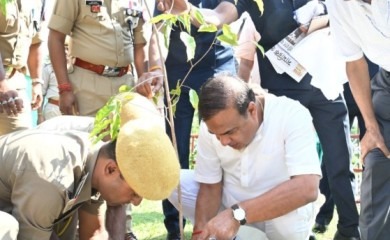
Assam Chief Minister Himanta Biswa Sarma launched the week-long Van Mahotsav campaign on July 1, 2026, urging citizens to leverage public participation by planting saplings. Implemented during the monsoon to ensure optimal survival rates, the initiative aims to enhance the state's green cover and strengthen long-term climate resilience against severe regional flooding.
GUWAHATI — Assam Chief Minister Himanta Biswa Sarma on Wednesday officially launched the week-long Van Mahotsav campaign, calling on citizens across the northeastern state to plant native tree saplings. This annual eco-initiative arrives at a critical juncture as the region confronts severe climate realities, including the first intense wave of monsoon floods. The state administration seeks to build on localized green programs by transforming the annual forest festival into an active, citizen-led mass movement.
Activating Jan Bhagidari for Regional Climate Adaptation
The campaign, starting July 1, 2026, focuses heavily on the concept of Jan Bhagidari—or collective public participation—to enhance the ecological resilience of the state. Speaking on the inaugural day of the initiative, Chief Minister Sarma urged every household, academic institution, and local civic group to commit to planting and nurturing at least one sapling over the course of the week.
The timing of the launch aligns closely with the onset of the southwest monsoon season, a strategic choice made by state planners. The elevated rainfall levels typical of July provide optimal soil moisture conditions, drastically improving the survival and long-term maturity rates of young plants compared to early-year afforestation drives.
Government Policy Anchors Forest Cover and Eco-Monitoring
The state government has significantly scaled up its systemic funding allocations toward carbon sink generation and biodiversity preservation over consecutive budgetary cycles. Beyond urban plantation targets, the Environment and Forest Department has been directed to enforce tracking metrics to ensure that initial planting drives result in established forest cover.
To support transparency, government-led afforestation programs are utilizing remote technologies, including geotagging and periodic drone surveys. These systems monitor sapling growth over critical six-month and twelve-month survival milestones, validating the commercial deployment of funds under the Compensatory Afforestation Fund Management and Planning Authority (CAMPA) guidelines.
Mitigating Floods and Ecological Vulnerabilities
The push for increased green cover is structurally tied to Assam's complex hydrological challenges. At the time of the launch, extreme monsoon downpours had triggered riverbank erosion and active flooding across several vulnerable districts, including Dhemaji and Lakhimpur, impacting local agricultural economies and public infrastructure.
Ecological specialists from regional environmental panels note that extensive, root-stabilized forest zones are critical to mitigating seasonal land degradation. Cultivating native flora along sensitive river banks and degraded hillsides provides natural barriers that slow surface runoff, control topsoil erosion, and enhance groundwater recharge throughout the Brahmaputra valley.
Official Sources Section
The operational objectives of the campaign were detailed in executive public updates released by the Chief Minister’s Office in Guwahati. Statutory compliance guidelines, seedling distribution points, and monitoring criteria are managed through the digital portals of the Ministry of Environment, Forest and Climate Change.
Quote Section
In an official statement published to mobilize community action at the start of the environmental week, Chief Minister Himanta Biswa Sarma stated:
"Let us devote the power of Jan Bhagidari to increase our green cover and guarantee a secure future for our children by planting a sapling over the next one week. On all my travels outside Guwahati, I always make it a point to plant one."
Why It Matters
For local agriculturalists, urban planners, and domestic businesses, the Van Mahotsav campaign provides tangible environmental buffers against rising regional temperatures and unpredictable monsoon cycles. Expanding the structural root networks of native trees reduces severe topsoil depletion, protecting the long-term fertility of agricultural zones while helping communities adapt to climate variations.
Key Facts at a Glance
Campaign Duration: Formally scheduled as a week-long initiative from July 1 to July 7, 2026.
Core Philosophy: Grounded in Jan Bhagidari to turn conservation into a community-led movement.
Favorable Timing: Launched during the early monsoon phase to maximize sapling survival rates.
Tracking Framework: Supported by digital geotagging and technological monitoring systems.
FAQ Section
What is the primary objective of the Van Mahotsav campaign in Assam?
The campaign aims to rapidly expand the state's green cover, preserve regional biodiversity, prevent severe riverbank erosion, and lower carbon footprints through large-scale community tree-planting efforts.
Which types of tree saplings are recommended for planting?
The state forest department recommends choosing indigenous or native species, as they are naturally adapted to the local soil and weather patterns, requiring less maintenance while supporting local wildlife.
How does the government verify the success of these plantation drives?
The Environment and Forest Department employs digital field tracking, including geotagging and drone-based spatial imaging, to audit tree survival rates and ensure long-term accountability.
Source: Assam Environment and Forest Department Portal, Ministry of Environment, Forest and Climate Change Guidelines