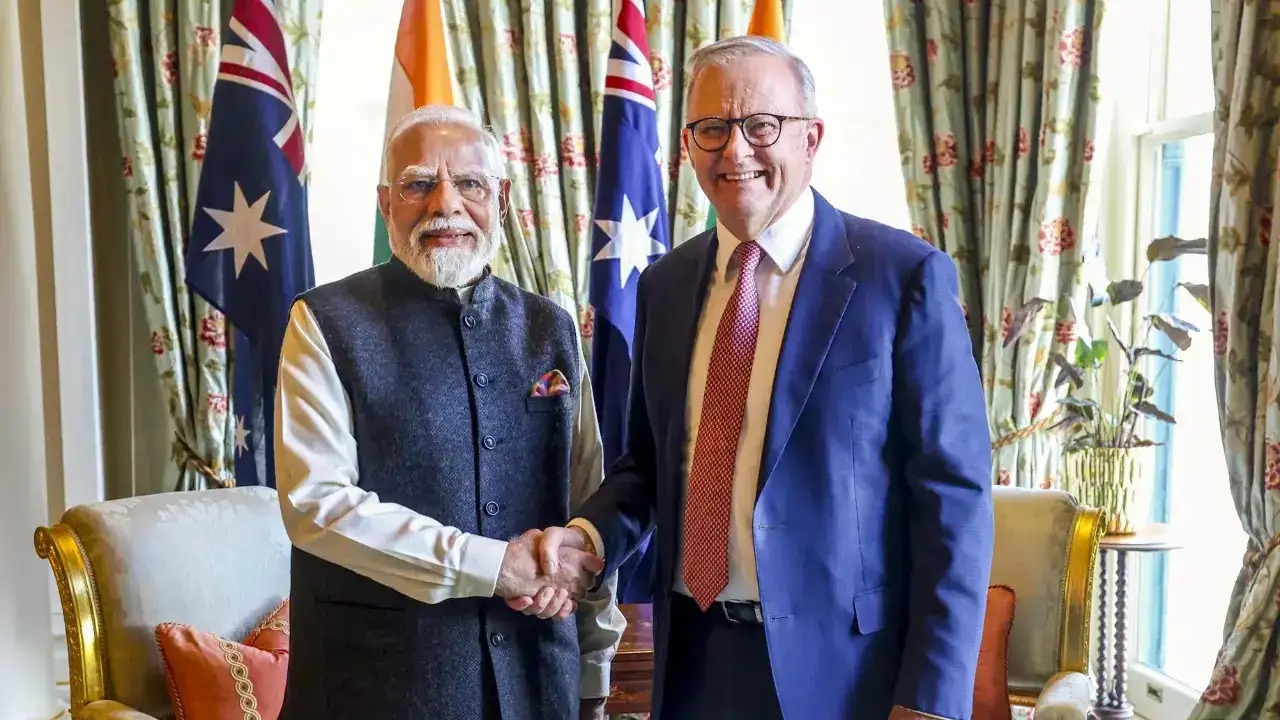
Prime Ministers Narendra Modi and Anthony Albanese have signed a definitive administrative arrangement in Melbourne, unlocking long-delayed commercial uranium exports from Australia to India under strict IAEA safeguards. The landmark deal opens a massive long-term market for the Australian uranium mining sector to support India’s ambitious 100 GW clean energy targets.
MELBOURNE — In a major geopolitical and economic development, Australia and India have finalized the vital administrative arrangements required to activate long-term commercial exports of radioactive fuel. Signed by Australian Prime Minister Anthony Albanese and Indian Prime Minister Narendra Modi during the Annual Leaders' Summit in Melbourne on July 9, 2026, the landmark accord effectively ends a 12-year bureaucratic stalemate. The operationalization of this supply pipeline is expected to provide a substantial long-term demand signal for the Australian uranium mining sector.
The deal arrives at a critical juncture for both nations as global energy architectures shift away from carbon-intensive grids and politically unstable supply corridors. For India, securing a reliable, diverse stream of overseas yellowcake is essential to feed its planned 100-gigawatt (GW) domestic nuclear power infrastructure pipeline. For Australia, the agreement opens an expansive, multi-decade market for its resource sector while advancing Canberra's ongoing economic strategy to diversify its regional trade exposures beyond China.
Operationalizing the Safeguards and Regulatory Pipeline
The newly executed administrative arrangement serves as the final procedural bridge for the Australia-India Nuclear Cooperation Agreement, which originally entered into force in 2015. While a baseline framework has existed for over a decade, actual commercial shipments were delayed by complex diplomatic negotiations surrounding verification protocols. Because India is not a formal signatory to the Treaty on the Non-Proliferation of Nuclear Weapons (NPT), Australian policymakers required specific, legally binding mechanisms to ensure exported materials are tracked cleanly.
Under the finalized terms, all future commercial uranium shipments will operate under strict International Atomic Energy Agency (IAEA) safeguards. The tracking framework enforces a rigorous legal separation between India’s civilian energy operations and its sovereign military systems, completely satisfying Australia’s domestic non-proliferation mandates. The completion of this regulatory framework allows Australian mining corporations and state-owned Indian utility providers to move directly into active commercial contract negotiations, volume pricing, and export licensing workflows.
Impact on the Australian Uranium Mining Landscape
Resource analysts emphasize that opening the Indian market provides an important long-term foundation for Australian uranium mining, though immediate production surges face physical constraints. Despite holding nearly 28% of the world’s known uranium reserves, Australia currently operates only three active extraction sites all concentrated within South Australia, including BHP Group's massive Olympic Dam copper-uranium operations. Multiple Australian states maintain strict legislative bans on uranium extraction due to historical environmental and non-proliferation concerns.
However, the clear demand signal from New Delhi changes the financial math for mid-tier developers and junior mining explorers. With spot uranium prices consolidating around $85 per pound following brief spikes earlier in the year, the addition of a major long-term buyer is expected to accelerate project financing discussions for new or stalled mining assets in permissible jurisdictions like South Australia and the Northern Territory.
| Operator / Entity | Key Production Asset | Regional Jurisdiction | Current Operational Status |
| BHP Group Ltd. | Olympic Dam | South Australia | Active (By-product extraction) |
| Boss Energy Ltd. | Honeymoon | South Australia | Active production ramping |
| Deep Yellow Ltd. | Mulga Rock | Western Australia | Advanced exploration / Approvals |
| Cameco Corp. | Kintyre / Yeelirrie | Western Australia | Suspended pending state policy shifts |
Large diversified producers are already noting shifting demand dynamics. Institutional statements from BHP Australia indicated that as India’s rapid industrial growth continues, long-term corporate demand for core materials like copper, potash, and uranium will rise significantly.
Official Sources Section
The diplomatic and operational parameters of the nuclear cooperation agreement have been formally synchronized and verified through joint state papers issued by the Prime Minister of Australia's Official Office and the Ministry of External Affairs (MEA), India. Technical safeguard compliance parameters remain subject to regulatory oversight by the Australian Safeguards and Non-Proliferation Office (ASNO) and the IAEA.
Quote Section
"Today, we have signed an important agreement in the field of nuclear energy," stated Indian Prime Minister Narendra Modi during the joint press conference in Melbourne. "This will open the way for uranium supplies from Australia to India and give new impetus to our clean energy objectives."
"The arrangement facilitates Australian uranium exports to India to help increase the share of non-fossil fuel power capacity, providing an additional market for the Australian resources sector," added Australian Prime Minister Anthony Albanese.
Why It Matters
The activation of the bilateral uranium corridor carries practical implications for energy utility companies, industrial consumers, and financial investors across the Asia-Pacific region. For India, a stable supply of high-grade uranium provides the continuous baseload power required to operate its growing data center networks, heavy manufacturing hubs, and electric vehicle charging grids without relying heavily on carbon-emitting coal plants. For global capital markets, the deal offers a reliable alternative supply chain, reducing reliance on politically complex Eurasian energy routes.
Key Facts at a Glance
Bilateral Milestone: Prime Ministers Modi and Albanese sign the final administrative deal in Melbourne to activate uranium trade.
Safeguard Compliance: All exports operate under strict IAEA tracking protocols to guarantee exclusively peaceful civilian energy use.
India’s Nuclear Target: New Delhi aims to expand its nuclear energy capacity more than ten-fold to 100 GW by 2047.
Resource Scale: Australia commands approximately 28% of known global uranium reserves, valued at A$1.6 billion in current annual exports.
FAQ Section
Why did it take 12 years to start uranium exports after the initial agreement?
While the overarching political agreement was signed in 2014, finalising the specific administrative arrangements required extensive negotiations to set up verification mechanisms that satisfy Australia's strict non-proliferation standards.
Does this deal mean uranium mining will be legalized across all Australian states?
No. The administrative arrangement does not alter individual state laws. Uranium mining remains strictly regulated on a state-by-state level, meaning new production will initially be concentrated in South Australia and the Northern Territory.
Which countries currently supply uranium to India's nuclear fleet?
India currently relies on long-term fuel import arrangements from Russia and Uzbekistan, with additional shipments from Canada's Cameco scheduled to begin arriving under separate trade agreements.
Source: Joint Leaders' Summit Communiqué, Prime Minister of Australia's Official Office and the Media Library of the Ministry of External Affairs, India.