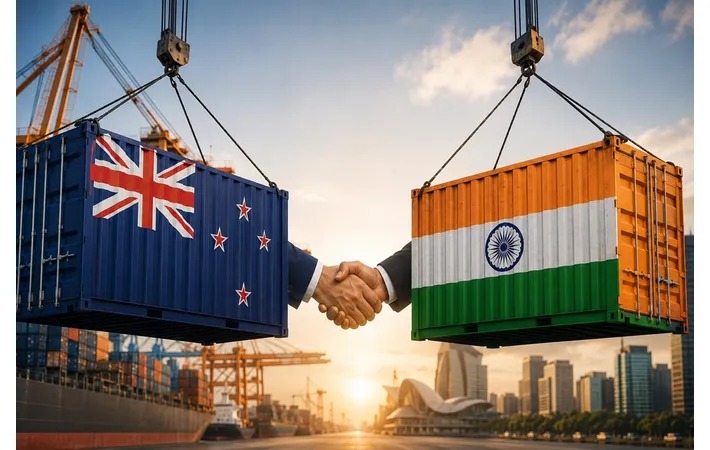
New Zealand has announced that 57% of its exports to India will be tariff-free under their new Free Trade Agreement. Signed in April 2026, the deal guarantees 100% duty-free access for Indian exports to New Zealand, fostering a new era of trade, mobility, and investment between the two nations.
The landmark trade announcement comes ahead of Prime Minister Narendra Modi’s historic two-day state visit to Wellington, signaling a new chapter in Indo-Pacific economic cooperation.
WELLINGTON — New Zealand Prime Minister Christopher Luxon announced on Thursday that 57% of his nation’s exports to India will become "tariff-free from day one" under the recently signed India-New Zealand Free Trade Agreement (FTA). The declaration, made via social media, marks a pivotal moment in bilateral economic relations as both countries prepare for Prime Minister Narendra Modi’s state visit on July 10–11, 2026.
The FTA, which was officially signed in April 2026, serves as a comprehensive framework to deepen investment and trade ties. For New Zealand, the agreement is expected to provide a substantial boost to its businesses by unlocking access to one of the world's fastest-growing major economies.
A New Phase in Economic Ties
The proposed trade deal aims to harmonize commercial interests between the two nations, which have historically maintained modest trade volumes. By eliminating duties on a majority of its exports to India, New Zealand seeks to capitalize on the Indian market's vast consumer base of 1.4 billion people.
According to the Ministry of Commerce and Industry, the agreement is a "once-in-a-generation" effort. For India, the pact provides duty-free access to the New Zealand market for 100% of its exports from the day the agreement enters into force. This is particularly significant for India's labour-intensive sectors, including textiles, leather, footwear, and engineering goods.
Strategic Impact of the FTA
The agreement is not limited to goods; it spans a broad range of sectors, including:
Services and Mobility: The deal includes provisions for skilled professionals, student mobility, and specific visa pathways for STEM graduates.
Traditional Medicine: New Zealand has agreed to facilitate Health and Traditional Medicine services, marking the first time such cooperation has been institutionalized in a bilateral trade pact.
Manufacturing Efficiency: Indian firms stand to benefit from the removal of tariff barriers on essential industrial inputs, such as wooden logs and scrap metals, which are expected to lower production costs.
Prime Minister Luxon emphasized that the agreement is intended to deliver "more jobs, higher exports, and stronger economic growth" for New Zealand, effectively leveraging the country's Pacific-island reach to anchor its economic future in the rapidly expanding Indian market.
Official Sources
New Zealand Government: Official statements regarding the 57% tariff-free threshold for New Zealand exports to India.
Ministry of Commerce and Industry (India): Provided the framework for the India-New Zealand Free Trade Agreement signed in April 2026.
PIB India: Released the official documentation highlighting the FTA’s key takeaways, including the 100% duty-free access for Indian exports.
Why It Matters
For businesses and investors, this agreement effectively bridges a long-standing competitive gap. By reducing tariff hurdles, the FTA allows for more predictable trade cycles and lowers entry barriers for SMEs in both countries. As India seeks to diversify its supply chains and New Zealand looks toward Asian markets for growth, the pact provides a stable, long-term legal framework to support billions in potential investment.
Key Facts at a Glance
Tariff Relief: 57% of New Zealand’s exports to India will be tariff-free from the start.
Reciprocity: India receives 100% duty-free access for its exports to the New Zealand market.
Scope: Covers goods, services, investment, mobility for professionals, and traditional medicine.
Timeline: The agreement was signed in April 2026; high-level discussions regarding implementation will take place during the July 2026 state visit.
FAQ
1. What sectors in India will benefit most from this trade agreement?
Labour-intensive sectors such as textiles, apparel, leather, footwear, gems and jewellery, and engineering goods are expected to see the most significant growth due to zero-duty access in New Zealand.
2. Are there any protected sectors in India?
Yes, India has retained protections for sensitive sectors including dairy, select agricultural products (such as onions, sugar, and pulses), and animal fats to ensure domestic interests are preserved.
3. Does the agreement include visa benefits?
The FTA introduces new visa pathways, including a quota of 5,000 visas for skilled Indians and a "Working Holiday Visa" for 1,000 young Indians annually.
Source: Ministry of Commerce and Industry, PIB India, New Zealand Government