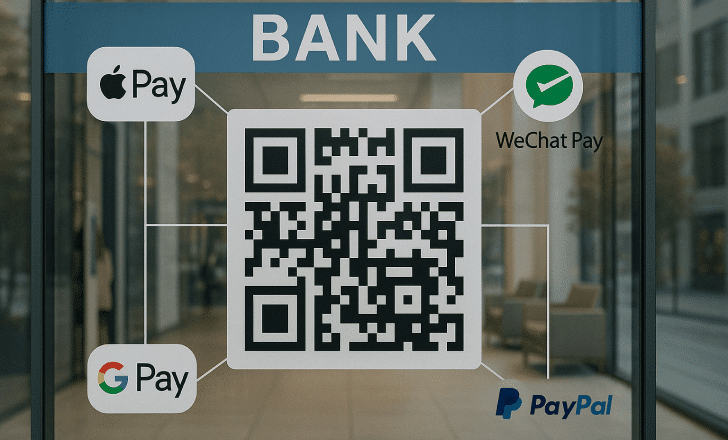
Banking associations and central banks are urging lenders to accelerate QR code payment integration to expand financial inclusion and lower merchant transaction costs. Backed by upcoming regulatory deadlines in July 2026, the global shift toward interoperable, account-based QR scanning aims to reduce reliance on costly physical payment hardware.
LAGOS / DHAKA — Banking institutions and financial market groups worldwide are being urged to aggressively scale up the deployment of quick response (QR) code payment channels to safeguard national payment rails. In coordinated sector briefings concluding on June 28, 2026, the Association of Corporate Communication and Marketing Professionals in Banks (ACAMB) alongside multiple central bank authorities issued directives urging commercial lenders to transition rapidly toward account-based, cardless digital payment ecosystems. The global push comes as regulators seek to combat rising point-of-sale (POS) terminal maintenance costs, minimize customer transaction friction, and eliminate persistent service downtimes.
Low-Cost Infrastructure Drives Financial Inclusion Campaigns
During an industry panel at the Nigeria Inter-Bank Settlement System (NIBSS) in Lagos, financial administrators noted that traditional card-swipe hardware presents heavy capital acquisition barriers for micro, small, and medium enterprises (MSMEs). By prioritizing universal QR code architectures, such as the account-based NQR platform, banks can enable merchants to activate electronic payment networks without purchasing expensive terminal hardware.
Under these frameworks, retail businesses only need to display a printed or digital code to verify incoming funds in real-time. Officials emphasized that eliminating upfront terminal activation costs removes a primary obstacle to formalizing the informal economy, providing a low-friction path toward total financial inclusion for underserved rural merchants.
Central Banks Enforce Mandatory QR Code Standards
The strategic shift toward contactless, asset-light code scanning is transitioning from a recommendation to a regulatory mandate in several expanding markets. Bangladesh Bank announced that the deployment of its unified interoperable platform, "Bangla QR," will become strictly mandatory across all national retail tiers starting July 1, 2026. Central bank authorities in Dhaka warned that after this critical deadline, failing to provide an operational QR channel will be classified as a violation of national trade regulations.
Similarly, the Central Bank of Uzbekistan finalized standard regulations making unified QR codes mandatory for all trade and service organizations. These regulatory frameworks ensure full network-level interoperability, meaning a single displayed merchant QR code can be scanned and instantly processed by any participating mobile banking or digital wallet application, preventing market fragmentation.
Mitigating Transaction Disputes and Interbank Downtime
Beyond reducing hardware costs, wider adoption of account-to-account QR structures serves as a critical shield against transaction failure and billing disputes. Because QR networks initiate direct push-transfers from a consumer’s account to a vendor’s balance, the complex chain of multi-party transaction routing typical of international credit cards is avoided.
NIBSS Managing Director Premier Oiwoh confirmed that monitoring real-time transaction velocity helps clearing houses dynamically redistribute data loads, mitigating systemic crashes. Data metrics from early adopters like United Bank for Africa (UBA) show that transitioning POS operations to interoperable QR models delivers instant settlement notifications and dramatically reduces consumer chargeback disputes.
Official Sources Section
Regulatory codes, deployment timelines, and sector frameworks are validated through:
Quote Section
"There is absolutely no huge cost to acquire or set up the merchant infrastructure; businesses only need to print or display the code," NIBSS Managing Director and Chief Executive Officer Premier Oiwoh stated during the infrastructure review session.
"According to officials tracking macro-financial metrics, shifting everyday consumer transactions to unified digital payment paths shrinks the informal economic footprint and improves overall macroeconomic transparency."
Why It Matters
Transitioning commercial payments to QR standards alters the cost structure of retail commerce by reducing reliance on high-fee card networks. For shoppers, scanning a code provides a fast, cardless transaction method that eliminates the risk of terminal-based card skimming fraud. For small business owners, instant payment settlements improve daily working capital velocity without cutting into thin profit margins.
Key Facts at a Glance
Hardware Dematerialization: Merchants can bypass expensive terminal hardware by using printed static or dynamic QR codes.
Regulatory Enforcements: Major regulatory bodies have set mandatory implementation deadlines starting July 1, 2026.
Interoperability Goals: New unified standards ensure a single QR layout works across all independent mobile banking apps.
Operational Benefits: Account-based push payments yield instant merchant settlement and lower processing fees.
FAQ Section
What is the difference between static and dynamic QR codes for payments?
A static QR code contains permanent banking details and requires the customer to type in the exact transaction amount manually. A dynamic QR code is generated automatically by a merchant's phone or screen for a specific purchase amount and expires once processed.
Why are central banks making unified QR codes mandatory?
Mandating unified codes prevents fragmentation, ensuring merchants do not have to display separate codes for different banking networks. A single interoperable standard lets any app complete the purchase, streamlining retail checkout speeds.
Are QR code payments more secure than traditional debit cards?
Yes. QR payments utilize direct account-to-account credit pushes through encrypted banking apps, eliminating the risk of card skimming, credential cloning, or localized merchant terminal data breaches.
Source: Official digital payment infrastructure reports released by the Nigeria Inter-Bank Settlement System (NIBSS), public monetary policy directives issued by Bangladesh Bank, and corporate regulatory announcements managed by the Association of Corporate Communication and Marketing Professionals in Banks (ACAMB).