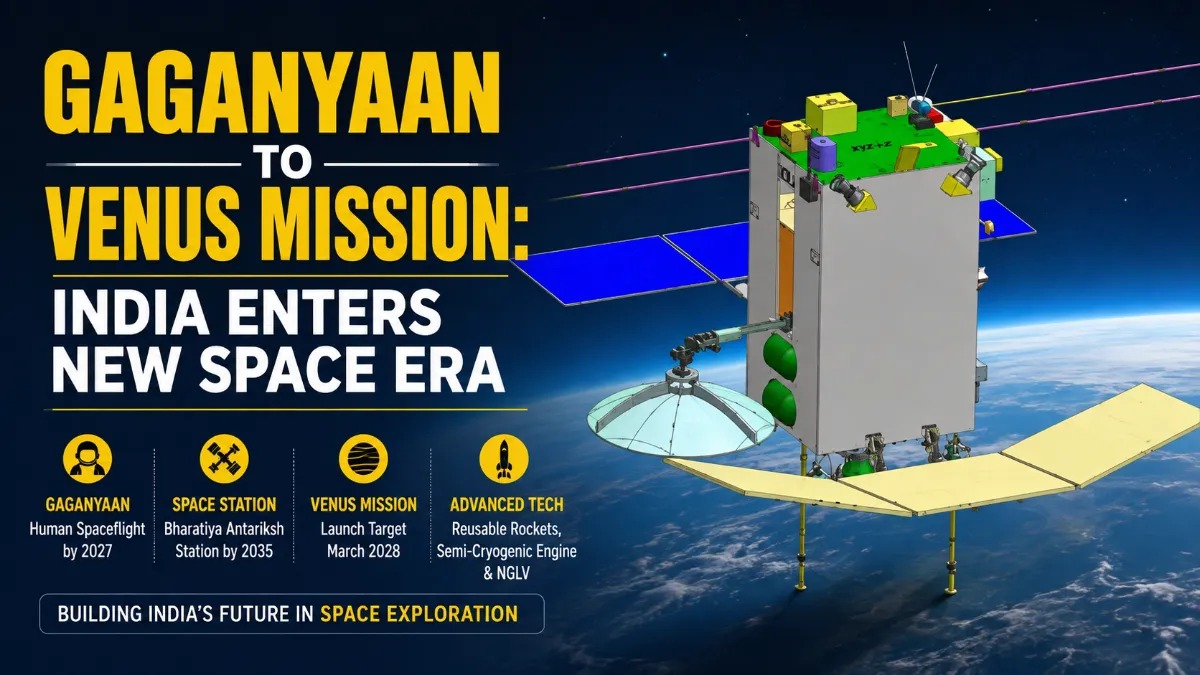
India is entering a new space era defined by monumental missions ranging from the crewed Gaganyaan human spaceflight and the upcoming Bharatiya Antariksh Station to the 2028 Venus Orbiter Mission. Backed by reusable rocket innovations, these initiatives reinforce India's status as an emerging global superpower in space exploration.
India Enters New Space Era: From Gaganyaan to Venus Mission
India's ambitious space roadmap reaches new milestones as ISRO accelerates human spaceflight initiatives, planetary exploration, and next-generation launch technologies.
NEW DELHI — Marking a transformative chapter in the nation's scientific history, India is rapidly advancing into a new era of deep-space exploration and human spaceflight. According to official government disclosures and updates released by the Indian Space Research Organisation (ISRO), upcoming milestones span the flagship crewed Gaganyaan programme, precursor missions for the indigenous Bharatiya Antariksh Station (BAS), and humanity's deeper planetary ambitions, including the planned Venus Orbiter Mission. The comprehensive framework positions New Delhi to consolidate its status as a leading global space power through advanced orbital infrastructure, heavy-lift capabilities, and sustained technological self-reliance.
Human Spaceflight and the Path to Bharatiya Antariksh Station
The Gaganyaan human spaceflight programme—carrying a revised total outlay encompassing multiple integrated missions—aims to dispatch a crew of three Indian astronauts into a 400-kilometer low Earth orbit. As part of the rigorous testing protocol leading to the crewed flight targeted for 2027, ISRO has scheduled uncrewed experimental flights featuring the half-humanoid payload Vyommitra.
Beyond initial orbital flights, these developments serve as essential stepping stones for the Bharatiya Antariksh Station (BAS). With the first module, BAS-01, slated for launch around 2028, the multi-module orbital outpost is targeted for full operationalization by 2035, enabling long-duration microgravity research and complex crew operations. Furthermore, specialized orbital docking validation missions (SPADEX) are underway to master spacecraft-to-spacecraft transfer and fluid mechanics vital for future assembly projects.
Deep-Space Ambitions: The Venus Orbiter Mission
Expanding beyond Earth orbit, India's planetary science division is actively building towards the Venus Orbiter Mission (VOM), formally approved for a launch window in early 2028. Designed to investigate the complex surface geology, dense atmosphere, and ionospheric dynamics of our planetary neighbor, the spacecraft will deploy sophisticated Indian and international science payloads.
Concurrently, ISRO is developing next-generation engineering assets, including a 200-tonne thrust semi-cryogenic engine, reusable vertical takeoff and vertical landing (VTVL) booster recovery systems, and the partially reusable Next Generation Launch Vehicle (NGLV). These innovations aim to drastically curb long-term launch costs while multiplying payload capacity for future commercial and scientific ventures.
Official Sources Section
Data, project timelines, and technical configurations regarding these national space initiatives are referenced from official policy fact-sheets, administrative announcements by the Union Cabinet of India, and technical documentation published via the Indian Space Research Organisation (ISRO) Portal.
"According to officials, these strategic space initiatives will support India's ambition to become a leading global space power by building enduring capabilities for sustained human presence and complex orbital operations."
Why It Matters
For citizens, technology industries, and the broader scientific community, India's transition into advanced human spaceflight and interplanetary research catalyzes high-tech employment, drives downstream manufacturing innovations, and inspires future generations in STEM. Economically, mastering reusable rocket technology and heavy-lift logistics positions India as a highly competitive, cost-effective hub within the burgeoning global space economy.
Key Facts at a Glance
Gaganyaan Programme: Uncrewed precursor flights leading toward crewed missions carrying three astronauts to a 400-km orbit.
Space Station Roadmap: Bharatiya Antariksh Station (BAS) module BAS-01 planned for 2028, targeting full operational status by 2035.
Venus Orbiter Mission: Scheduled for launch in March 2028 to study Venus's geology, atmosphere, and sun-planet interactions.
Next-Gen Tech: Development of semi-cryogenic engines, VTVL booster reusability, and LOX-Methane NGLV rockets.
FAQ Section
What are the primary objectives of the Gaganyaan mission?
Gaganyaan aims to demonstrate indigenous human spaceflight capabilities by sending a three-member crew into a 400-km orbit for a multi-day mission and safely returning them to Earth.
When is India's Venus Orbiter Mission scheduled to launch?
The Venus Orbiter Mission is formally scheduled for launch in March 2028, following approval by the Union Cabinet.
What is the long-term plan for the Bharatiya Antariksh Station?
India's planned modular space station is targeted for full operationalization by 2035, with precursor module BAS-01 scheduled for launch by 2028.
Where can official updates on ISRO's future missions be tracked?
Official milestones, mission announcements, and technical press releases are regularly updated through the ISRO Official Website.
Source: Indian Space Research Organisation (ISRO), Union Cabinet Press Releases, Telangana Today / IANS Coverage.