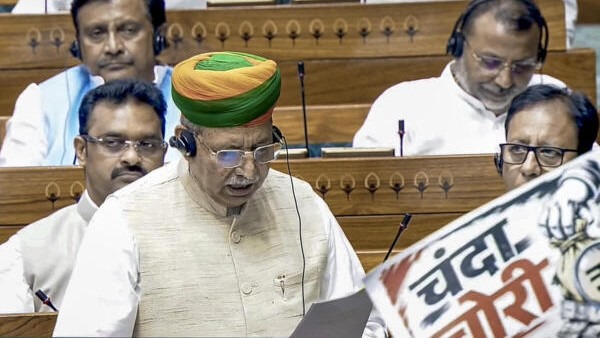
The Union Government has introduced the Supreme Court (Number of Judges) Amendment Bill, 2026, in the Lok Sabha to increase the apex court's sanctioned strength from 33 to 37 puisne judges. Tabled amid Opposition protests, the expansion aims to enhance judicial efficiency and tackle a historic backlog of over 92,000 cases.
NEW DELHI — The Union Government officially introduced the Supreme Court (Number of Judges) Amendment Bill, 2026, in the Lok Sabha on Monday, July 20, 2026. Tabled by Union Minister of Law and Justice Arjun Ram Meghwal, the key piece of legislation seeks to expand the maximum sanctioned strength of the nation's highest judicial body. The bill seeks to permanently replace a temporary executive ordinance promulgated by the Centre earlier this year, adding four additional judicial seats to accelerate case clearances. The legislative rollout took place during the opening day of the parliamentary Monsoon Session amid intense slogan-shouting and operational disruptions by the Opposition over unrelated student exam issues.
Expansion of the Sanctioned Judicial Bench
According to the text of the bill introduced in the Lower House, the legislation will formally amend the foundational Supreme Court (Number of Judges) Act, 1956. The newly introduced amendment expands the total number of puisne judges allowed on the bench from 33 to 37. Including the office of the Chief Justice of India (CJI), the absolute statutory limit of the apex court will rise to 38 sitting judges once the bill successfully clears both houses of Parliament.
The targeted timeline for this judicial expansion involves:
The formal introduction and parliamentary tabling of the statutory bill.
Debate and vote iterations requiring a simple majority for successful Lok Sabha passage.
Transmittal to the Rajya Sabha for final approval before receiving presidential assent.
Systematic selection recommendations managed by the Supreme Court Collegium to fill the new benches.
The financial memorandum attached to the bill notes that the structural funding required to cover the salaries, allowances, and housing infrastructures for the four new judges and their dedicated support staff will be drawn entirely from the Consolidated Fund of India.
Historical Evolution of Top Court Benches
This marks the first major benchmark expansion of the apex court since 2019, when the sanctioned capacity was increased from 31 to 34 judges (including the CJI). The Supreme Court of India originally commenced operations in 1950 with an initial bench composition of just eight judges.
The progressive expansion has been driven continuously by the ever-growing scope of the court’s appellate jurisdiction and a high volume of Special Leave Petitions (SLPs) filed by citizens from every state. Despite the 2019 expansion, systemic pressure has mounted steadily, with total pending cases reaching an unprecedented record high of 92,823 items by mid-2026, according to metrics compiled by the National Judicial Data Grid.
Legislative Context and Opposition Friction
The introduction of the bill by Law Minister Arjun Ram Meghwal faced immediate logistical turbulence on the floor of the House. Opposition parliamentarians staged mass protests and raised synchronized slogans regarding the ongoing National Eligibility cum Entrance Test (NEET-UG) paper leak allegations. The intense commotion disrupted regular business, forcing the Speaker to execute multiple short-term house adjournments throughout the afternoon.
Despite the operational disruptions, the government successfully moved for leave to introduce the bill, prioritizing the expansion of judicial capacity as a core objective for the current legislative session.
Official Sources Section
The statutory details, bench targets, and historical timelines featured in this legal analysis have been verified using central public records.
The parliamentary milestones correspond to official reports published by the Press Information Bureau (PIB) of India. The underlying legislative framework complies with tracking databases maintained by the Lok Sabha Secretariat and the Ministry of Law and Justice under active government monitoring protocols.
Quote Section
"According to officials familiar with the judicial planning process, adding four puisne judges will immediately allow the Chief Justice to set up more specialized three-judge benches to clear backlogged civil disputes. The administration remains committed to supporting infrastructure extensions to ensure the new courtrooms can run smoothly."
Why It Matters
For Indian citizens, corporate entities, and ordinary litigants, the tabling of the bill carries deep practical implications. The historic backlog of over 92,000 cases means that complex commercial contracts, civil rights petitions, and criminal appeals routinely experience delays spanning several years. By expanding the bench to 38 judges, the court can run more concurrent regular and Constitution benches, helping to speed up resolution times for everyday cases.
For legal analysts and the broader industrial landscape, this expansion helps reduce legal uncertainty. Faster judgments from the apex court protect corporate investments, clear stalled public infrastructure projects, and build stronger trust in the rule of law. However, analysts note that the real-world impact will depend heavily on how quickly the Supreme Court Collegium recommends candidates and how fast the executive branch clears those appointments to fill the new vacancies.
Key Facts at a Glance
Bench Increase: The bill seeks to expand the sanctioned strength of the Supreme Court from 33 to 37 puisne judges.
CJI Inclusions: Including the Chief Justice of India, the top court's absolute capacity ceiling will rise to 38 judges.
Ordinance Replacement: The permanent bill replaces an emergency executive ordinance promulgated by the President in May 2026.
Backlog Trigger: The expansion is driven by case pendency trends, which reached a historic high of 92,823 cases.
FAQ Section
Why is the government increasing the number of Supreme Court judges?
The government is expanding the bench to address the massive backlog of pending cases, enabling the Supreme Court to function more effectively and ensure speedier access to justice for citizens.
Does this amendment require a complex constitutional majority to pass?
No. Article 124(1) of the Constitution allows Parliament to alter the number of Supreme Court judges through a standard legislative amendment using a simple majority vote.
Will the addition of new judges immediately clear the case backlog?
While adding judges allows for more active benches, legal experts point out that long-term disposal rates also depend on reducing the volume of incoming appeals and filling vacancies quickly once seats open up.
Source: Press Information Bureau - Government of India, Ministry of Law and Justice Statutory Registry, Lok Sabha Legislative Business Archive.