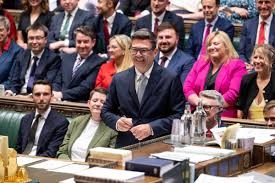
UK Prime Minister-in-waiting Andy Burnham will deliver a pivotal economy speech in Manchester, outlining a 10-year mission for regional growth. Proposing a historic decentralization of power, including a "No 10 North," Burnham aims to revitalize infrastructure, reform education, and stabilize the UK economy following Keir Starmer's resignation.
MANCHESTER, England — Andy Burnham, the frontrunner to become the United Kingdom's next prime minister, is set to deliver a defining Burnham economy speech on Monday at the People's History Museum in Manchester. Expected to outline a sweeping "10-year mission" to revitalize British living standards, the former Greater Manchester mayor will detail plans for the largest transfer of power out of Whitehall in modern history. As the nation faces significant regional inequality and political fatigue following the sudden resignation of Keir Starmer, this address serves as the foundational blueprint for a new Labour government under Burnham's leadership.
A 10-Year Mission for 'Good Growth'
In his highly anticipated Burnham economy speech, the prime minister-in-waiting will pledge to deliver "good growth in every postcode." A central pillar of his agenda involves pivoting away from top-down national management toward a decentralized approach. Following his recent return to the House of Commons via a decisive victory in the Makerfield by-election, Burnham's strategy focuses on re-industrialization, housing infrastructure development, and reforming essential utilities.
With the UK's debt-to-GDP ratio currently hovering around 96% and an estimated £137 billion debt interest bill due this year, financial markets and investors are closely scrutinizing his commitment to fiscal responsibility. Allies suggest his platform will emphasize practical, public-private partnerships to stimulate local economies without abandoning the government's established borrowing rules—a necessary reassurance for markets still sensitive to the fiscal turmoil of recent years.
The "No 10 North" and Historic Devolution
A major highlight of the impending policy rollout is the proposed establishment of a "No 10 North" in Manchester. This move intends to physically and administratively shift a portion of the prime ministerial operations closer to the communities it serves, deliberately breaking London's traditional gravitational pull on economic policy.
According to pre-released excerpts of the Burnham economy speech, he aims to give the UK the "circuit-breaker it needs" to end a decade of Westminster volatility that has seen six different prime ministers take office. By empowering regional mayors and local councils with greater statutory control over social housing, welfare, and post-16 education, Burnham hopes to replicate the regional success he oversaw during his tenure as mayor, often dubbed "Manchesterism."
Utility Reform and the Public Interest
Burnham is also expected to address the pressing issue of privatized utilities. Using the Greater Manchester "Bee Network" of integrated public transport as a successful proof of concept, he intends to advocate for more "public control" over the necessities of life, particularly water and energy.
With heavily indebted companies like Thames Water facing severe financial distress and potential special administration, the incoming prime minister is exploring models where public corporations can operate with a clear mandate, insulated from short-term shareholder extraction. This represents a significant pivot toward treating essential infrastructure as fundamental economic foundations rather than purely profit-driven enterprises.
Education Reform and 'Buying British'
Beyond structural government changes, the economic plan tackles workforce development and public procurement. Burnham is expected to mandate updated procurement rules that maximize support for domestic industries. In exchange for government contracts, companies will be required to offer greater "social value," including work placements and apprenticeships for local communities.
Additionally, addressing the youth employment crisis is a top priority in the Burnham economy speech. Following consultations with former Health Secretary Alan Milburn, who is conducting a review into youth inactivity, the incoming administration plans to enact reforms establishing true parity between academic and technical education. The goal is to drastically reduce the number of young people categorized as NEETs (Not in Education, Employment, or Training).
Official Sources Section
Information regarding the policy proposals and upcoming leadership transition stems from pre-speech briefings provided by the UK Labour Party, parliamentary records concerning the Makerfield by-election, and macroeconomic data provided by the Office for National Statistics (ONS). Details regarding the youth unemployment review are attributed to the ongoing independent assessment led by Alan Milburn.
Quote Section
According to officials close to the leadership transition, the upcoming address will demonstrate how Burnham plans to "lift Britain back up to where it should be."
Organizers stated that the focus of the event will firmly remain on placing "place before party, problem-solving before point-scoring, and long-term thinking over short-term politics."
Why It Matters
For UK citizens, the policies outlined in the Burnham economy speech could lead to more localized decision-making, potentially resulting in better-funded regional transit, affordable housing, and stabilized utility costs. For businesses and investors, the emphasis on a "circuit-breaker" signals an attempt to provide long-term stability after years of macroeconomic whiplash. The "Buy British" procurement strategy may also offer lucrative opportunities for domestic manufacturers, though foreign investors and trade partners will monitor how these rules impact international market access.
Key Facts at a Glance
Leadership Transition: Andy Burnham is poised to replace Keir Starmer as UK Prime Minister by late July 2026.
Decentralization: Plans include establishing a "No 10 North" to move executive power out of London's Whitehall.
Economic Strategy: A 10-year mission focused on re-industrialization, utility reform, and infrastructure development.
Education Focus: New initiatives will target the reduction of NEETs by boosting technical skills paths and apprenticeships.
Fiscal Reality: The proposals must navigate a constrained fiscal environment, including a national debt-to-GDP ratio of 96%.
FAQ Section
Why is Andy Burnham delivering this economy speech now?
Following Prime Minister Keir Starmer's resignation, Burnham emerged as the sole frontrunner for the Labour Party leadership. This speech introduces his governing agenda before he officially assumes the role of prime minister in July 2026.
What does the "No 10 North" initiative entail?
It is a proposal to relocate parts of the Prime Minister's central operation from 10 Downing Street in London to Manchester. The goal is to decentralize power and ensure that economic policies better reflect the needs of all UK regions.
How will his policies affect UK businesses?
Burnham plans to overhaul public procurement rules to favor "Buying British." While this is designed to support domestic industries, businesses will need to demonstrate significant "social value"—such as local hiring and apprenticeships—to secure government contracts.
What is the "Manchesterism" approach to the economy?
"Manchesterism" refers to Burnham's pragmatic approach developed during his time as Mayor of Greater Manchester. It combines public oversight of essential services with private investment and decentralized regional governance.
Source: UK Labour Party Official Platform, UK Parliament Business Proceedings, Office for National Statistics (ONS)