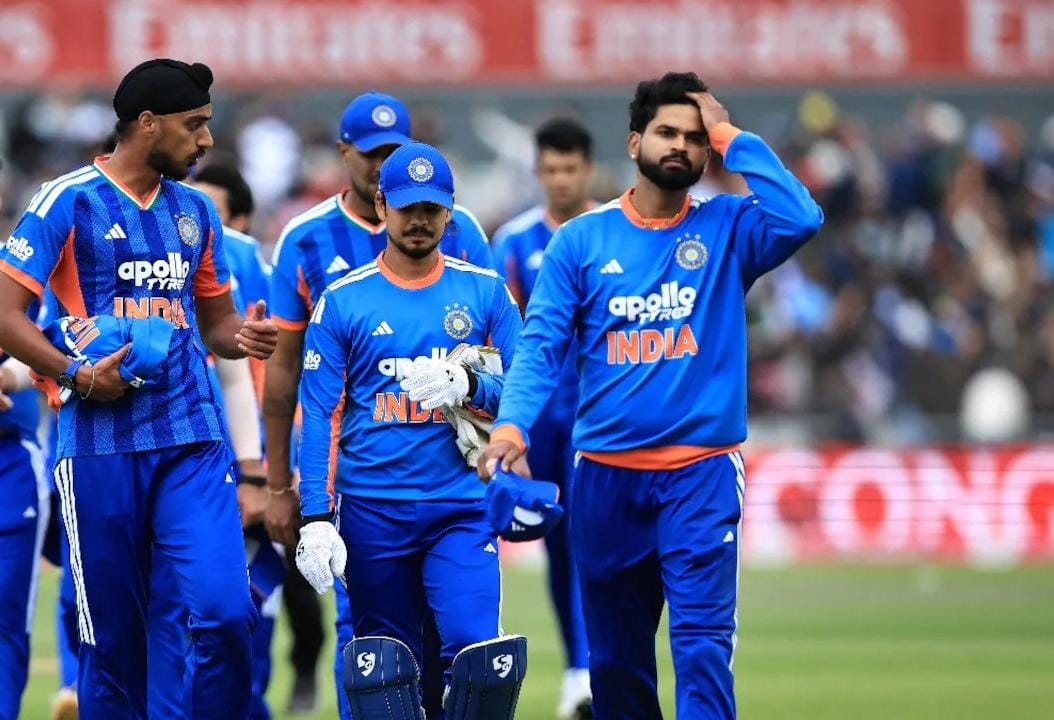
England completed a 4-0 T20I series sweep against India in Southampton, powered by a historic 233-run second-wicket partnership between Jos Buttler (131) and Harry Brook (95*). England's record total of 257 for 3 successfully dethroned India from the top of the official global ICC T20I team rankings.
SOUTHAMPTON — England’s men's cricket team delivered a historic batting masterclass to crush India by 56 runs in the fifth and final Twenty20 International (T20I), completing a dominant 4-0 bilateral series sweep. Former captain Jos Buttler and current skipper Harry Brook combined for a breathtaking, record-breaking 233-run partnership, propelling the hosts to a colossal 257 for 3. The total stands as England’s highest-ever T20I score against the Men in Blue, sending shockwaves through international cricket today as India officially surrendered its long-standing No. 1 spot in the global ICC T20I team rankings.
Historic Partnership Shatters Records at Rose Bowl
After Indian captain Shreyas Iyer won the toss and opted to bowl, England suffered an early setback when opener Phil Salt was dismissed for six by Prasidh Krishna. What followed was a flawless counter-attack that completely dismantled the visiting bowling unit.
Buttler, fighting a prolonged run of low scores, returned to his devastating best to smash a career-best 131 off just 64 deliveries, including 12 boundaries and eight sixes. Alongside him, Brook exhibited relentless power, finishing unbeaten on 95 from 45 balls.
The monumental 233-run stand entered the history books across multiple fronts:
Second-Wicket Global Record: It officially surpassed the previous world record for the highest second-wicket partnership in men's T20I history, overtaking the unbeaten 210-run stand set by India's Sanju Samson and Tilak Varma against South Africa.
Full Member Hierarchy: The partnership ranks as the second-highest stand for any wicket among ICC Full Member nations, trailing only Afghanistan's 236-run opening record established in 2019.
Highest Individual Score vs India: Buttler's 131 marks the highest individual score ever recorded against India in a T20 International, eclipsing Evin Lewis' unbeaten 125 from 2017.
Indian Bowling Exposed Under Pressure
The relentless assault by Brook and Buttler exposed significant vulnerabilities in the Indian bowling department, which lacked discipline on a true batting pitch. The English duo targeted India's main spinning option, Axar Patel, who finished with highly expensive figures of 0 for 63 across his four overs. Debutant right-arm pacer Prince Yadav faced a similarly brutal introduction to international cricket, conceding 60 runs in his four-over spell.
Tactical mistakes and a ragged fielding performance further compounded India's misery. Both batsmen were dropped during the innings; Brook was dropped early on three runs off Prince Yadav, while Buttler survived a clear chance after reaching his century. A late double-strike by Shivam Dube in the 19th over finally ended the partnership, dismissing Buttler and Jacob Bethell in consecutive deliveries to leave Dube with figures of 2 for 22.
Official Sources Section
Statistical validations, squad announcements, and post-match records are officially corroborated via match scorecards from the England and Wales Cricket Board (ECB) and the Board of Control for Cricket in India (BCCI). Team standings are verified by the International Cricket Council (ICC) official ranking systems.
Quote Section
Reflecting on his return to form after the match, player of the match Jos Buttler stated:
"When you go a long time without scoring runs you think the guys at the top might be thinking, 'It's time to move him on.' In a weird way that gave me a lot more freedom today – if I was going to fail, I'll do it on my own terms. Days like this feel amazing."
According to officials inside the Indian dressing room, team management conceded that the constant chopping, changing, and experimentation left a young squad vulnerable under extreme pressure against an aggressive, clinical opposition.
Why It Matters
For cricket fans and analysts, this result marks a definitive shift in the T20 International landscape. India's defeat concludes 1,601 days of continuous dominance at the top of the ICC team rankings, allowing England to reclaim the number-one spot. The absolute authority of the 4-0 sweep signals that England’s aggressive batting transition under Harry Brook's leadership has fully matured, while India must urgently reassess its secondary bowling depth and team stability ahead of upcoming international fixtures.
Key Facts at a Glance
Mammoth Partnership: Jos Buttler and Harry Brook added 233 runs for the second wicket, the highest second-wicket stand in T20I history.
Record Score against India: England's first-innings total of 257 for 3 is the highest-ever score posted by any team against India in the T20I format.
Individual Milestones: Buttler recorded his career-best international T20 score of 131, while Brook remained unbeaten on 95.
Rankings Shake-up: The 56-run defeat systematically stripped India of its No. 1 ICC T20I team ranking after more than four years at the top.
Bowling Nightmare: Two Indian bowlers—Axar Patel (63) and Prince Yadav (60)—conceded 60 or more runs during the 20-over innings.
FAQ Section
Is the 233-run partnership the highest ever in all T20 Internationals?
No. While it is the highest second-wicket partnership in history and the second-highest among Full Member nations, the overall record belongs to Japan's Lachlan Yamamoto-Lake and Kendel Kadowaki-Fleming, who shared an unbeaten 258-run opening stand against China in 2024.
What was India's final score in response to England's 257?
India managed to post 201 for 8 in their 20 overs, falling 56 runs short. Half-centuries from Ishan Kishan (56) and Tilak Varma (53) anchored the chase, but the climbing required run-rate proved insurmountable against disciplined English spin bowling.
Who is India's current full-time captain for this T20I series?
Shreyas Iyer served as India's full-time captain throughout the tour, heading a heavily rotated and experimental squad missing several first-choice regular players.
Source: International Cricket Council, England and Wales Cricket Board, Board of Control for Cricket in India.