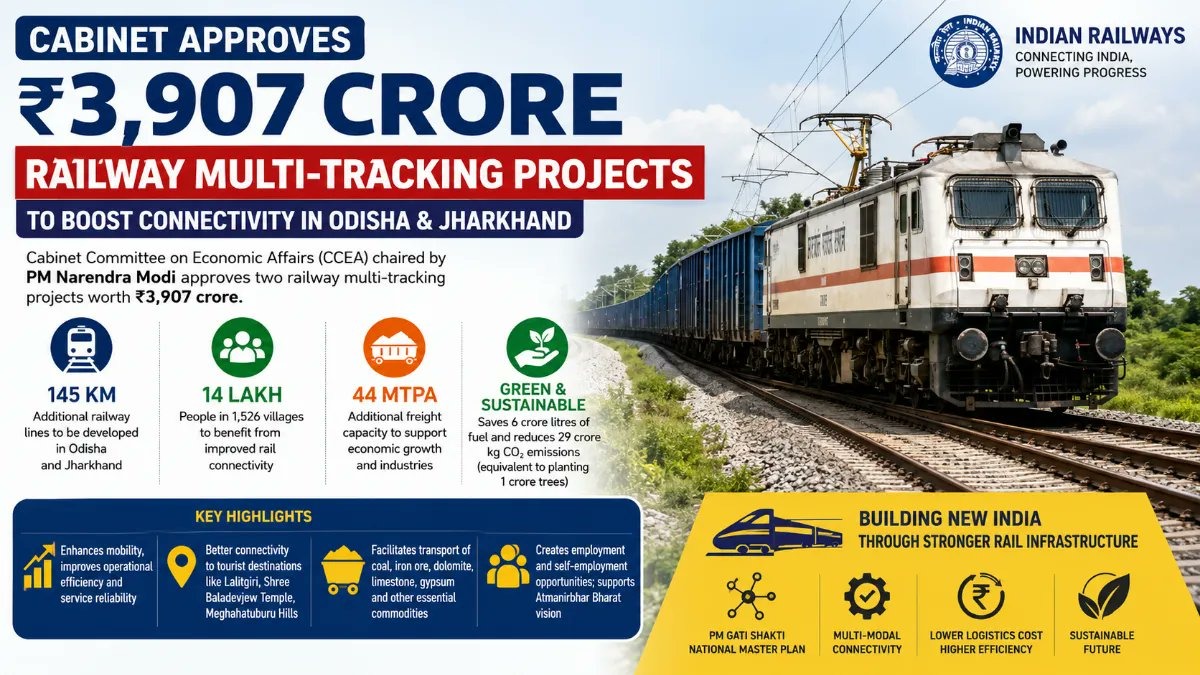
The Union Cabinet approved two railway multitracking projects costing ₹3,907 crore across four districts in Odisha and Jharkhand. Spanning 145 km, the upgrades target the Paradeep-Haridaspur and Rajkharsawan-Dangoaposi lines, boosting freight capacity by 44 MTPA and enhancing rural connectivity under the PM-Gati Shakti master plan.
NEW DELHI — In a major infrastructure push targeting eastern India’s heavy industrial corridors, the Cabinet Committee on Economic Affairs (CCEA), chaired by Prime Minister Narendra Modi, officially approved two major railway multitracking projects on Wednesday, July 15, 2026. Spanning four mineral-rich districts across the states of Odisha and Jharkhand, the combined logistics expansion will require a projected investment of approximately ₹3,907 crore. The dual rail corridor developments are designed to add roughly 145 kilometers to the existing network, significantly boosting regional line capacity, easing freight traffic congestion, and strengthening structural connectivity for remote rural populations.
Targeted Infrastructure Assets Form Core Expansion
The development blueprint issued by the Ministry of Railways breaks the comprehensive expansion down into two distinct, high-volume rail corridors. The first component targets the doubling of the existing Paradeep–Haridaspur section, a key transit channel funneling commodities directly into one of India’s busiest eastern deepwater ports. The second project focuses on laying a dedicated fourth line on the heavily congested Rajkharsawan–Dangoaposi route, a corridor that currently serves as a critical artery for primary industrial raw materials.
Both developments have been structurally mapped out under the institutional framework of the PM-Gati Shakti National Master Plan. By utilizing integrated geospatial data and cross-ministerial planning, the upgrades intend to eliminate historic transit delays that plague bulk transportation networks in the region. According to project completion timelines submitted to the cabinet, the engineering works are scheduled to be entirely operationalized by the 2030–31 fiscal year.
Industrial Impact and Carbon Reduction Metrics
From a commercial and corporate perspective, the multitracking initiatives directly target the heavy industrial logistics ecosystem. The targeted sections represent core pathways for transporting fundamental industrial inputs, including metallurgical coal, iron ore, dolomite, limestone, and gypsum. Industrial manufacturers and power generation firms are poised to benefit significantly, as the capacity enhancement works are projected to handle an additional freight volume of 44 million tonnes per annum (MTPA).
Beyond expanding commercial throughput, the Ministry highlighted substantial ecological dividends tied to the transition of freight from road networks onto expanded rail infrastructure. Official internal models estimate that the increased efficiency will reduce national oil imports by roughly 6 crore (60 million) litres annually. Furthermore, the operational optimization is forecasted to curb carbon dioxide emissions by 29 crore (290 million) kilograms, a reduction equivalent to the natural environmental impact of planting 1 crore (10 million) mature trees.
Local Economic Integration and Regional Tourism
The socio-economic footprint of the approved projects covers a broad cross-section of rural communities and regional landmarks. Administrative tracking data confirms that the new rail links will directly enhance transit connectivity for roughly 1,526 villages, encompassing a regional population base of nearly 14 lakh citizens. Local developers anticipate that this structural inclusion will catalyze local self-employment and broader micro-enterprise growth within the affected districts.
Concurrently, the rail capacity adjustments will optimize access for domestic and international travelers visiting prominent tourist and cultural hubs in eastern India. The upgraded alignments will directly improve modern rail access to the historic Lalitgiri Buddhist Complex, the Shree Baladevjew Temple, and the scenic Meghahatuburu Hills, providing a structural lift to regional tourism economies.
Official Announcements Section
The structural declarations were formally confirmed during a post-cabinet media briefing in New Delhi by Information and Broadcasting Minister Ashwini Vaishnaw. The operational directives have been systematically uploaded to the digital archives of the Press Information Bureau (PIB) for public tracking.
According to the central government press note, the capacity expansion works are an fundamental step toward modernizing mobility matrices across busy corridors, which directly stabilizes operational reliability and service delivery metrics for passengers and commercial clients alike.
Quote Section
"According to officials at the Ministry of Railways, these comprehensive line expansions are structurally engineered to de-congest saturated mineral corridors, driving down national logistics costs while ensuring predictable transit schedules for industrial supply lines."
Why It Matters
For heavy industries, mining conglomerates, and infrastructure investors, the cabinet's authorization offers long-term systemic stability by expanding capacity along highly constrained raw-material transit lines. By bringing an additional 44 MTPA of freight capacity online, the project directly lowers logistics overheads, making regional steel and manufacturing hubs structurally more competitive. For everyday citizens and regional commuters, the introduction of multi-tracking lines reduces scheduling conflicts between slow-moving cargo trains and express passenger services, minimizing delays and opening up remote communities to broader national economic currents.
Key Facts at a Glance
Capital Outlay: The Cabinet Committee on Economic Affairs greenlit an aggregate capital investment of approximately ₹3,907 crore.
Network Footprint: The projects add roughly 145 kilometers of fresh tracking across 4 industrial districts in Odisha and Jharkhand.
Freight Augmentation: The structural improvements accommodate an additional freight traffic load of 44 million tonnes per annum (MTPA).
Rural Reach: The expansion optimizes transit infrastructure for 1,526 distinct villages housing roughly 14 lakh residents.
Environmental Savings: The transition cuts carbon dioxide emissions by 29 crore kilograms and lowers fuel imports by 6 crore litres.
FAQ Section
What specific rail sections are being upgraded under this cabinet approval?
The intervention covers two main components: the complete doubling of the existing Paradeep–Haridaspur railway line and the installation of a dedicated fourth track along the Rajkharsawan–Dangoaposi corridor.
What is the final target completion year for these multitracking projects?
According to the official execution schedules authorized by the central government, both rail projects are targeted for full engineering completion by the 2030–31 fiscal year.
How do these projects impact India's broader environmental goals?
By shifting heavy industrial freight from road corridors to energy-efficient rail networks, the upgrades save an estimated 6 crore litres of imported oil and slash emissions by 29 crore kilograms of CO2 annually.
Which major industrial commodities rely heavily on these specific routes?
These lines serve as foundational corridors for bulk industrial commodities, including steel-grade iron ore, coal, dolomite, limestone, and gypsum.
Source: Cabinet briefing transcripts distributed by the Press Information Bureau (PIB), operational data releases from the Ministry of Railways, and regional planning reports from the Cabinet Committee on Economic Affairs (CCEA).