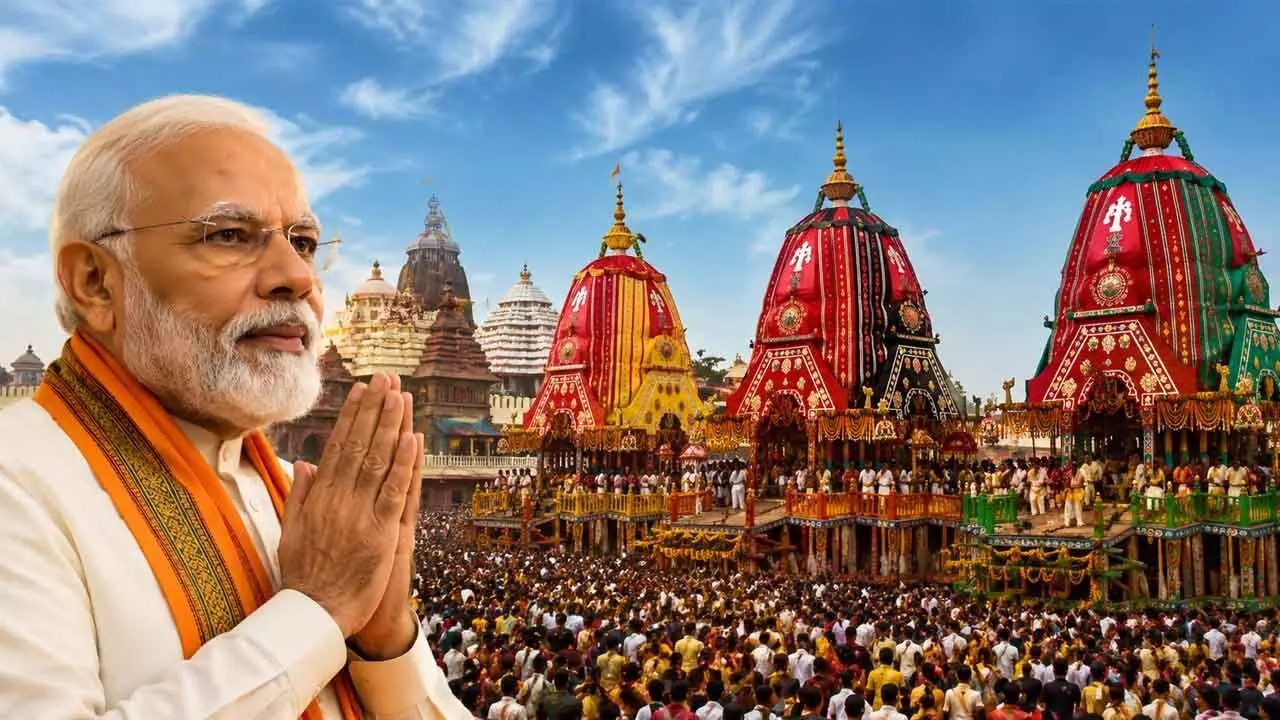
Prime Minister Narendra Modi extended national greetings on the launch of the Jagannath Rath Yatra, calling it a "radiant expression" of India’s spiritual legacy. The festival commenced on July 16, 2026, drawing lakhs of devotees to Puri alongside massive, coordinated safety, railway, and civic infrastructure deployments.
NEW DELHI — Prime Minister Narendra Modi extended his formal greetings to citizens across India and the global diaspora on Thursday, July 16, 2026, marking the commencement of the world-famous Jagannath Rath Yatra. Characterizing the historic chariot procession as a "radiant expression" of the country’s timeless spiritual and cultural heritage, the Prime Minister emphasized the festival's core values of social harmony, humility, and collective public participation. The statements coincided with the official launch of the annual nine-day religious event in the coastal city of Puri, Odisha, which has drawn hundreds of thousands of international and domestic devotees to witness the sacred journey of the sibling deities.
Prime Minister Highlights Themes of Selfless Service
In an official public declaration distributed through the Prime Minister's Office (PMO), Modi invoked the blessings of Mahaprabhu Jagannath to foster good health, societal togetherness, and widespread economic prosperity across the nation. The executive message placed special emphasis on the historical continuity of the festival and its power to inspire generations through its unique focus on egalitarian devotion.
"Greetings to everyone on the sacred occasion of Rath Yatra," Prime Minister Modi stated via his official communication channels. "This is a radiant expression of India's timeless spiritual and cultural heritage. The traditions associated with the Rath Yatra have inspired generations across India and the world. They embody humility, collective participation and selfless service."
The Prime Minister concluded his address by praying for the collective strength of the citizenry to fulfill their developmental endeavors, adding, "May He give us strength for all our endeavours and deepen the spirit of togetherness in our society. Jai Jagannath!"
National Leadership Joins Global Congregations
The Prime Minister’s greetings were mirrored by high-level messages from senior constitutional authorities, highlighting the deep cultural integration of the event. President Droupadi Murmu extended her heartfelt wishes from Rashtrapati Bhavan, describing the festival as a unique, soulful occasion that represents the direct union of the devotee and the divine. In her message, President Murmu noted the profound public symbolism of the deities stepping outside their inner sanctum to meet people from all segments of society, irrespective of cultural or economic backgrounds.
Concurrently, Union Home Minister Amit Shah published an official greeting, underscoring the logistical coordination undertaken by central and state authorities to ensure the safety and comfort of pilgrims.
The collective focus of the national leadership reflects the immense socio-religious scale of the event. In Puri alone, municipal data confirmed the arrival of massive crowds along the Bada Danda (Grand Road) to assist in pulling the iconic wooden chariots. The celebratory momentum extended well beyond Odisha, with secondary grand processions organized by chapters of the International Society for Krishna Consciousness (ISKCON) and local temples in major urban centers including New Delhi, Mumbai, Kolkata, and Bengaluru.
Chariot Dynamics and Puri Mobilization
Administratively managed by the Shree Jagannath Temple Administration (SJTA) and the Government of Odisha, the 2026 festival began under highly auspicious astrological alignments, including the rare Ravi Yoga. The focal point of the daily rituals remained the three freshly constructed, multi-wheeled wooden chariots—Nandighosha for Lord Jagannath, Taladhwaja for Lord Balabhadra, and Darpadalana for Goddess Subhadra—built entirely from scratch by hereditary craftsmen using traditional timber specifications.
The operational phase of the Yatra tracks the symbolic transit of the deities from their primary residence to the Gundicha Temple, located roughly three kilometers away, where they reside for nine days before returning via the Bahuda Yatra on July 24, 2026. To manage the immense influx of travelers and maintain order during the high-density gathering, the Odisha State Police deployed over 180 platoons of armed personnel, integrated real-time drone surveillance arrays, and established round-the-clock medical aid centers along the main travel corridors.
Official Announcements Section
The diplomatic and cultural notices regarding the national celebrations have been systematically archived by the Ministry of Culture and disseminated through the networks of the Press Information Bureau (PIB).
According to regional administrative statements from the Odisha Chief Minister’s Office, special transit provisions, including 315 dedicated festival special trains operated by the Ministry of Railways, were successfully active on opening day to accommodate the surge of passengers traveling across the eastern economic corridor.
Quote Section
"According to officials from the temple administration and regional tourism bureaus, the initial chariot pull commenced precisely on schedule following the completion of the traditional Chhera Pahanra ritual, wherein the titular King of Puri sweeps the chariot platforms with a golden broom to signify universal humility."
Why It Matters
For citizens, local businesses, and international travelers, the Jagannath Rath Yatra represents one of the largest seasonal spikes in internal tourism and spiritual migration in southern Asia. The smooth execution of the festival directly drives regional hospitality sectors, transport systems, and artisanal micro-economies throughout eastern India. Furthermore, the public emphasis on unity and selfless service by the nation's top leadership underscores how these ancient traditional institutions are leveraged to reinforce contemporary social cohesion, civil infrastructure resilience, and public safety standards during mega-scale civic gatherings.
Key Facts at a Glance
Executive Greet: PM Narendra Modi officially designated the Rath Yatra as a "radiant expression" of India's enduring spiritual inheritance.
Grand Procession: The festival officially commenced on July 16, 2026, marking the Ashadha Shukla Paksha Dwitiya tithi.
Transit Strategy: The Ministry of Railways deployed over 300 festival special trains to safely manage the influx of lakhs of devotees into Puri.
Ritual Return: The sibling deities will reside at the Gundicha Temple for nine days before commencing their return journey, the Bahuda Yatra, on July 24.
FAQ Section
What is the primary significance of the Jagannath Rath Yatra?
The Rath Yatra is the unique annual occasion when the presiding deities of the Puri Temple leave their inner sanctum to travel down the Grand Road, allowing all devotees, regardless of background, caste, or nationality, an equal opportunity to seek blessings.
Who are the three deities celebrated during this chariot festival?
The festival centers around the grand journey of Mahaprabhu Lord Jagannath, his elder brother Lord Balabhadra, and their sister Goddess Subhadra.
How long does the entire Rath Yatra festival last?
The entire celebration spans approximately nine days, starting with the onward journey to the Gundicha Temple and concluding with the Bahuda Yatra (the return procession).
Source: Official press logs from the Press Information Bureau (PIB), executive statements from the Prime Minister's Office (PMO), and operational updates from the Shree Jagannath Temple Administration (SJTA).