The operationalization of the India-UK Comprehensive Economic and Trade Agreement (CETA) commenced with a $446,046 inaugural shipment from Chennai. Securing zero-duty access across 99% of export lines, the treaty deploys digital self-certification via the eCoO 2.0 platform, drastically reducing cross-border trade friction for Indian manufacturers and MSMEs.
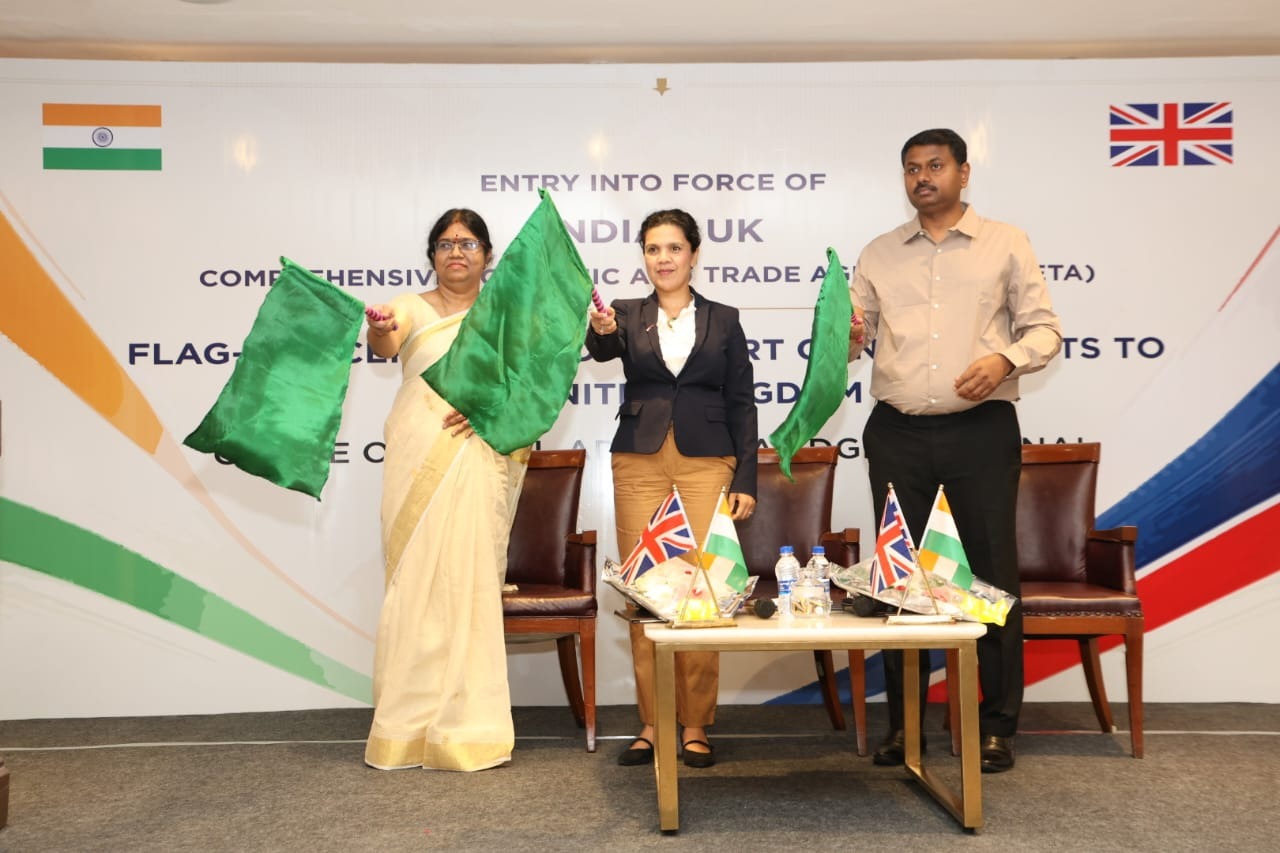
CHENNAI — Marking a critical turning point in bilateral economic relations, the first commercial consignments under the newly enacted India-United Kingdom Comprehensive Economic and Trade Agreement (CETA) were officially flagged off from Chennai on Wednesday, July 15, 2026. The initial batch of exports, valued at $446,046, entered the preferential trade framework on the exact day the landmark treaty officially entered into force across both nations. This milestone deployment introduces a streamlined era of zero-duty market access for Indian manufacturing, agricultural, and value-added sectors, aiming to significantly lower traditional logistical bottlenecks and documentation processes.
Diverse Sectors Lead Inaugural Export Shipments
The initial commercial dispatch from Tamil Nadu highlighted a varied industrial footprint, spanning high-value manufacturing, engineering goods, and processed agricultural commodities. According to tracking data shared during the ceremony, the inaugural export roster featured specialized gold jewellery from M/s Emerald Jewel Industry India Limited in Coimbatore, alongside automotive components supplied by Chennai-based M/s Brakes India Pvt. Ltd.
Additional industrial cargo processed during the launch included cast wheels from M/s Wheels India Limited and leather footwear items managed by M/s Good Leather Shoes Pvt. Ltd.
Parallel to manufacturing, the Agricultural and Processed Food Products Export Development Authority (APEDA) facilitated a 50-metric-tonne (MT) consignment designed to highlight regional food-processing capabilities. This agricultural shipment comprised 25 MT of premium traditional rice, millets, and jaggery powder exported by M/s Rigel Spices, along with 25 MT of frozen ready-to-eat products provided by M/s Visnukumar Traders Pvt. Ltd.
Trade Regularization and Macroeconomic Framework
The Chennai event occurred alongside a larger national rollout, during which over 50 export consignments valued above $140 million were cleared through more than 20 ports, airports, and inland container depots nationwide. The operational timelines for the CETA framework were finalized exactly 30 days prior during a bilateral meeting on the sidelines of the G7 Summit in France.
Under the baseline parameters of the economic treaty, India secures zero-duty market access for roughly 99 percent of its exports, covering nearly the entirety of current bilateral trade values. Concurrently, digital regulatory mechanisms have been updated; the first official Certificates of Origin were processed via the updated eCoO 2.0 platform on a self-certification basis, designed to reduce transaction friction for micro, small, and medium enterprises (MSMEs).
Official Statements and Administrative Directives
The launch ceremony was jointly managed by the Directorate General of Foreign Trade (DGFT) and regional Export Promotion Councils, drawing representation from engineering, agricultural, leather, and jewelry trade bodies.
Dr. Sutapa Choudhury, the British Deputy High Commissioner for Tamil Nadu, Puducherry, and Keralam, stated that the implementation establishes a new template for structural trade cooperation and directly advances the core metrics established under the UK-India Vision 2035 roadmap.
Smt. Rajalakshmi Devaraj, Zonal Additional Director General of Foreign Trade in Chennai, observed that the operationalization of CETA immediately targets the elimination of historic trade barriers, offering local manufacturing hubs a competitive window into Western European markets.
Quote Section
"According to officials from the Directorate General of Foreign Trade, the implementation of the CETA framework will substantially scale down the volume of compliance documentation traditionally required for international shipping, accelerating the timeline from factory floor to overseas distribution."
Why It Matters
For regional manufacturers and exporters, the integration of CETA reduces structural tariffs on high-volume consumer goods like textiles, leather goods, and engineering parts. By cutting down regulatory processing times via self-certification platforms, the trade pact provides small and medium-sized manufacturers with identical market entry parameters as larger conglomerates. Investors and logistics networks stand to benefit from more predictable shipping timelines, while agricultural exporters gain an established, lower-tariff channel for value-added and processed food distribution into British consumer chains.
Key Facts at a Glance
Initial Valuation: The inaugural commercial shipments cleared from the Chennai hub reached an exact aggregate valuation of $446,046 on day one.
Tariff Alleviation: The agreement guarantees zero-duty market access for roughly 99% of India's total export lines to the United Kingdom.
Sector Distribution: Cargo included automotive parts, cast wheels, precision gold jewelry, leather footwear, and 50 metric tonnes of processed agri-foods.
Digital Integration: Custom clearances utilized the eCoO 2.0 electronic platform to issue self-certified Certificates of Origin, lowering administrative overhead.
FAQ Section
What is the primary objective of the India-UK CETA?
The Comprehensive Economic and Trade Agreement (CETA) lowers or removes import duties on the vast majority of goods traded between India and the UK, normalizes rules of origin, and simplifies administrative custom clearances to maximize bilateral trade volume.
Which specific companies participated in the first Chennai dispatch?
The inaugural launch included shipments from Emerald Jewel Industry India, Brakes India Pvt. Ltd., Wheels India Limited, Good Leather Shoes, Rigel Spices, and Visnukumar Traders.
How does the agreement affect MSMEs and smaller manufacturers?
Through the integration of the digital eCoO 2.0 self-certification system, smaller entities can bypass third-party clearing agencies for origin verification, drastically lowering transaction costs and regulatory lead times.
Are there any sensitive economic sectors protected under this treaty?
Yes. India has maintained protective domestic tariffs on sensitive segments such as dairy products and edible oils, while the UK has retained targeted strategic tariffs on items including sugar, milled rice, pork, and poultry.
Source: Press Information Bureau (PIB) India, Directorate General of Foreign Trade (DGFT), and regional operational releases from the Agricultural and Processed Food Products Export Development Authority (APEDA).