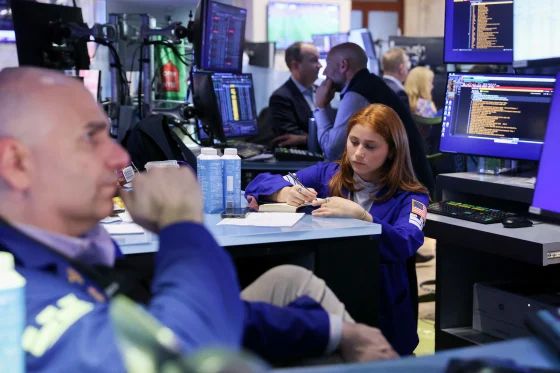
A deepening global tech selloff heavily battered Asian and European equity markets on June 23, 2026. Driven by frothy AI valuations and hawkish central bank outlooks, the correction triggered a 10 percent drop in South Korea's KOSPI index and steady retreats across major European bourses.
LONDON — A bruising global tech selloff rippled across international financial hubs on Tuesday, June 23, 2026, triggering sharp drops throughout Asian and European equity markets. The aggressive liquidations, which originated from a sharp valuation correction on Wall Street, intensified overnight as institutional investors reassessed the immense structural spending required to fund the artificial intelligence boom.
The swift market correction marks a critical turning point for global indices this year. After months of riding record-setting momentum fueled by chipmakers and software providers, global equity markets are facing downward pressure as sticky inflation gauges and higher borrowing costs squeeze debt-financed tech infrastructure spending.
Asian Semiconductor Hubs Bear the Brunt of the Rout
The impact of the global tech selloff was felt most acutely across Asian trading floors, where heavyweight hardware and memory suppliers dominate benchmark performance. South Korea’s benchmark KOSPI index suffered a spectacular 10 percent plunge, forcing regulatory authorities to briefly implement emergency trading halts. The downward spiral was led by memory manufacturing giants SK Hynix and Samsung Electronics, which both plummeted over 12 percent in a single session.
In Tokyo, the Nikkei 225 index finished the day 3.5 percent lower, heavily weighed down by a 10 percent slide in technology investment titan SoftBank Group, along with sharp declines for semiconductor equipment makers Tokyo Electron and Advantest. Concurrently, Hong Kong’s Hang Seng index slid 1.8 percent, pushing regional tech components deeper into a technical bear market, while the Shanghai Composite shed 1.4 percent.
European Bourses Slump Under Growing Yield Pressure
As trading moved westward, European equity markets quickly mirrored the negative sentiment. The pan-European Stoxx 600 index fell as tech heavyweights, including chip equipment maker ASML and BE Semiconductor Industries (Besi), experienced notable profit-taking blocks. Germany's DAX dropped 1.0 percent, France’s CAC 40 slid 0.6 percent, and the United Kingdom’s FTSE 100 or 250 baskets registered uniform losses of roughly 0.5 percent during afternoon trading.
Beyond corporate tech metrics, macroeconomic pressures continue to strain broader equity markets. Hawkish policy guidance from newly appointed Federal Reserve Chair Kevin Warsh has fanned investor anxieties that interest rates will stay higher for longer to combat stubborn global inflation. High global bond yields have raised the cost of capital, making high-multiple tech valuations harder to sustain for companies funding massive data center developments via debt markets.
The correction was also exacerbated by individual corporate updates. Google-parent Alphabet saw its worst trading session in over a year after key artificial intelligence researchers departed the company, raising concerns over product pipeline stability. Meanwhile, Elon Musk’s SpaceX, which recently debuted on public boards, fell over 16 percent in back-to-back sessions as its post-IPO momentum faded and plans for an extensive corporate bond issuance re-ignited leverage worries.
Quote Section
"The persistent global tech selloff reflects growing investor discipline surrounding the sheer cash-guzzling nature of current artificial intelligence infrastructure," a senior quantitative equity strategist told market networks under anonymity on Tuesday. "According to officials, the market is turning highly selective on tech assets. While structural demand remains robust, funding these massive long-term computing layouts with high-cost debt during a hawkish central bank cycle poses genuine risks to corporate balance sheets."
Why It Matters
The global tech selloff has significant practical implications for retail investment portfolios, retirement accounts, and enterprise capital expenditure budgets. Because a handful of mega-cap technology firms command an outsized share of total index values, sharp drops in these specific names quickly drag down passive index funds, directly impacting mainstream household savings. For businesses, more expensive debt capital will likely force a more disciplined, slower rollout of next-generation technology integrations over the coming fiscal quarters.
Key Facts at a Glance
Index Pullback: A broad global tech selloff severely hit Asian and European equity markets, wiping out weeks of record-setting equity gains.
Trading Suspended: South Korea's KOSPI plunged 10 percent, triggering temporary trading cushions as semiconductor leaders Samsung and SK Hynix fell over 12 percent.
European Retreat: Major European indices including the German DAX and French CAC 40 dropped between 0.6 and 1.0 percent due to tech sector profit-taking.
Interest Rate Pressures: Persistent inflation worries and hawkish signals from the U.S. Federal Reserve have pushed bond yields higher, squeezing high-multiple growth stock valuations.
Corporate Headwinds: High-profile staff departures at Alphabet and an aggressive debt-raising push by SpaceX added to market anxieties.
FAQ Section
Why is the tech sector leading the broader stock market decline?
Investors are taking a more cautious stance on premium valuations given the massive, ongoing costs tied to building out AI computing power, especially as high interest rates raise the cost of corporate borrowing.
What happens when an index like the KOSPI drops 10 percent in one day?
When extreme volatility hits, exchanges trigger built-in circuit breakers that temporarily halt all trading activity. This gives institutional systems time to process orders and helps prevent emotional panic selling.
Are traditional defensive sectors safe during a global tech selloff?
Yes. During major technology drawdowns, capital often rotates out of high-growth sectors and moves into defensive buckets such as utilities, consumer staples, and healthcare, which tend to hold up better when growth stocks face a correction.
Source: Official market indices compiled by the Euronext Group, financial data logs managed by the Tokyo Stock Exchange, and macro policy documentation updated by the Federal Reserve Board.