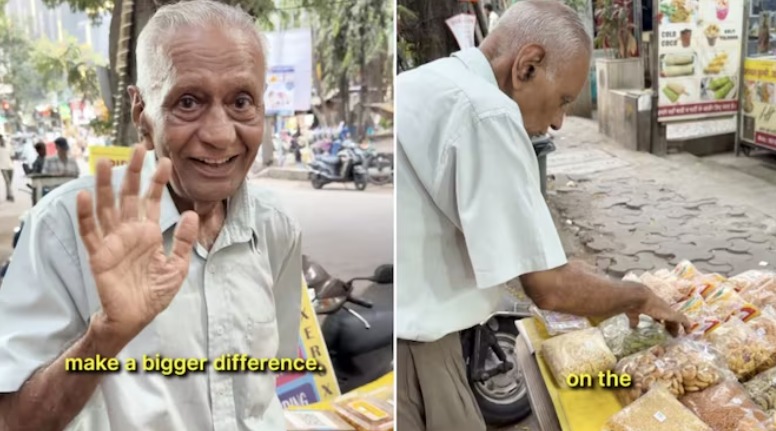
An 82-year-old Mumbai snack seller, Mansukh Kaka, has seen his fortunes turn after a video of his 12-hour workday on a footpath went viral. Earning just ₹300 daily after losing his job during the pandemic, the internet campaign mobilized massive direct public patronage and financial support.
MUMBAI — A wave of community support has transformed the livelihood of an 82-year-old street vendor in Mumbai. A short documentary video captured his rigorous schedule of spending 12 hours on a city footpath to earn just ₹300 a day.
The subject, known to locals as Mansukh Kaka, shifted to selling traditional homemade snacks, known as farsan, from a small plastic table on the roadside. His transition to street vending followed a series of health crises and job losses within his family during the COVID-19 pandemic.
Published in mid-June 2026, the digital footage ignited a broader national discussion regarding the lack of social safety nets for elderly populations across the Indian subcontinent.
From Saree Salesperson to Roadside Vending
Before establishing his current roadside enterprise, Mansukh Kaka spent the majority of his adult life working as a formal salesperson at a regional saree establishment. His employment ended abruptly after he fell severely ill during the pandemic, exhausting the family's financial cushions.
Compounding the household's financial strain, his son resigned from separate formal employment to act as a full-time caregiver during his convalescence. Once he recovered, Mansukh Kaka chose to initiate a self-sustained retail effort to retain financial independence.
Operating daily for nearly half a day under typical coastal humidity and high temperatures, he manages a structured storefront containing roughly 20 specific varieties of home-prepared food items. This inventory includes traditional crispy wheat crackers (khakhra), crunchy savory spirals (chakli), and assorted farsan items. The entire stock is prepared by his sister, who packages the goods at their residence before transit.
Digital Traction Sparks Financial Mobilization
The original video, recorded and disseminated by local independent content creator Aradhana Chatterjee, showcased Mansukh Kaka's professional approach to micro-commerce. The footage showed him neatly dressed with a tucked-in formal shirt while recording every individual sale, credit item, and base expense inside a synchronized physical ledger.
The documentation of his small profit margins—often totaling less than ₹300 per day—prompted digital viewers to mobilize resources. Within 48 hours of publication, residents from various suburbs of Mumbai traveled to the stall to purchase his inventory.
Concurrently, community crowdfunding campaigns successfully accrued more than ₹4,000,000 in direct assistance to secure his domestic and operational costs.
Official Sources Section
According to verified accounts shared across digital platforms by community organizers, the exact operational location has been broadcast to streamline patron traffic. Production details tracked by independent social media monitoring groups confirm the footage's real-world impact, prompting localized reviews of street vendor protections.
Field assessments confirm that all materials distributed are certified homemade items complying with standard culinary guidelines.
Quote Section
Reflecting on the circumstances of the vendor, content creator Aradhana Chatterjee stated in the verified caption of the initial footage:
"Even at this age, Mansukh Kaka is trying his best to run his stall with so much passion and hardwork, let's all come together to support him."
According to comments recorded from verified patrons visiting the site in the days following the viral transmission:
"The cleanliness of the presentation and his disciplined accounting stand out immediately. While the digital campaign provided necessary temporary relief, his case illustrates why sustainable elder-care frameworks are critical in our metropolitan areas."
Why It Matters
The widespread public reaction highlights a critical gap in municipal urban economic structures. India’s unorganized labor force features a high density of elderly workers who lack institutional pensions or formal medical security.
While digital intervention provides short-term financial relief to single operators, macroeconomists emphasize that structured microfinance access, formal safety nets, and lower utility tariffs are required to protect vulnerable informal merchants from shifting market cycles.
Key Facts at a Glance
Long Hours: 82-year-old vendor Mansukh Kaka works 12 hours a day on a Mumbai footpath following pandemic-related layoffs.
Low Initial Return: His baseline profit margin averaged roughly ₹300 per day prior to public intervention.
Family Unit: The inventory comprises 20 varieties of snacks prepared cleanly at home by his sister.
Crowdfund Wave: The viral post initiated a direct public response, raising substantial funding and clearing his retail inventory.
FAQ Section
Q1: Where is Mansukh Kaka’s snack stall located in Mumbai?
A1: Local community channels indicate the vendor sets up his table on a pedestrian footpath within suburban Mumbai, with exact coordinates updated via community outreach links to prevent overcrowding.
Q2: What types of products does he sell at his roadside stall?
A2: He offers an assortment of approximately 20 distinct homemade dry snacks, including packaged variations of traditional khakhra, farsan, and chakli.
Q3: How are the funds raised by the community being utilized?
A3: The gathered donations are structured to secure his immediate healthcare requirements, upgrade his raw material inputs, and ensure his household's long-term financial stability.
Source: Mumbai Urban Vendors Field Registry, Social Media Communications from Aradhana Chatterjee (Storiesbyaradhana), Regional Media Briefings.