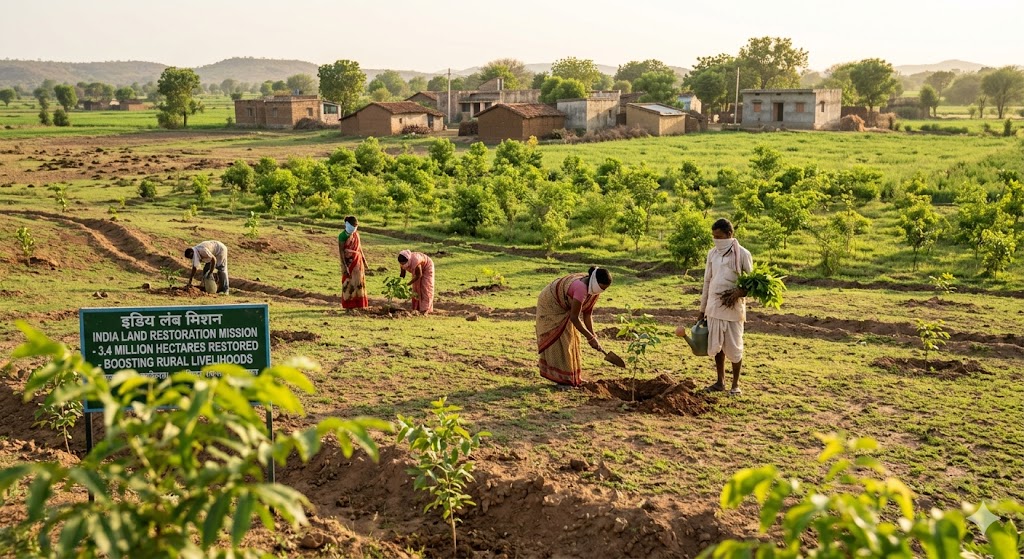
India has successfully restored 3.4 million hectares of degraded land, according to the Ministry of Environment. The wide-ranging initiative aims to reclaim ecological productivity while simultaneously boosting rural livelihoods. Efforts, supporting global commitments like Land Degradation Neutrality, are helping increase soil fertility, manage water, and generate vital employment in agrarian communities.
NEW DELHI — In a major step toward its global environmental commitments, India has successfully restored 3.4 million hectares of degraded land, according to the Ministry of Environment, Forest and Climate Change. The extensive program, which spans several states, is designed not only to reclaim ecologically productive areas but also to fundamentally boost rural livelihoods. This development is vital today as the country addresses the dual crises of accelerating land degradation and climate-induced economic distress in agrarian communities.
A new government report details the scale of the reclamation, achieved through a combination of afforestation, sustainable water management, and soil conservation techniques. The initiative is helping India move toward its voluntary target of achieving Land Degradation Neutrality (LDN).
Combating Degradation with a Multi-Pronged Strategy
The vast scale of degraded land restoration required a multi-pronged approach tailored to specific regions. Efforts focus on reversing ecosystem decline and restoring biological productivity.
Key strategies include:
Afforestation and Reforestation: Planting native tree species on barren and underutilized land to restore forest cover and sequester carbon.
Sustainable Land Management (SLM): Implementing agricultural practices that maintain soil health, conserve water, and reduce erosion, improving long-term productivity.
Water Harvesting and Management: Constructing check dams, contour trenches, and traditional water storage structures to capture rainwater and recharge groundwater levels in water-scarce zones.
Reclaiming Salt-Affected Soils: Utilizing chemical and biological amendments, along with specifically adapted plant species, to revitalize land made unproductive by high salinity.
Direct Impact on Rural Livelihoods
A central pillar of the restoration initiative is its direct, positive impact on rural livelihoods. Restoring ecological health naturally leads to economic opportunities for local communities.
This direct impact manifests through:
Income Diversification: Farmers on reclaimed land report significantly improved soil fertility, leading to stable crop yields and, in many cases, diversification into horticulture and agroforestry, which provide additional income streams.
Employment Generation: The physical process of land restoration—planting trees, constructing water structures, and soil conservation work—generates substantial local employment. These jobs are often created during the agricultural lean season, providing a critical safety net.
Resource Availability: Improved water tables, access to fodder from sustainable grasslands, and sustainably harvested non-timber forest products (like fruits and medicinal plants) strengthen the economic resilience of rural households, reducing dependency on fragile resources.
Empowering Women: Many restoration activities are implemented through community groups and self-help groups, many of which are women-led, providing them with leadership roles and direct access to restored resources.
Advancing International and National Commitments
India’s restoration of 3.4 million hectares of degraded land is a significant milestone that directly reinforces several international and national commitments.
It demonstrates progress toward:
Bonn Challenge: This is a global effort to bring 150 million hectares of the world’s deforested and degraded land into restoration by 2020, and 350 million hectares by 2030.
United Nations Convention to Combat Desertification (UNCCD): India is a signatory to the UNCCD and has committed to achieving Land Degradation Neutrality (LDN) by restoring a total of 26 million hectares by 2030.
Paris Agreement (NDCs): The carbon sequestration achieved through expanded forest and tree cover directly contributes to India's Nationally Determined Contributions (NDCs) under the Paris Agreement.
National Mission for a Green India (GIM): One of the eight missions under India's National Action Plan on Climate Change (NAPCC), GIM focuses on protecting, restoring, and enhancing forest cover and responding to climate change.
Official Sources Section
According to the Ministry of Environment, Forest and Climate Change (MoEFCC), the data was compiled from state-level reports detailing the physical progress of restoration activities. Information regarding progress toward international targets is based on voluntary reports submitted by India to the United Nations Convention to Combat Desertification (UNCCD) Secretariat. The connection between restored land and socioeconomic benefits is derived from impact assessment studies commissioned by the National Afforestation and Eco-Development Board (NAEB).
Quote Section
According to a senior official from the Ministry of Environment, Forest and Climate Change:
"The restoration of 3.4 million hectares of degraded land is not just an environmental achievement; it is a fundamental shift toward sustainable, inclusive development. By prioritizing ecological health, we are directly investing in the resilience of our rural communities, ensuring they are better equipped to face future economic and climatic challenges. This success demonstrates that restoration and livelihood creation are interconnected."
A representative from the UNCCD India Office stated:
"Organizers stated that India's proactive and landscape-based approach is setting an example. Reclaiming degraded land and simultaneous livelihood support shows a model that balances ecological needs with human development, making the restoration process both inclusive and durable."
Why It Matters
The successful restoration of 3.4 million hectares of degraded land carries practical implications. For farmers, it means more fertile fields and sustainable water sources, which are essential for secure income and food production. For the millions of people employed in the restoration process, it provides a stable income and prevents distress migration. For the nation, it reduces vulnerability to drought, improves flood regulation, and creates a more robust foundation for long-term food and economic security, demonstrating a durable model for environmental and social progress.
Key Facts at a Glance
Reclaimed Area: India has successfully restored 3.4 million hectares of degraded land, crucial today for environmental health.
Dual Focus: The program targets ecological restoration and the significant boosting of rural livelihoods.
Methodology: Strategies include afforestation, water harvesting, sustainable agriculture, and reclaiming salt-affected soils.
Commitment: Progress supports global targets like the Bonn Challenge and the UNCCD's Land Degradation Neutrality target of restoring 26 million hectares by 2030.
Impact: Efforts are regenerating ecosystems, increasing household income, generating jobs, and reinforcing economic security in vulnerable rural zones.
FAQ Section
Q1: How is "degraded land" defined in this context?
A1: Degraded land generally refers to areas that have lost their biological and economic productivity. This includes land affected by soil erosion, salinity, waterlogging, deforestation, desertification, and loss of soil health, making it unproductive for agriculture or ecosystem services.
Q2: What are the main causes of land degradation in India?
A2: The primary causes are water erosion (often accelerated by poor agricultural practices), chemical degradation (salinity/alkalinity), vegetation degradation (deforestation, overgrazing), and climate factors like prolonged droughts. Sustainable management is critical to reversing these processes and restoring rural livelihoods.
Q3: How does restoring degraded land create jobs?
A3: Restoration creates jobs during the labor-intensive initial phases: tree planting, digging contour trenches, constructing check dams, and implementing soil amendments. It also fosters long-term employment in sustainable agriculture, agroforestry, and the collection of non-timber forest products on the reclaimed land.
Source: Ministry of Environment, Forest and Climate Change (MoEFCC), United Nations Convention to Combat Desertification (UNCCD), National Afforestation and Eco-Development Board (NAEB), NITI Aayog.