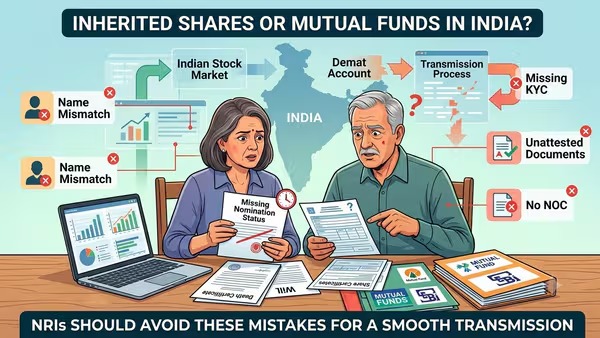
Non-Resident Indians (NRIs) inheriting financial assets in India including equity shares, mutual fund units, and corporate or government bonds must navigate a structured legal transmission process. To claim these holdings smoothly, NRI heirs need to complete localized Know Your Customer (KYC) requirements, verify registered nominations, obtain necessary legal succession documentation, and open non-resident bank and demat accounts.
MUMBAI — Millions of Non-Resident Indians (NRIs) living across North America, Europe, the Middle East, and Asia face complex procedural steps when inheriting financial assets left behind by deceased family members in India. These assets ranging from dematerialized equity shares and mutual fund folios to physical corporate bonds and government securities do not transfer automatically.
Under the regulatory frameworks established by the Securities and Exchange Board of India (SEBI) and the Reserve Bank of India (RBI), legal heirs must undergo a formal procedure known as asset transmission. Understanding the required documentation, tax implications, and repatriation guidelines ensures that NRI beneficiaries claim their inherited wealth without administrative delays.
Step 1: Trace All Holdings and Check Nomination Status
The initial step for an NRI heir is identifying all physical and digital holdings left by the deceased investor. A Consolidated Account Statement (CAS) issued by depositories like NSDL and CDSL, alongside mutual fund registrars (CAMS and KFintech), helps aggregate digital portfolios.
Determining nomination status across each asset is critical, as it dictates the complexity of the transmission process:
Nominee Registered: If the deceased registered the NRI as an explicit nominee, transmission is streamlined. The claimant submits the death certificate, transmission request form (TRF), and valid identity proofs.
No Nominee (Intestate or via Will): If no nominee was specified, or if legal heirs dispute the claim, financial intermediaries require court-issued legal documentation—such as a Probate of Will, Succession Certificate, or Letter of Administration.
Step 2: Establish NRI KYC and Open NRO-Linked Accounts
Inherited investments cannot be directly transferred into a domestic resident account or resident demat portfolio. NRIs must set up non-resident financial infrastructure in India prior to filing transmission requests:
NRI Demat Account: Necessary for receiving transmitted shares and dematerialized bonds. Usually opened as a Non-Resident Ordinary (NRO) demat account.
NRO Bank Account: Required to receive mutual fund redemptions, bond coupon payments, and accrued corporate dividends.
NRI KYC Compliance: Submitting a self-attested Permanent Account Number (PAN) card, valid foreign passport, Overseas Citizen of India (OCI) card (if applicable), and overseas address proof.
Step 3: Complete Overseas Document Authentication
One of the main reasons for processing delays in NRI transmission claims involves improperly attested documents originating outside India.
Foreign affidavits, indemnity bonds, Power of Attorney (PoA) authorizations, and identity proofs executed abroad must undergo:
Notarization: Certification by a registered Notary Public in the claimant’s country of residence.
Apostille or Consular Attestation: Documents executed in Hague Convention signatory countries require an Apostille stamp. In non-signatory nations, documents must be attested by the local Indian Embassy or High Commission.
Step 4: Submit Transmission Requests across Intermediaries
Once documentation is complete, the NRI claimant submits transmission applications to the appropriate financial institutions:
| Asset Class | Operational Processing Entity | Target Account / Folio |
| Listed Equity Shares | Depository Participant (Broker/Bank holding Demat) | NRI NRO Demat Account |
| Mutual Funds | Asset Management Company (AMC) or Registrar (CAMS/KFintech) | NRI Mutual Fund Folio (NRO-linked) |
| Bonds / Debentures | Registrar and Share Transfer Agents (RTA) or Depository | NRI Demat Account / NRO Bank Account |
| Physical Shares / IEPF Assets | Investor Education and Protection Fund Authority (Form IEPF-5) | NRO Bank Account & NRI Demat Account |
Official Guidelines and Regulatory Disclosures
According to guidelines issued by the Securities and Exchange Board of India (SEBI) and the Reserve Bank of India (RBI):
"Under SEBI's standardized transmission framework, registrars and listed entities are required to process complete transmission requests within 21 calendar days. For non-resident heirs, inherited financial assets credited to NRO accounts are subject to FEMA repatriation guidelines, allowing remittance up to USD 1 million per financial year subject to tax compliance verification."
Quote Section
According to legal experts and financial advisors, NRIs should ensure that their name matches exactly across their PAN card, passport, and foreign address proofs before submitting transmission paperwork, as minor typographical variations remain a primary cause for documentation rejection by registrars.
Why It Matters
Properly claiming inherited Indian investments prevents assets from going unclaimed and being transferred to government bodies like the Investor Education and Protection Fund (IEPF). Following a structured transmission roadmap ensures that NRIs maintain full legal ownership, preserve historical acquisition costs for future capital gains tax calculations, and retain the flexibility to repatriate funds under RBI regulations.
Key Facts at a Glance
Transmission Mandate: Inherited shares and mutual funds cannot transfer automatically; heirs must file formal transmission applications.
Nominee Advantage: Having a registered nominee reduces documentation requirements and accelerates turnaround timelines to 7–30 working days.
Document Attestation: Documents signed outside India require notarization, Apostille, or Indian Embassy attestation.
Required Accounts: NRIs must hold an active NRO bank account and an NRO demat account in India.
Repatriation Limit: Under FEMA guidelines, NRIs can repatriate up to USD 1 million per financial year from inherited NRO asset sales.
Frequently Asked Questions (FAQs)
What is the difference between asset transfer and asset transmission?
Asset transfer involves a voluntary commercial sale or gift between living persons. Asset transmission is the legal process of transferring ownership of securities from a deceased holder to their legal heir or nominee.
Is a succession certificate mandatory for NRIs claiming inherited shares?
A succession certificate is not always mandatory if a valid nominee is registered. However, if there is no nominee, no Will, or if asset values exceed thresholds set by companies or RTAs, a court-issued succession certificate or probate is required.
Can an NRI receive inherited shares into a resident demat account?
No. An NRI cannot hold or receive securities in a domestic resident demat account. The inherited assets must be credited to a dedicated NRI (NRO) demat account.
How can an NRI repatriate proceeds from inherited asset sales back to their country of residence?
Under the Reserve Bank of India’s Liberalized Remittance Scheme (LRS) and FEMA frameworks, NRIs can repatriate up to USD 1 million per financial year from their NRO accounts. Repatriation requires submitting Form 15CA and Form 15CB certified by a Chartered Accountant in India.
Source: Official regulatory guidelines and procedural frameworks published by the Securities and Exchange Board of India (SEBI), the Reserve Bank of India (RBI), and the Ministry of Corporate Affairs (MCA).