Comcast Corporation has announced a tax-free spin-off separating into two independent public companies. The deal leaves Comcast focused on broadband and wireless infrastructure, while spinning off NBCUniversal and Sky into a standalone media giant led by Mike Cavanagh, optimizing both entities to navigate changing technology and global entertainment markets.
PHILADELPHIA, United States — Comcast Corporation announced today its formal intention for Comcast to spin off NBCUniversal and Sky into separate companies. The corporate separation, structured as a tax-free transaction for existing shareholders, will divide the massive telecommunications and media empire into two distinct, publicly traded corporate entities. The strategic pivot arrives as global media firms face shifting distribution models, maturing broadband markets, and intense competition within international streaming ecosystems.
The decision represents a major structural shift for the Philadelphia-based conglomerate. By initiating the separation, the executive leadership team aims to unlock shareholder value and grant both standalone entities the financial agility to pursue independent strategic paths. Upon finalized execution of the deal, current Comcast equity holders will maintain direct ownership stakes across both newly configured public enterprises.
Detailed Structure of the Dual Corporate Entities
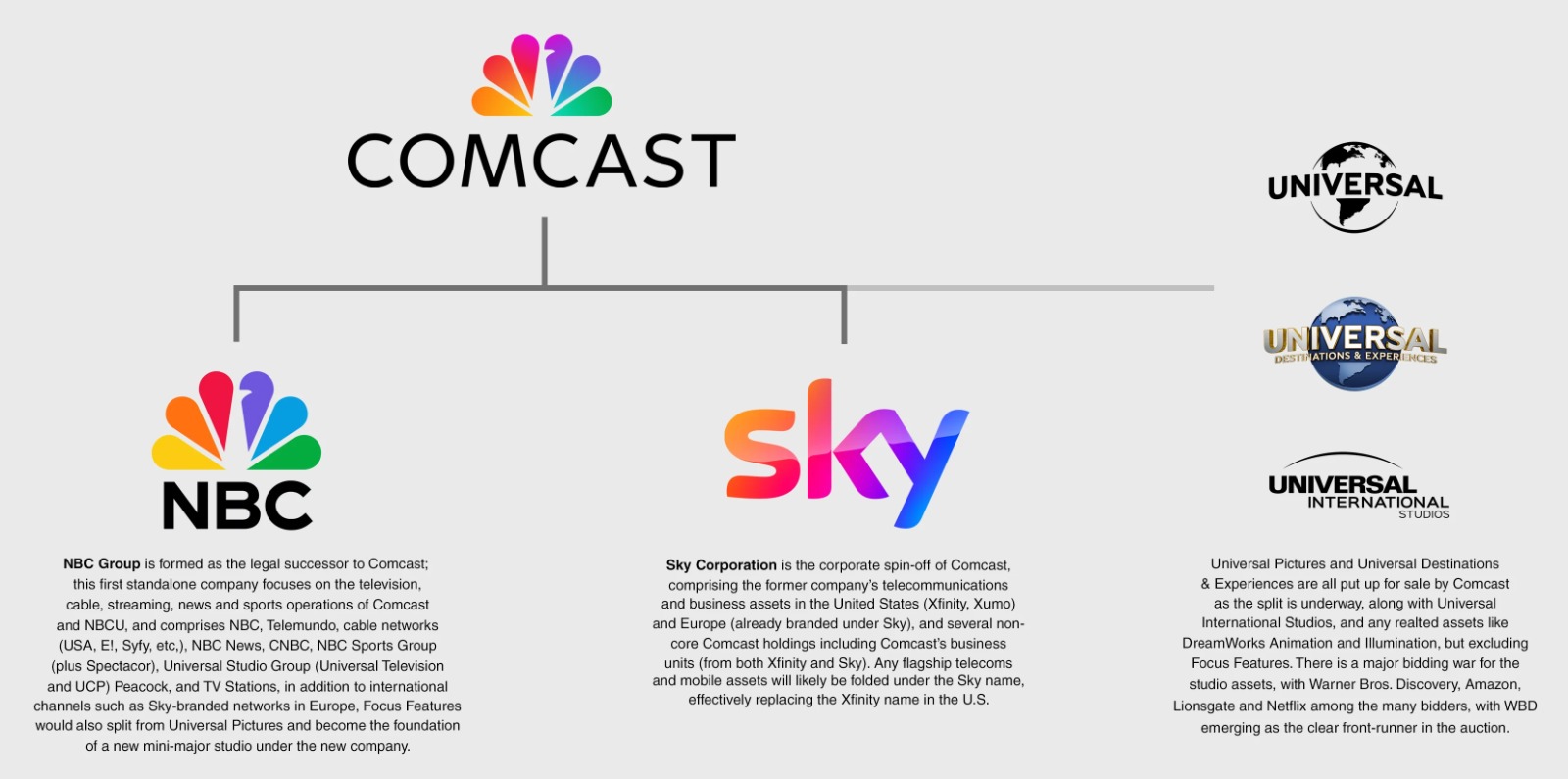
Under the finalized transaction framework, the division will explicitly separate Comcast's core connectivity and infrastructure platforms from its content creation, theatrical, and broadcasting wings. The first company will retain the foundational Comcast corporate branding, operating primarily as a pure-play technology and connectivity specialist. This entity will manage the company's high-capacity domestic broadband networks, regional wireless operations, and Xfinity-branded consumer systems, which collectively service over 65 million residential and commercial accounts across the United States.
The second standalone public enterprise will operate under the unified NBCUniversal banner, housing a premier global collection of entertainment, media, and theme park assets. This operational footprint includes the core NBC broadcast network, Universal Pictures film studios, the Peacock direct-to-consumer streaming service, and international theme park destinations. Additionally, the European media giant Sky Group, which Comcast acquired in 2018 for approximately $40 billion, will be fully integrated into this independent media company, consolidating its extensive international pay-TV and premium sports broadcasting distribution networks.
Executive Leadership Restructuring and Governance
The organizational separation will trigger an immediate realignment across the executive ranks. Longtime Chairman and Chief Executive Officer Brian L. Roberts is slated to maintain a central governance position, remaining actively involved in steering the strategic oversight of both independent corporations.
Operational control, however, will be cleanly bifurcated. Current Comcast President Mike Cavanagh will assume the role of Chief Executive Officer at the newly independent NBCUniversal entity, directly overseeing its multi-billion-dollar content production pipelines and global parks operations. Concurrently, Michael Angelakis, the former Chief Financial Officer of Comcast, will return to an executive operations role to serve as the Chief Executive Officer of the infrastructure-focused Comcast technology business. To ensure a smooth structural transition over the coming months, Angelakis has joined the executive office as a senior strategic advisor.
Shifting Dynamic of the Global Entertainment Sector
The corporate roadmap for Comcast to spin off NBCUniversal and Sky into separate companies marks an inflection point following a decade of aggressive media consolidation. Comcast initially secured a controlling stake in NBCUniversal from General Electric in 2011, before completing a full buyout in 2013. The subsequent purchase of Sky in 2018 was designed to build a vertically integrated global media delivery system capable of bundling distribution with premium entertainment content.
However, the rapid consumer shift away from linear television bundles toward digital streaming alternatives has rewritten the economics of the entertainment sector. The decision for Comcast to spin off NBCUniversal and Sky into separate companies allows the entertainment unit to manage its capital allocations toward high-growth content production and international streaming without competing against the capital-intensive infrastructure demands of broadband fiber build-outs.
Market Impact on Investors and Consumers
The structural separation carries practical implications for diverse financial and retail stakeholders:
For Equity Investors: Wall Street tracking shows that pure-play entities often achieve higher valuation multiples than heavily diversified conglomerates, allowing investors to isolate their capital exposure to either telecom infrastructure or media.
For Media Consumers: The separation is expected to streamline content licensing strategies, potentially leading to more targeted bundling partnerships involving the Peacock and Sky ecosystems.
For Broadband Customers: A standalone telecom entity can concentrate capital expenditure purely on upgrading next-generation fiber-optic and 5G wireless networks.
Official Sources Section
The transaction timelines and corporate asset allocations were validated through the statutory regulatory reports submitted to the U.S. Securities and Exchange Commission (SEC). All organizational structural paths and executive appointment details align with the official market notifications published via the Comcast Investor Relations Hub.
Quote Section
"According to officials, the proposed separation reflects Comcast's long-term track record of actively positioning its business units to compete in rapidly changing consumer markets. As technical innovation and consumer behaviors reshape media and communication, both firms will be optimized to pursue independent strategic priorities."
Why It Matters
The complex corporate maneuver for Comcast to spin off NBCUniversal and Sky into separate companies shows that the era of mega-mergers combining distribution pipelines with content networks is evolving. By operating as lean, independent enterprises, both companies can respond rapidly to competitive market shifts. NBCUniversal secures the financial freedom to participate in potential media sector consolidation, while Comcast protects its core utility cash flows from the inherent volatility of the global box office and content streaming wars.
Key Facts at a Glance
The Transaction: Comcast intends to execute a tax-free spin-off to split its media and technology businesses into two distinct public entities.
Timeline for Completion: The entire administrative and regulatory separation process is projected to conclude in approximately one year.
Core Separation Line: Telecom networks and Xfinity services remain with Comcast, while film, television, theme parks, Peacock, and Sky move to NBCUniversal.
Executive Appointments: Mike Cavanagh will transition to lead NBCUniversal as CEO, while Michael Angelakis assumes the CEO post at Comcast.
Frequently Asked Questions
Q: What happens to existing shares when Comcast decides to spin off NBCUniversal and Sky into separate companies? A: The corporate action is structured to be tax-free for tax purposes. Upon completion of the spin-off, current Comcast shareholders will receive pro-rata equity ownership shares in the newly independent NBCUniversal entity while retaining their core holdings in Comcast.
Q: Will consumer services like Xfinity broadband or the Peacock streaming app be disrupted? A: No immediate disruptions are projected for retail consumers. Both companies will continue to fulfill active subscription agreements, though long-term digital distribution partnerships will be managed through commercial cross-company contracts.
Q: Why is Sky being grouped with NBCUniversal instead of the core telecom business? A: While Sky operates a major direct-to-consumer pay-TV network across Europe, its underlying value is deeply tied to premium media, news, original content production, and sports broadcasting, aligning its structural goals with NBCUniversal's entertainment footprint.
Source: U.S. Securities and Exchange Commission Regulatory Filings, Comcast Corporate Press Room, Nasdaq Market Information Systems