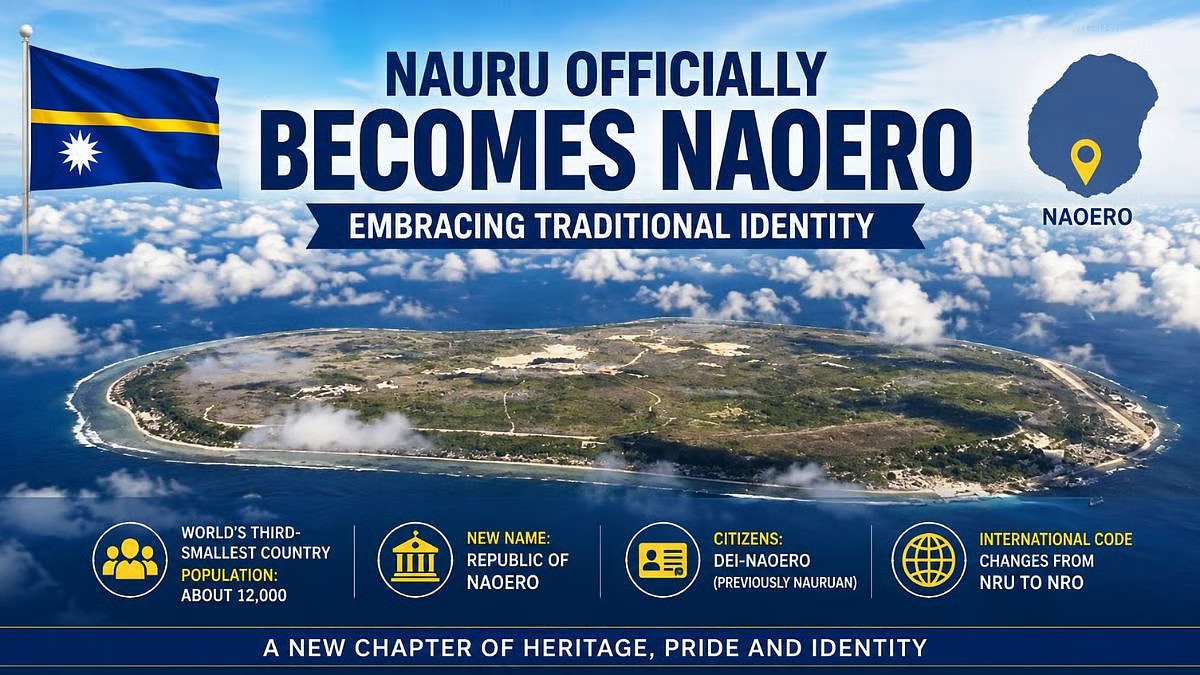
The Pacific island nation of Nauru has officially renamed itself the Republic of Naoero to restore its traditional indigenous identity. Backed by parliamentary approvals, the world's third-smallest country transitioned its international code from NRU to NRO while updating global diplomatic registries and local demonyms to dei-Naoero.
The Pacific island nation of Nauru has updated its official name to Naoero to honor its indigenous heritage and correct colonial-era spellings.
Overview of Naoero's Historic Name Change
YAREN — The Pacific island nation of Nauru, recognized as the world's third-smallest country by population, has officially changed its name to the Republic of Naoero. Announced by President David Adeang, the transition aligns the nation's global designation with the precise spelling and pronunciation used in the native Nauruan language.
Under the sweeping national update, the country's international code shifts from NRU to NRO, while its citizens will now be formally referred to as dei-Naoero instead of Nauruan. While the island was widely known abroad as "Now-roo," locals have consistently called their homeland "Now-ero". Government officials stated that the older international moniker was adopted during colonial history largely because foreign speakers struggled with native phonetics, making it a matter of administrative convenience rather than intentional choice.
The legislative process advanced swiftly after President Adeang introduced the proposal in January. Following parliamentary approval across two rounds of constitutional voting, authorities opted to waive a planned national referendum, noting that the traditional name already appeared on the national coat of arms and remained deeply embedded in daily community life.
Cultural Restoration and Global Integration
The decision places Naoero among a growing list of sovereign states reclaiming indigenous titles over colonial-era designations, following similar historical shifts by countries like Eswatini and Türkiye. For Naoero—a coral limestone atoll spanning just 21 square kilometers with roughly 12,000 residents—the change carries profound cultural significance.
The transition impacts various operational structures. Government registries, national aviation assets, and maritime vessels are undergoing rebranding to reflect the NRO designation. International bodies, including the United Nations and diplomatic missions representing Australia, New Zealand, the United States, and China, have already updated their official databases and public portals to reflect the name change.
Impact on Citizens, Diplomacy, and Governance
For local citizens, the shift represents an important step toward preserving a severely endangered native language and reinforcing national self-determination. Economically, the island continues to navigate unique challenges, including historical reliance on phosphate mining and modern vulnerabilities linked to rising sea levels.
By updating global registries, the government aims to project a unified cultural identity on the world stage. Travelers, shipping logistics coordinators, and international investors interacting with the island must update financial compliance systems and travel documentation references to align with the new NRO country code.
Official Sources Section
The administrative updates, legislative timelines, and presidential addresses regarding the renaming are based on official government announcements and statements released by the Office of the President of the Republic of Naoero, alongside international regulatory tracking reports from The Associated Press and Reuters.
Quote Section
"According to officials and statements released by President David Adeang's administration, 'This proposed change seeks to more faithfully honour our nation's heritage, our language, and our identity, marking the beginning of renewed national pride.'"
Why It Matters
Reclaiming the traditional name of Naoero corrects a historical mismatch imposed by foreign colonizers. For global institutions, mapmakers, and financial networks, the transition requires updating international codes from NRU to NRO. More broadly, it underscores an ongoing global movement where small island developing states assert cultural sovereignty and preserve ancestral heritage against the backdrop of modern globalization.
Key Facts at a Glance
New Official Name: The country is now formally designated as the Republic of Naoero.
International Code Update: The nation's ISO-style country code shifts from NRU to NRO.
Demonym Change: Citizens of the island will now be known as dei-Naoero.
Population Scale: Home to approximately 12,000 residents, Naoero remains the world's third-smallest nation by population.
FAQ Section
Why did Nauru change its name to Naoero?
The government changed the name to correct a colonial-era spelling adaptation and honor the traditional indigenous name used by locals in their native language.
What is the new international country code for Naoero?
Following the administrative update, the country's official international code has changed from NRU to NRO.
How do you pronounce the new name?
The name is pronounced "Now-ero," replacing the previous international pronunciation of "Now-roo".
Will international organizations recognize the updated name?
Yes. The United Nations and foreign diplomatic missions, including those of Australia, New Zealand, the US, and China, have already updated their official platforms to reflect Naoero.
Source: Office of the President of Naoero, The Associated Press, Reuters