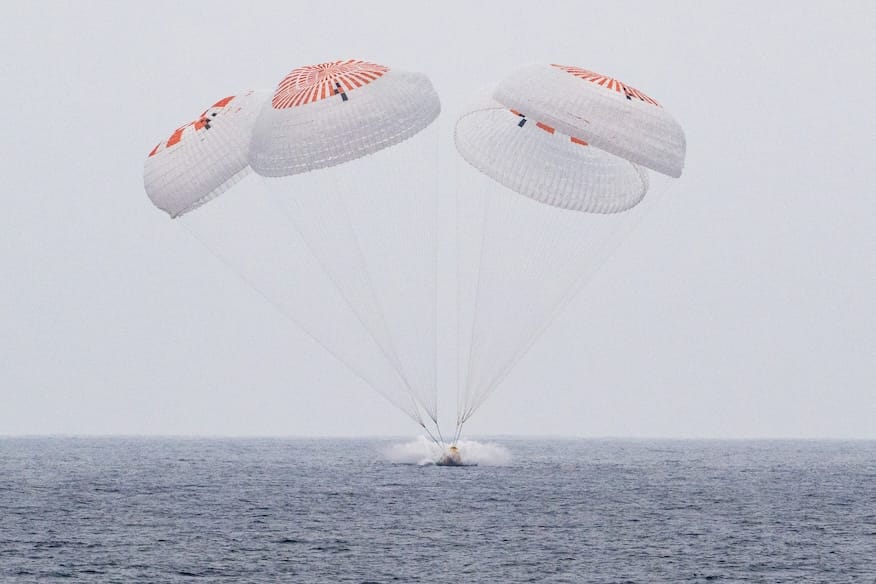
After nearly five months in orbit, SpaceX’s Crew-10 astronauts have safely returned to Earth, marking the successful completion of a mission that advanced scientific research, international collaboration, and commercial spaceflight reliability. The crew splashed down in the Pacific Ocean of...
After nearly five months in orbit, SpaceX’s Crew-10 astronauts have safely returned to Earth, marking the successful completion of a mission that advanced scientific research, international collaboration, and commercial spaceflight reliability. The crew splashed down in the Pacific Ocean off the coast of San Diego on August 9, 2025, concluding a 148-day journey aboard the International Space Station (ISS).
Mission Overview and Return Details
1. Crew Composition and Timeline
The Crew-10 team included NASA astronauts Anne McClain and Nichole Ayers, Japan Aerospace Exploration Agency (JAXA) astronaut Takuya Onishi, and Roscosmos cosmonaut Kirill Peskov.
- Launched on March 14, 2025, aboard a SpaceX Falcon 9 rocket from Kennedy Space Center
- Docked with the ISS on March 16 after a 29-hour journey
- Undocked on August 8 and splashed down on August 9 at 11:33 a.m. Eastern Time
- Total time in orbit: 148 days, with over 2,368 Earth orbits and nearly 63 million miles traveled
The crew returned aboard the SpaceX Dragon capsule named Endurance, which autonomously navigated the descent and re-entry. The capsule endured temperatures up to 3,500 degrees Fahrenheit during atmospheric re-entry before deploying parachutes at 18,000 feet for a smooth splashdown.
2. Scientific Contributions and Experiments
Crew-10 conducted hundreds of experiments across biology, material science, and human physiology.
- Studied plant and microalgae growth in microgravity
- Investigated space radiation’s impact on DNA sequences in plants
- Observed changes in human eye structure and cellular behavior under zero gravity
- Demonstrated technologies critical for long-duration missions to the Moon and Mars
McClain and Ayers also completed a spacewalk on May 1, relocating a communications antenna and preparing for future solar array installations.
Reflections and Legacy
1. Crew Sentiments and Global Message
During a handover ceremony with Crew-11, the astronauts reflected on their experience. Commander Anne McClain emphasized the mission’s symbolic value, stating that it represented what humanity can achieve through cooperation.
- Crew-10’s return coincides with the ISS approaching its 25th anniversary of continuous human presence
- McClain highlighted the station as one of the greatest feats of international collaboration
The crew acknowledged the geopolitical tensions on Earth but underscored the importance of unity in space exploration.
2. Commercial Spaceflight Milestone
Crew-10’s safe return reinforces SpaceX’s role in reliable commercial crew operations.
- The Dragon capsule used for Crew-10 had previously flown missions for Crew-
3, Crew-5, and Crew-7
- The Falcon 9 rocket used in the launch marked its second flight, showcasing reusability and cost-efficiency
NASA and SpaceX streamed the re-entry live, offering space enthusiasts a front-row seat to the mission’s conclusion.
Post-Mission Plans and Recovery
After splashdown, the crew was retrieved by SpaceX recovery teams and transported to NASA’s Johnson Space Center in Houston. They will undergo medical evaluations and reunite with their families before beginning post-flight debriefings and data analysis.
Crew-10’s return marks another chapter in humanity’s journey beyond Earth. From groundbreaking research to symbolic unity, the mission stands as a testament to what can be achieved when nations and innovators work together. As the ISS prepares to celebrate 25 years of continuous human presence, Crew-10’s legacy will inspire future explorers heading to the Moon, Mars, and beyond.
Sources: NASA, The Hill, ABP Live, Yahoo News, India Today