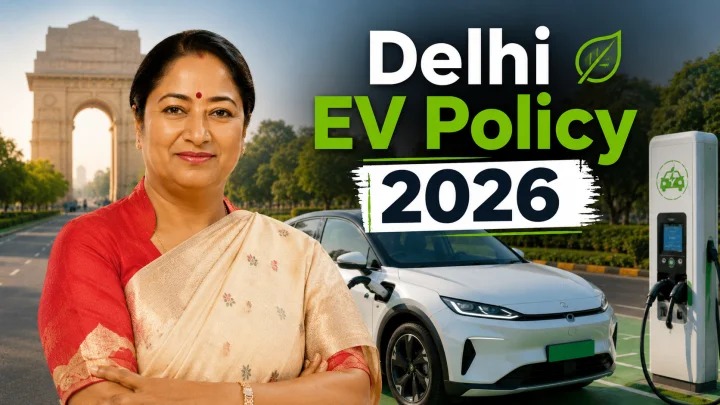
The Delhi government has approved a ₹15,000-crore EV Policy 2.0, mandating a transition to electric two-wheelers and commercial vehicles by 2028. The policy, effective July 1, 2026, aims to curb pollution through purchase subsidies and a phased ban on new ICE vehicle registrations, significantly impacting the broader automotive sector.
NEW DELHI — The Delhi Cabinet, led by Chief Minister Rekha Gupta, officially approved a comprehensive new Electric Vehicle (EV) Policy on June 29, 2026, aimed at accelerating the city's transition to cleaner transportation. The policy, which commits a ₹15,000-crore budget to be invested over the next four years, introduces stringent registration deadlines for internal combustion engine (ICE) vehicles while providing significant financial incentives for EV adoption.
Effective July 1, 2026, the policy will remain in force until March 31, 2030. According to the state government, the move is designed to address Delhi's chronic air pollution, with transport sectors—specifically two-wheelers and commercial goods carriers—identified as primary contributors to poor air quality.
Mandatory Phase-out of ICE Vehicles
The policy sets a definitive timeline for the electrification of Delhi’s vehicle fleet. Starting January 1, 2027, the city will mandate that only electric three-wheelers and N1 category goods carriers be eligible for new registration. This mandate will extend to two-wheelers beginning April 1, 2028.
"We are trying to convert the entire fleet of these vehicles into EV," stated the Transport Commissioner. The initiative also requires school bus operators to convert at least 10% of their existing fleets to electric within two years of the notification. To support this transition, the government plans to install 32,000 charging points across the capital over the next four years.
Market Impact and Investor Reaction
The announcement has triggered a mixed response in the stock market. While the policy provides a long-term roadmap for EV manufacturers, shares of major automobile companies faced downward pressure on Tuesday, falling up to 7% in intra-day trading on the National Stock Exchange (NSE).
Market analysts suggest that the sector's volatility stems from concerns over the rapid pace of the transition. Automobile manufacturers are reportedly re-evaluating their investment strategies and product launch plans in light of the phased ban on ICE registrations. Conversely, pure-play electric vehicle firms saw positive movement, with some reaching new highs as investors anticipate increased demand driven by the government's purchase incentives. The policy notably excludes hybrids from these subsidies, a move that surprised some industry stakeholders.
Official Incentives and Support
According to official government releases, the incentive structure is tiered to encourage early adoption:
Two-wheelers: Purchase incentives of ₹30,000 in the first year, ₹20,000 in the second, and ₹10,000 in the third.
Three-wheelers: Incentives of ₹50,000, ₹40,000, and ₹30,000 across the first three years.
N1 Commercial Trucks: A subsidy of ₹1 lakh in the first year.
Scrappage: Benefits ranging from ₹10,000 to ₹1 lakh are available for owners who scrap older BS-IV vehicles to switch to EVs.
Why It Matters
The practical implications for consumers and businesses in Delhi are significant. For individual buyers, the subsidies provide a lower barrier to entry for EV ownership, while businesses managing commercial fleets must now pivot their procurement strategies to comply with the 2027 and 2028 registration mandates. By setting these firm deadlines, the Delhi government is positioning itself as a leader in India's electric mobility transition, potentially setting a precedent that other Indian states may adopt.
Key Facts at a Glance
Total Budget: ₹15,000 crore allocated for electric mobility promotion over four years.
Registration Bans: No new ICE three-wheelers/N1 trucks after Jan 1, 2027; no new ICE two-wheelers after April 1, 2028.
Charging Infrastructure: Goal of establishing 32,000 public charging points by 2030.
Hybrid Exclusion: The policy clarifies that subsidies apply strictly to battery-powered electric vehicles, excluding hybrid models.
FAQ
Does the new policy cover hybrid vehicles?
No, the Delhi government has explicitly stated that incentives are reserved for pure electric vehicles and will not be provided for hybrid models.
What happens to my current petrol-powered two-wheeler?
The policy affects new registrations. Existing ICE vehicles can continue to operate, though owners are encouraged to scrap older BS-IV models for a subsidy of up to ₹10,000 when switching to an EV.
Why are auto manufacturers concerned?
Manufacturers fear that the aggressive timeline for phasing out ICE registrations could disrupt current supply chains and force sudden shifts in R&D and production priorities.
Are there subsidies available for charging installation?
Yes, the policy includes provisions for funding charging infrastructure development through a combination of the PM e-Drive scheme and the Delhi state budget.
Source: Government of Delhi (Transport Department), National Stock Exchange (NSE), The Hindu