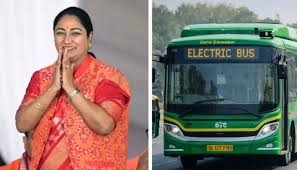
The Delhi government is launching 56 women-only electric buses across 28 high-demand routes to improve safety and accessibility. The initiative, featuring CCTV and panic buttons, serves working women and students, with services integrated into the digital Pink Saheli Smart Card system for free, seamless travel across the capital.
New dedicated network across 28 high-footfall corridors aims to enhance safety, accessibility, and sustainable mobility for women commuters in the capital.
NEW DELHI — The Delhi government has announced the launch of a dedicated network of 56 women-only electric bus services, a strategic move designed to improve public transport safety and convenience for working women and girl students across the national capital. Transport Minister Dr. Pankaj Kumar Singh confirmed that these services will operate across 28 high-footfall corridors, providing a secure and environmentally friendly commuting option.
Expanding Sustainable Transport
The new network, to be operated by the Delhi Transport Corporation (DTC), consists of two primary service categories tailored to meet peak-hour demand.
Ladies Special Services: 30 buses will operate on 15 busy city routes, connecting key employment centers, commercial districts, institutional hubs, and Metro interchange stations.
University Ladies Special (U-SPL) Services: 26 buses will cover 13 routes, specifically linking major residential areas such as Najafgarh, Rohini, Janakpuri, Mundka, Mayur Vihar, Kalkaji, Palla, and Dhaula Kuan directly with Delhi University’s North and South Campuses and other prominent educational institutions.
The initiative utilizes a 100% electric fleet, reinforcing the government’s commitment to sustainable mobility while addressing the specific travel needs of women during early morning and late evening hours.
Enhanced Safety and Accessibility
According to the Delhi government, each of the 56 electric buses is equipped with advanced safety and accessibility features. These include:
Surveillance and Emergency Support: CCTV cameras and panic buttons directly linked to the Operation Control Centre (OCC).
Inclusive Infrastructure: Disabled-friendly low-floor ramps to ensure ease of access.
Support Staff: Bus marshals or female police personnel will be deployed where required to ensure commuter security.
Digital Integration: The services are integrated with the "Pink Saheli Smart Card" system, enabling eligible women to continue availing free travel benefits seamlessly.
Official Sources
The initiative was formally announced by Transport Minister Dr. Pankaj Kumar Singh on July 15, 2026. All operational details regarding route identification and fleet deployment are managed by the Delhi Transport Corporation (DTC) in accordance with the state's public transport vision.
Why It Matters
This expansion of women-only electric bus services represents a significant step toward making Delhi’s public transport more inclusive. By focusing on high-density corridors and aligning schedules with office and college hours—morning trips between 7:52 am and 9:00 am, and return trips between 4:32 pm and 6:15 pm—the government aims to reduce overcrowding and provide a dependable, dignified commuting environment. The move also aligns with the broader transition to a fully digital, smart-card-based fare system for free travel in the capital.
Key Facts at a Glance
Total Fleet: 56 women-only electric buses.
Coverage: 28 high-footfall corridors.
Primary Users: Working women and girl students.
Key Technology: 100% electric, CCTV surveillance, and panic buttons.
Fare System: Integrated with the Pink Saheli Smart Card.
FAQ
What are the peak operating hours for these buses?
The Ladies Special services operate in both directions during office peak hours: 7:52 am to 9:00 am and 4:32 pm to 6:15 pm.
Can I use a paper pink ticket on these buses?
No, the Delhi government is transitioning to a digital system. From August 1, 2026, the Pink Saheli Smart Card will be the mandatory mode for availing free travel; paper pink tickets will no longer be valid.
How were the routes selected?
Routes were identified based on corridors witnessing the highest movement of women passengers, specifically targeting employment hubs and educational campuses.
Source: ET Infra, Hindustan Times, India Today, UNI India