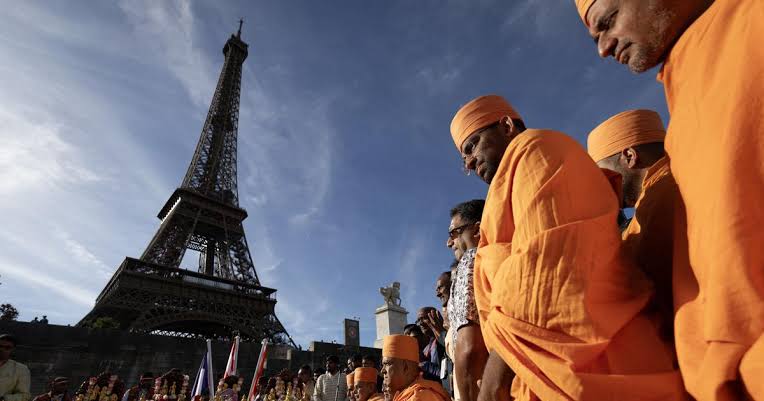
The Eiffel Tower temporarily closed following a staff strike protesting instructions that sidelined female employees during a tour by the Hindu group BAPS. BAPS monks practice strict celibacy vows avoiding interaction with women. Site operator SETE admitted the conditions should have been rejected, while BAPS apologized for workplace disruption caused.
PARIS — The Eiffel Tower temporarily closed its doors to international tourists on Monday after employee trade unions organized a protest walkout. Workers voiced outrage over instructions given during a private weekend visit by a delegation affiliated with the prominent Hindu religious organization Bochasanwasi Akshar Purushottam Swaminarayan Sanstha (BAPS). The incident has rapidly evolved into a high-profile debate across France regarding public secularism, labor rights, and gender equality in civil spaces.
The Eiffel Tower Walkout
The dispute originated during a morning tour on Saturday, September 5, when approximately 100 members linked to the BAPS organization visited the Eiffel Tower. The delegation was in France to celebrate the consecration of a newly built traditional Hindu temple in Bussy-Saint-Georges, an eastern suburb of Paris.
Trade union representatives representing tower staff, notably the Confédération Générale du Travail (CGT), alleged that female employees were instructed by site management to withdraw from their primary workstations as the delegation passed. Staff reported that female security and operations personnel were asked to relocate to secondary areas or had their posts temporarily filled by male colleagues to ensure the religious delegation encountered minimal interactions with women.
By Monday morning, staff held an extraordinary general meeting to register their objections, halting visitor access and leaving hundreds of tourists waiting beneath the monument.
Understanding BAPS: History and Monastic Practice
The Bochasanwasi Akshar Purushottam Swaminarayan Sanstha, commonly known as BAPS, is a major socio-spiritual denomination within Swaminarayan Hinduism. Established formally in 1907 in Gujarat, India, by Shastriji Maharaj, the global organization currently maintains more than 1,300 temples and spiritual centres worldwide, including major Akshardham complexes in New Delhi, Gandhinagar, London, and New Jersey. The movement is led by its spiritual guru, 92-year-old Mahant Swami Maharaj.
The controversy at the monument stems from strict monastic vows practiced by ordained sadhus (monks) within the Swaminarayan tradition. BAPS monks practice absolute lifelong celibacy (nishkam), which traditionally includes strict rules prohibiting physical contact, direct eye contact, or unstructured social interaction with women. While the broader organization engages millions of male and female householder devotees worldwide and participates extensively in humanitarian activities, this ascetic rule requires monks to maintain separation from women in both ritual and personal settings.
Official Responses and Political Repercussions
Société d'Exploitation de la Tour Eiffel (SETE), the operational company managing the site, acknowledged the incident and conceded that special conditions requested ahead of the tour were handled improperly. SETE confirmed that the delegation requested arrangements to limit interactions with female staff members, stating clearly that such operational conditions should never have been accepted by management. SETE President Ariel Weil reaffirmed the monument's allegiance to secularism and equal opportunity under the French Republic.
The BAPS Paris organization issued a formal statement expressing regret over the workplace tensions while clarifying its intentions. BAPS stated that the early morning visit was coordinated strictly for group logistics and crowd management rather than systemic discrimination. The organization reiterated that it never intended to sideline workers based on sex and apologized for any distress or inconvenience experienced by the monument's staff.
French political figures strongly condemned the operational instructions. Paris Mayor Emmanuel Grégoire described the treatment of female staff as unacceptable and supported calls for an internal administrative inquiry. National Assembly President Yaël Braun-Pivet emphasized that public spaces in France require absolute gender visibility and equality, stating that no visiting party's cultural customs should supersede French labor values.
Official Sources
Official positions regarding the event were established through:
Statements released by the monument's management operator, Société d'Exploitation de la Tour Eiffel (SETE).
Formal communiqués published by the Confédération Générale du Travail (CGT) staff union.
Public response filings and social media statements issued by the BAPS Paris Mandir committee.
Regular briefing responses provided by India’s Ministry of External Affairs (MEA), which noted that the matter remains strictly between the local entities and venue management.
Quotes
"During the visit of this delegation, women were asked to leave their places of work in order to place men there. Tensions mounted over the weekend, and employees decided to meet to ensure women are never treated this way again."
— Diane Davoine, Eiffel Tower Union Representative (CGT)
"The conditions requested to limit interactions with women should not have been accepted. It is clearly not an acceptable practice, and we restate the monument's commitment to republican values and equality."
— Ariel Weil, President of the Société d'Exploitation de la Tour Eiffel (SETE)
"The visit was arranged in conjunction with the Eiffel Tower team to avoid disrupting others. It was never intended as a request rooted in gender, and we sincerely apologize for any pain or inconvenience caused."
— BAPS Paris Representatives, in an official response statement
Why It Matters
The controversy highlights the ongoing tension between private religious observances and the strict public secularism (laïcité) and labor laws of host countries like France. For commercial operators, municipal bodies, and international delegations, the event underscores that workplace equality protections under statutory labor codes—such as Article L. 1132-1 of the French Labour Code—supersede accommodations made for visiting religious dignitaries.
Key Facts at a Glance
The Incident: Staff at the Eiffel Tower walked out on Monday after female workers were allegedly instructed to vacate work posts during a Hindu group's visit.
The Organization: BAPS is a prominent socio-spiritual Hindu denomination founded in Gujarat in 1907, known for building expansive Akshardham temples worldwide.
The Monastic Custom: BAPS monks follow strict historic vows of lifelong celibacy requiring separation and minimal contact with women.
Management Finding: Site operator SETE admitted the group's accommodation requests regarding female interaction were mistakenly approved and should have been rejected.
Frequently Asked Questions
What is BAPS?
Bochasanwasi Akshar Purushottam Swaminarayan Sanstha (BAPS) is a global Hindu sect within Swaminarayan Hinduism. Established in 1907, it has millions of followers and operates more than 1,300 temples internationally.
Why was the Eiffel Tower closed on Monday?
Tower staff represented by French labor unions staged a strike and held an operational meeting to protest instructions that temporarily relocated female employees away from a visiting religious delegation.
Why do BAPS monks avoid interaction with women?
Ordained ascetics (sadhus) within the tradition take vows of eight-fold celibacy, which mandate avoiding direct contact, proximity, and unstructured interactions with women as part of their monastic discipline.
Did BAPS issue an apology?
Yes. BAPS Paris released a public statement stating that the visit was coordinated purely to avoid public disruption, adding that it respects mutual equality and apologizes for any hurt or inconvenience caused to workers.
Source: Official statements via Société d'Exploitation de la Tour Eiffel (SETE), employee representations from Confédération Générale du Travail (CGT), press releases by BAPS Swaminarayan Sanstha, and media briefing records from the Ministry of External Affairs (MEA), Government of India.