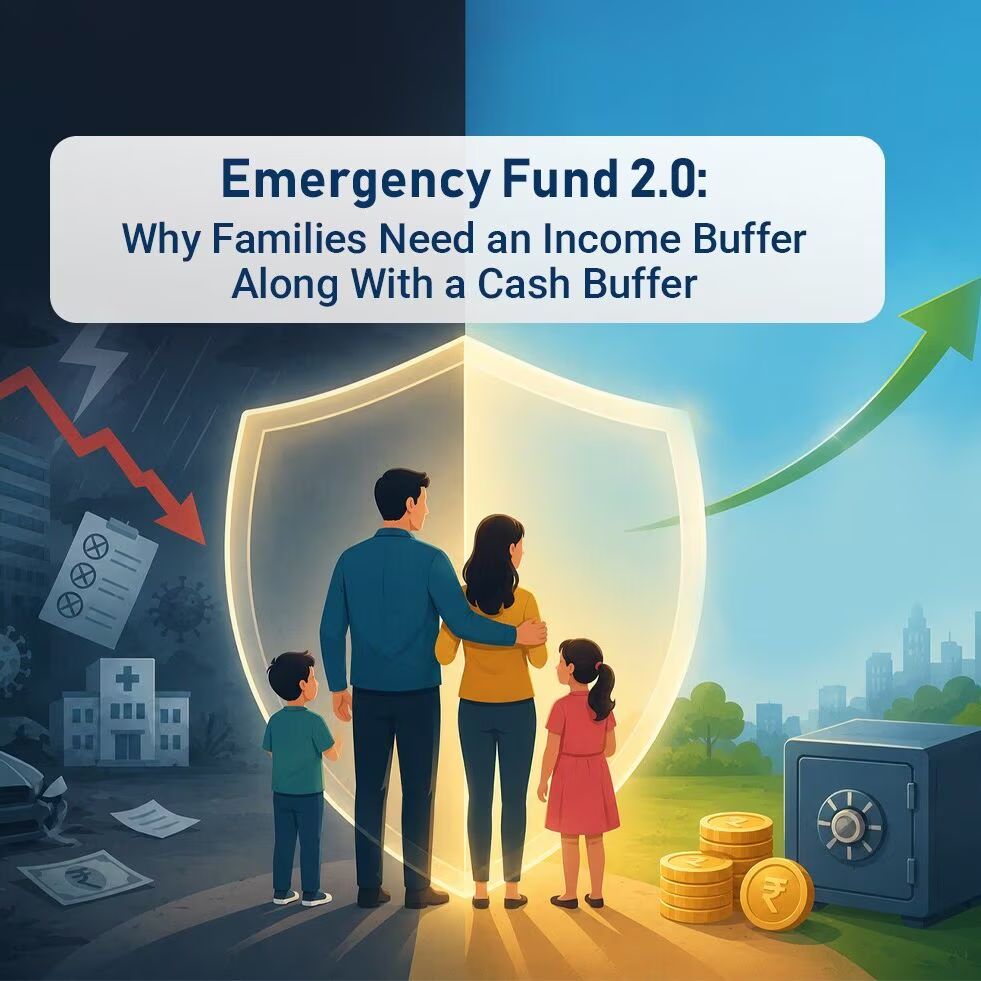
Financial planners advise that traditional cash emergency funds may fall short during extended career disruptions. Introducing "Emergency Fund 2.0," experts recommend combining a standard six-month liquid cash reserve with an income-generating bond portfolio. This two-tiered strategy produces regular cash flows to cover fixed household expenses like EMIs and school fees.
Backed by financial planning insights, modern households are adopting a two-layered resilience strategy combining liquid savings with income-generating assets.
As corporate restructuring, extended job searches, and sudden career breaks become increasingly common across urban centers, traditional financial safety nets are undergoing a strategic re-evaluation. Historically, personal finance advisors recommended maintaining a fixed pool of liquid cash equivalent to three to six months of living expenses. However, financial analysts note that when primary salary streams halt for prolonged periods, fixed household liabilities—such as home loan EMIs, children's school fees, healthcare costs, and insurance premiums—continue unabated. To bridge this vulnerability, wealth management experts are advocating for "Emergency Fund 2.0," a framework that pairs a traditional cash reserve with a dedicated income-producing asset buffer.
Limitations of Pure Cash Reserves and the Rise of Income Buffers
While a conventional cash buffer stored in savings accounts or liquid mutual funds provides immediate transactional access during minor shocks, it suffers from severe depletion rates during extended crises. Inflation erodes purchasing power over time, and a purely static cash pool will eventually run dry if a household's primary income source remains disrupted for a year or longer.
To counteract this, financial planners suggest establishing an income buffer—a gradual, disciplined portfolio built using suitable yield-generating instruments like high-quality bonds.
Complementary Design: The income buffer does not replace liquid emergency savings; rather, it operates alongside cash reserves to alleviate pressure on accumulated wealth.
Periodic Cash Flows: By deploying capital into structured fixed-income products via Online Bond Platform Providers (OBPP), families can secure regular interest payouts to cover recurring essentials.
Corpus Growth: During normal economic periods, periodic returns can be automatically reinvested, compounding the corpus until it is required to support household expenditures.
Practical Implementation and Wealth Management Impact
Constructing a dual-layer financial defense requires strategic milestone planning. Financial consultants suggest that a typical family with heavy structural commitments maintain a baseline liquid emergency fund covering six to eight months of expenses (roughly ₹6 lakh to ₹8 lakh). Concurrently, building a separate bond or income-generating portfolio—targeted at yielding supplemental cash flow—can extend a household's financial runway indefinitely.
For retail investors and salaried professionals, starting early—such as a few years prior to acquiring major liabilities like real estate mortgages—allows the income-generating corpus sufficient time to compound. This proactive approach shields long-term wealth investments, such as retirement equity funds, from premature distress liquidation during unexpected economic downturns.
Why It Matters
Relying solely on liquid cash can leave households vulnerable during prolonged economic downturns; adopting a two-tiered model safeguards long-term goals while ensuring continuous cash flow for essential liabilities.
Key Facts at a Glance
Layer One: Traditional cash buffer consisting of 6 to 8 months of essential expenses held in liquid instruments.
Layer Two (Emergency Fund 2.0): An income buffer composed of bonds or yield-generating assets designed to supply periodic cash flows.
Primary Objective: Protecting long-term investments from distress liquidation during prolonged job losses or career breaks.
Execution Strategy: Reinvesting periodic yields during stable years to compound the corpus before financial responsibilities peak.
FAQ Section
What is the main difference between a cash buffer and Emergency Fund 2.0?
A traditional cash buffer provides immediate, short-term liquidity for sudden, urgent expenses, whereas Emergency Fund 2.0 introduces an income-generating asset layer (like bonds) to provide steady periodic cash flows during prolonged income disruptions.
Does an income buffer replace a standard emergency fund?
No. Financial planners emphasize that an income buffer complements—rather than replaces—liquid cash reserves, ensuring families have both immediate cash access and ongoing cash flow support.
How can a bond portfolio help during a career break?
While liquid savings handle immediate survival needs during the initial weeks of a job loss, an income buffer portfolio continuously generates interest payouts to help cover fixed monthly costs like EMIs and school fees.
Where can investors review structured guidance on building dual-layer safety nets?
Detailed expert frameworks and consumer investment strategies are accessible publicly via Livemint Personal Finance Coverage.
Source: Livemint Personal Finance Coverage, Treasury Financial Insights