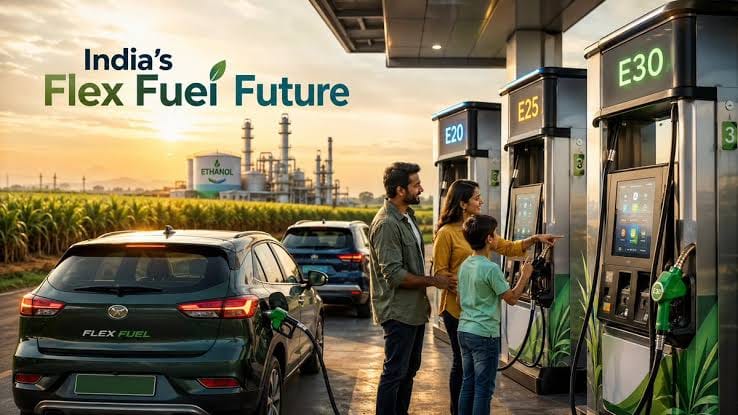
The Indian Federation of Green Energy (IFGE) announced that ethanol and electric vehicles must coexist to drive India's clean mobility transition. Official ARAI and SIAM testing confirms E20 petrol mileage drops by just 2 to 6 percent, offering an immediate decarbonization solution for 300 million legacy vehicles while preserving foreign exchange reserves.
NEW DELHI — The Indian Federation of Green Energy (IFGE) on August 10, 2026, issued a official statement advocating for a diversified clean mobility framework where bio-ethanol, electric vehicles (EVs), compressed natural gas (CNG), hybrids, and hydrogen operate as complementary technologies. Addressing growing public debate regarding E20 petrol compatibility and vehicle mileage loss, the renewable energy advocacy organization clarified that tests conducted by technical bodies show a limited fuel efficiency reduction of 2 to 6 percent. IFGE emphasized that ethanol blending provides an immediate decarbonization pathway for India’s existing fleet of nearly 300 million internal combustion engine (ICE) vehicles while electric vehicle manufacturing scales across the country.
Technical Data Refutes Widespread Engine Damage Claims
Addressing consumer apprehensions regarding E20 fuel—a blend of 20 percent ethanol and 80 percent petrol—IFGE cited research data from the Automotive Research Association of India (ARAI), Indian Oil Corporation, and the Society of Indian Automobile Manufacturers (SIAM). Comprehensive testing indicates that the shift from E10 to E20 petrol causes a modest drop in fuel efficiency ranging between 2 and 6 percent.
Furthermore, IFGE confirmed that empirical testing revealed no evidence of widespread engine damage or mechanical failure attributable to E20 fuel. Automakers manufacturing vehicles in India have incorporated ethanol-compatible materials across fuel lines and engine components. Industry experts noted that operational concerns are primarily confined to older, non-compliant vehicles, which require routine maintenance checks on rubber gaskets and fuel injectors.
Strategic Need for Coexistence Between Ethanol and EVs
The federation highlighted that India’s transition to zero-emission transit cannot rely on a single technology. While electric vehicle adoption continues to expand across two-wheeler, three-wheeler, and passenger car segments, millions of conventional engine vehicles will remain active on Indian roads over the next decade.
Dilip Patil, Regional Director of IFGE-West in Pune, stressed that framing national policy as an "ethanol versus EVs" narrative creates counterproductive policy divisions. Instead, biofuels act as a functional bridge technology, providing immediate carbon reductions for internal combustion engines while charging infrastructure and power grids undergo long-term expansion.
Macroeconomic Gains and Foreign Exchange Reserves Impact
The implementation of the Ethanol Blending Program (EBP) continues to yield substantial macroeconomic benefits. Official figures released by the Ministry of Petroleum and Natural Gas show that bio-fuel blending has delivered major financial and environmental savings:
Foreign Exchange Preservation: India saved more than ₹1.97 lakh crore in foreign exchange outlays since Ethanol Supply Year (ESY) 2014-15.
Crude Import Reduction: The program successfully substituted nearly 316 lakh metric tonnes of imported crude oil.
Agricultural Income Support: Direct procurement of ethanol feedstocks—including sugarcane juice, B-heavy molasses, and damaged food grains—boosted liquidity across rural farming communities.
Official Sources Section
According to official releases, government reports, and industry filings:
Indian Federation of Green Energy (IFGE): Official media release and executive briefing issued by Dilip Patil, Regional Director, IFGE-West.
Ministry of Petroleum and Natural Gas: Official figures on foreign exchange savings and crude oil substitution under the Ethanol Blending Program.
Testing Authorities: Technical data compiled by the
Automotive Research Association of India (ARAI),
Indian Oil Corporation, and the
Society of Indian Automobile Manufacturers (SIAM).
Quote Section
"The debate should not be framed as ethanol versus EVs; India needs both," stated Dilip Patil, Regional Director of IFGE-West, Pune. "E20 provides an immediate pathway to reduce crude oil dependence and strengthen energy security, while EVs, hybrids, and other technologies continue to scale across the country."
Why It Matters
The clarification from IFGE addresses widespread consumer anxiety regarding fuel efficiency loss and potential engine degradation caused by E20 petrol. By demonstrating that E20 petrol mileage drop is limited to 2 to 6 percent, the findings reassure vehicle owners while confirming the strategic role of ethanol blending in lowering crude imports and reducing greenhouse gas emissions across 300 million existing ICE vehicles.
Key Facts at a Glance
Complementary Strategy: IFGE states ethanol blends and EVs must coexist to manage India's energy transition.
Limited Mileage Impact: Testing by ARAI, SIAM, and Indian Oil confirms an E20 mileage drop of only 2% to 6%.
Legacy Fleet Management: E20 offers immediate emission cuts for 300 million legacy ICE vehicles.
Economic Benefit: Ethanol blending has saved over ₹1.97 lakh crore in foreign exchange since 2014-15.
FAQ Section
Q1: What is E20 petrol and why is it used in India?
E20 petrol is a blend of 20 percent bio-ethanol and 80 percent conventional petrol used to reduce greenhouse gas emissions, cut crude oil imports, and support domestic agricultural production.
Q2: How much does E20 petrol reduce vehicle mileage?
According to official studies by ARAI, Indian Oil, and SIAM, E20 petrol causes a modest 2 to 6 percent reduction in fuel efficiency compared to E10 petrol.
Q3: Does E20 petrol damage car and motorcycle engines?
No widespread engine damage has been reported in official testing. Vehicles manufactured in India feature ethanol-compatible components, though owners of older legacy vehicles should perform routine fuel system maintenance.
Q4: Why does IFGE state that EVs and ethanol must coexist?
IFGE states both are needed because India has nearly 300 million internal combustion engine vehicles on the road that require immediate decarbonization, while EV manufacturing and charging networks continue to scale.
Source: Official statements issued by the Indian Federation of Green Energy (IFGE), data from the Ministry of Petroleum and Natural Gas, and joint testing reports by SIAM and ARAI.