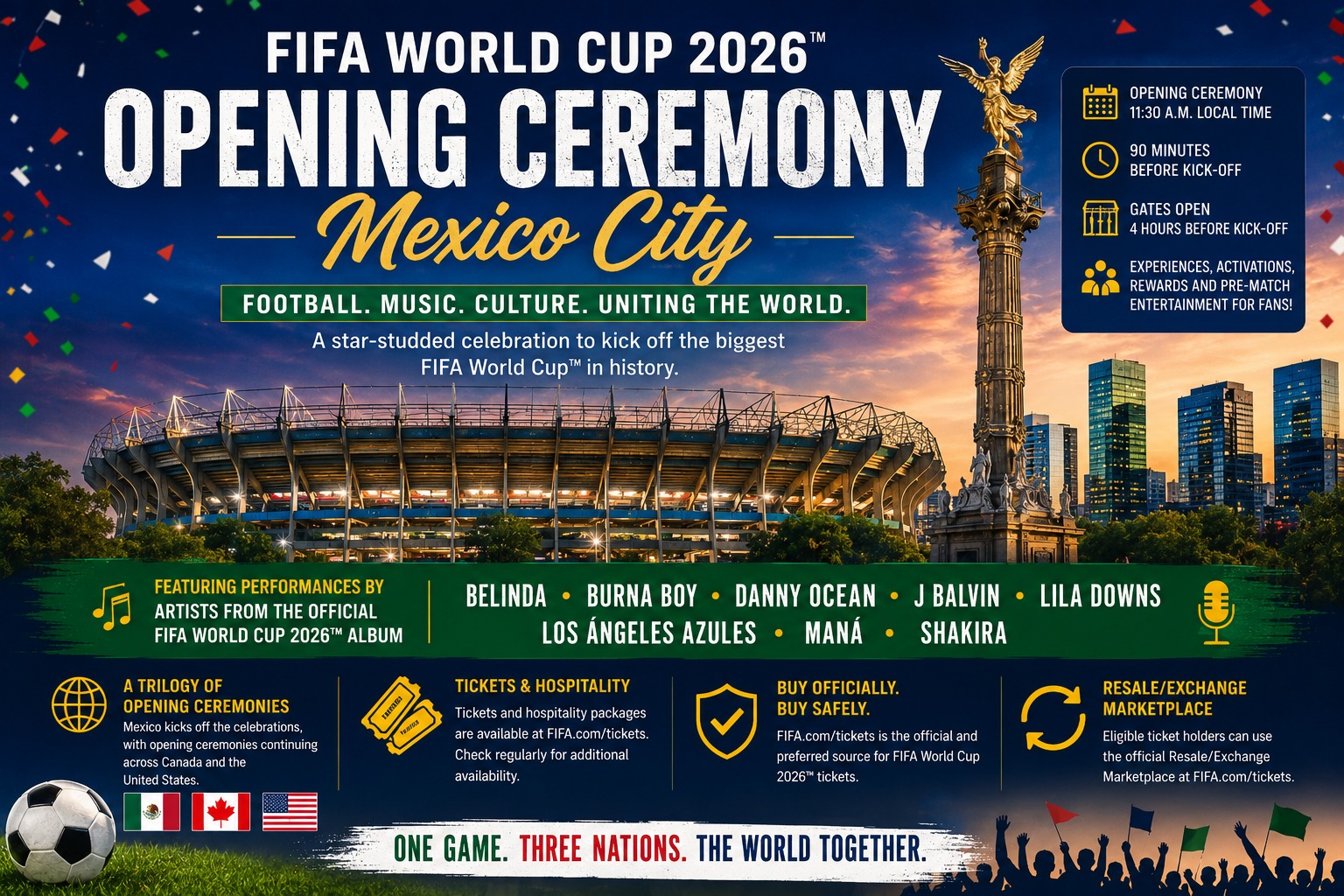
The expanded FIFA World Cup 2026 officially kicked off in Mexico City, launching an unprecedented 48-team, 104-match tournament across Canada, Mexico, and the United States. The structural overhaul introduces a Round of 32 knockout phase, extending the road to the New Jersey final for competing nations.
MEXICO CITY — The largest sports spectacle in global football history officially commenced on Thursday, June 11, 2026, as co-hosts Mexico faced South Africa at the historic Estadio Azteca. The opening clash launched the 23rd edition of the FIFA World Cup, a tournament uniquely shared across 16 host cities in Canada, Mexico, and the United States. Running through to the final on July 19, 2026, this rendition introduces structural adjustments that completely reshape the mechanics of international tournament play.
The 2026 iteration marks an immediate departure from decade-long traditions. By engineering a broad structural expansion to the tournament's framework, FIFA aims to capture new media markets and give emerging football nations an unprecedented competitive stage. For international fans, corporate sponsors, and broadcasting networks, understanding the updated competitive rules, travel demands, and scheduling layouts is essential to navigating the month-long event.
Historic 48-Team Expansion Altering Group Math
The most visible modification implemented for this tournament is the expansion of the playing field from 32 teams to a record 48 nations. This structural increase has directly altered the baseline mathematical journey required to hoist the iconic trophy.
According to formal tournament parameters published by FIFA, the teams are organized into 12 distinct groups of four. Rather than eliminating half the field immediately after the opening stage, the top two teams from each group, alongside the eight best third-placed finishers, will advance. This design creates a newly minted Round of 32 knockout phase, extending the total tournament schedule to 104 matches. Consequently, the eventual world champions must navigate eight total fixtures instead of the historical seven.
Comprehensive List of Tournament Groups
| Group | National Teams Competing |
| Group A | Mexico, South Africa, South Korea, Czechia |
| Group B | Canada, Switzerland, Qatar, Bosnia and Herzegovina |
| Group C | Brazil, Morocco, Scotland, Haiti |
| Group D | United States, Paraguay, Australia, Türkiye |
| Group E | Germany, Ecuador, Ivory Coast, Curaçao |
| Group F | Netherlands, Japan, Sweden, Tunisia |
| Group G | Belgium, Egypt, Iran, New Zealand |
| Group H | Spain, Uruguay, Saudi Arabia, Cape Verde |
| Group I | France, Senegal, Norway, Iraq |
| Group J | Argentina, Austria, Algeria, Jordan |
| Group K | Portugal, Colombia, DR Congo, Uzbekistan |
| Group L | England, Croatia, Ghana, Panama |
Multi-Nation Logistics and Continental Broadcast Shifts
Executing a continental tournament demands vast logistical synchronization. Matches are distributed across three distinct time zones, stretching from Vancouver and Los Angeles on the Pacific coast to Miami, New York, and Toronto on the Atlantic seaboard.
To limit exhausting transcontinental travel for the athletes, FIFA has grouped group-stage fixtures into regionalized clusters. However, global fans face significant broadcast timing adjustments. For instance, international viewing logs tracked by regional broadcast rights holder Zee in India show that because games kick off during North American afternoons and evenings, domestic viewers must stream the action live between 9:30 PM IST and 9:30 AM IST.
Micro-Island Debutants and the Final Elite Chapter
The broad format has opened the door to several lower-ranked nations making their historic World Cup debuts. Curaçao, boasting a modest population of roughly 156,000 residents, stands out as the smallest nation ever to qualify for the final tournament stage, alongside fellow small-island contenders Cape Verde.
Concurrently, sports analytics platforms emphasize that this tournament marks a definitive closing chapter for a golden generation of football icons. Defending world champions Argentina, captained by a 38-year-old Lionel Messi, begin their title defense against Austria in Group J. Meanwhile, Portugal’s 41-year-old superstar Cristiano Ronaldo is participating in what is widely projected to be his final appearance on the grand international stage.
Official Sources Section
The competition parameters, group draws, and structural rules detailed in this report are sourced from official media releases published by FIFA, international scheduling blueprints from the United States Soccer Federation, and broadcast notifications from official regional carriage partners.
Quote Section
"According to officials, the implementation of the 48-team framework represents a milestone in globalizing the sport. Organizers stated that the tri-nation infrastructure is fully optimized to manage the unprecedented scale of 104 matches, creating a safe, sustainable, and highly competitive environment that gives more nations a pathway to dream of World Cup glory."
— FIFA Tournament Operations Briefing
Why It Matters
For traveling spectators and consumers, the massive geographical footprint means multi-city itineraries require complex cross-border visa clearances and varied local transit bookings. For international businesses and sports bars, the extended 39-day schedule provides a sustained economic window for consumer engagement. For corporate investors, the expansion into 16 major North American municipal stadium infrastructures unlocks unprecedented commercial streams across ticketing, corporate hospitality, and localized marketing.
Key Facts at a Glance
Unprecedented Scale: The FIFA World Cup 2026 features an expanded field of 48 nations playing a total of 104 matches across three host countries.
Knockout Adjustments: An added Round of 32 means the eight best third-placed group stage teams will survive the opening phase, lowering the immediate margin of elimination.
Championship Venue: While the tournament commenced at Mexico City's Estadio Azteca, the final match will take place at the MetLife Stadium in New Jersey on July 19, 2026.
Historical Benchmarks: The expanded format welcomes tiny debutant nations like Curaçao, while framing the projected final World Cup appearances for legends Lionel Messi and Cristiano Ronaldo.
Frequently Asked Questions
How does the new group stage format function in the 2026 tournament?
The 48 qualified teams are divided into 12 groups of four. Every team plays their group opponents once. The top two teams from each group automatically progress to the Round of 32, joined by the eight best third-placed finishers across the entire tournament.
Where will the knockout rounds and the final match take place?
Knockout games are distributed across Canada, Mexico, and the United States. The tournament reaches its climax with the world championship final match at the MetLife Stadium in East Rutherford, New Jersey, on Sunday, July 19, 2026.
Are there penalty shootouts during the group stage of the competition?
No, there are no penalty shootouts in the group stage; games ending in a draw after 90 minutes award one point to each team. Shootouts are utilized exclusively from the Round of 32 onward if teams remain tied after 30 minutes of extra time.
Source: FIFA Official Tournament Portal, Fox Sports World Cup Hub