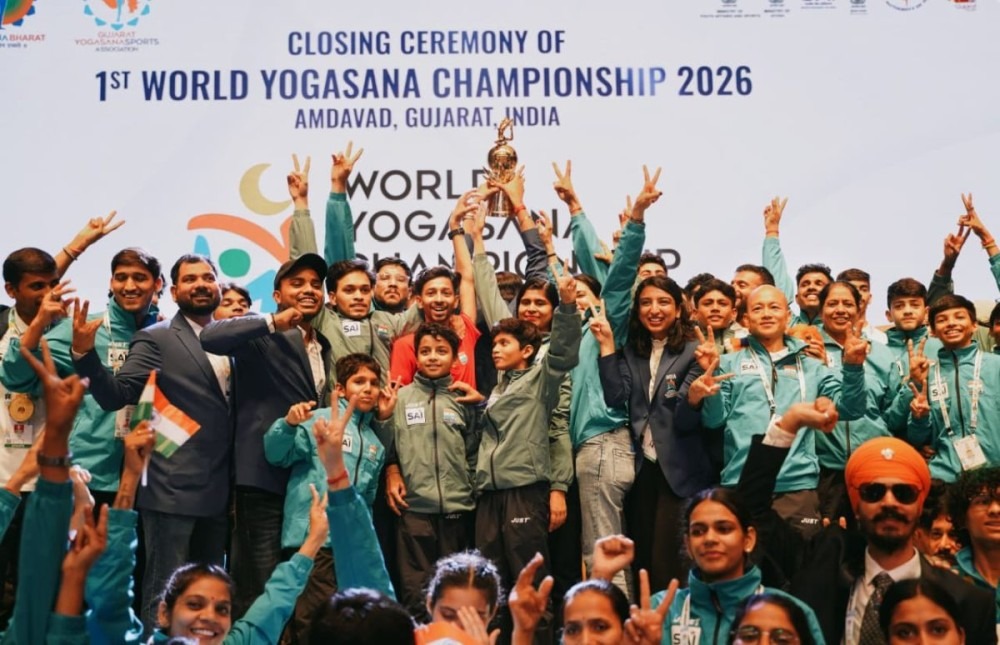
The inaugural World Yogasana Championship in Ahmedabad enabled Generation Z athletes from Mauritius to reconnect with their ancestral roots in Bihar and Tamil Nadu. The international tournament featured 522 athletes from 79 countries, successfully establishing the traditional Indian discipline as a globally competitive sport while bridging deep cultural diaspora gaps.
AHMEDABAD — The inaugural World Yogasana Championship completed its five-day competitive run on Thursday, transforming into a prominent vehicle of cultural rediscovery for a new generation of Mauritian athletes. Organized by Yogasana Bharat in coordination with World Yogasana and the Indian Olympic Association, the international sporting event took place at the EKA Arena in Ahmedabad from June 4 to June 8, 2026. Official delegations reviewed the broader societal impacts of the cross-border matches during administrative closing briefings on June 11, 2026.
For the participating Generation Z athletes representing the Indian diaspora of Mauritius, the journey to Gujarat marked their first physical entry into the country their ancestors departed generations ago. The deployment of an indigenous Indian discipline as a globally recognized competitive sport provided these young sportspersons with a contemporary platform to explore familial origins that had previously survived only through verbal family folklore and grand-parental narratives.
Posture Competitions as Tools for Diaspora Identification
The technical execution of the multi-nation tournament repositioned yogasana the competitive physical adaptation of traditional yoga from a localized spiritual exercise to a structured international sport. Athletes from 79 countries competed across detailed structural disciplines including traditional yogasana, artistic single, artistic pair, and rhythmic pairs.
According to demographic briefings provided by the Sports Authority of India (SAI), several key competitors from the Mauritian squad successfully leveraged their presence at the Ahmedabad arena to map out specific ancestral tracks. Competitors Chethnaa Reesaul, Parineeti Kalkah, and Ganisha Bajah, who attend the Mahatma Gandhi Senior Secondary School in Nouvelle France, Mauritius, confirmed their lineages trace directly to historical migration corridors originating in Bihar. Concurrently, fellow team members Aarya Chelumbrun and Dakshesh Sai Joorun verified family roots spanning Tamil Nadu.
Reversing Generational Separation Through Elite Athletics
The administrative structure of the championship emphasized how indigenous physical culture can strengthen international bilateral relations. Over generations of geographic displacement, precise paperwork identifying the exact ancestral villages of the Indo-Mauritian community had systematically faded.
Data published by Prasar Bharati (DD News) highlights that the competitive trip was supported by educational supervisors, including Mauritian Deputy Rector Reena Dewkarun and educator-coach Disha Nekitsing. The presence of these academic trainers highlighted a broader institutional effort within Mauritius to protect historical customs, linguistics, and cuisine, while using formal international sports to give the youth a realistic connection to modern India.
Long-Term Global Integration and Olympic Movement Goals
Beyond facilitating individual journeys of self-discovery, the completion of the inaugural world cup represents a foundational step toward placing yogasana within the prospective framework of the Olympic movement. The five-day tournament featured 522 global athletes, with hosts India dominating the final medal standings by securing 114 total medals, including 102 gold.
Regulatory reports from the Ministry of Youth Affairs and Sports emphasize that competitive yogasana scoring models demand absolute flexibility, trunk balance, physical endurance, and precise core stability. Having successfully featured in localized domestic showcases like the Khelo India Youth Games and the National Games, the sport's global rollout in Ahmedabad demonstrates its structural scalability as a fully standardized, international athletic discipline.
Official Sources Section
The athletic statistics, ancestral tracking data, and institutional structures referenced inside this report are drawn directly from press releases authorized by the Sports Authority of India (SAI), official event reporting from Prasar Bharati (DD News), and formal tournament logs managed by the international governing federation, World Yogasana.
Quote Section
"For me, this is one of the most unexpected legacies of the inaugural Yogasana World Championships. It is not just about bringing nations together through sport. It is also about helping a new generation like us rediscover where our story began. Growing up, we always knew that our ancestors came from India, but it felt like something that belonged to the past. Being here has made that connection feel real."
— Ganisha Bajah, 13-Year-Old Mauritian National Athlete
Why It Matters
For young diaspora communities and cultural groups, this development shows how competitive sports can successfully preserve and renew interest in ancestral heritage. For international sports organizations and corporate sponsors, the inclusion of 522 athletes from 79 distinct nations points to a rising global commercial market for indigenous competitive sports. For tourism operators and academic institutions in both India and Mauritius, the success of the tournament opens clear opportunities to build structured heritage travel packages and youth exchange programs tailored to Generation Z.
Key Facts at a Glance
Inaugural Event: The first-ever World Yogasana Championship brought together 522 international athletes from 79 countries to compete at the EKA Arena in Ahmedabad.
Cultural Connection: The tournament served as a gateway for Gen Z Mauritian athletes to physically reconnect with ancestral roots in Bihar and Tamil Nadu.
Athletic Rigor: Competitors were evaluated on strict scoring matrices measuring flexibility, control, balance, and endurance across multiple posture events.
Medal Standing Dominance: Host nation India finished at the top of the collective tournament standings, claiming 114 medals, including 102 gold.
Frequently Asked Questions
What exactly is competitive yogasana, and how is it evaluated?
Yogasana is a competitive sport adapted from ancient yoga practices. Specially trained judges score athletes on their flexibility, structural balance, core endurance, stability, and control while holding designated postures across traditional, artistic, or rhythmic disciplines.
Which regions of India did the Mauritian athletes trace their origins to?
The young athletes from the Mauritian delegation traced their direct historical lineages back to the states of Bihar and Tamil Nadu, from where their ancestors migrated generations ago.
Who organized the 2026 World Yogasana Championship?
The landmark event was organized by Yogasana Bharat in close collaboration with the international federation World Yogasana and the Indian Olympic Association, with direct administrative support from the Ministry of Youth Affairs and Sports.
Source: Sports Authority of India (SAI), Prasar Bharati (DD News) India, World Yogasana International Federation Records