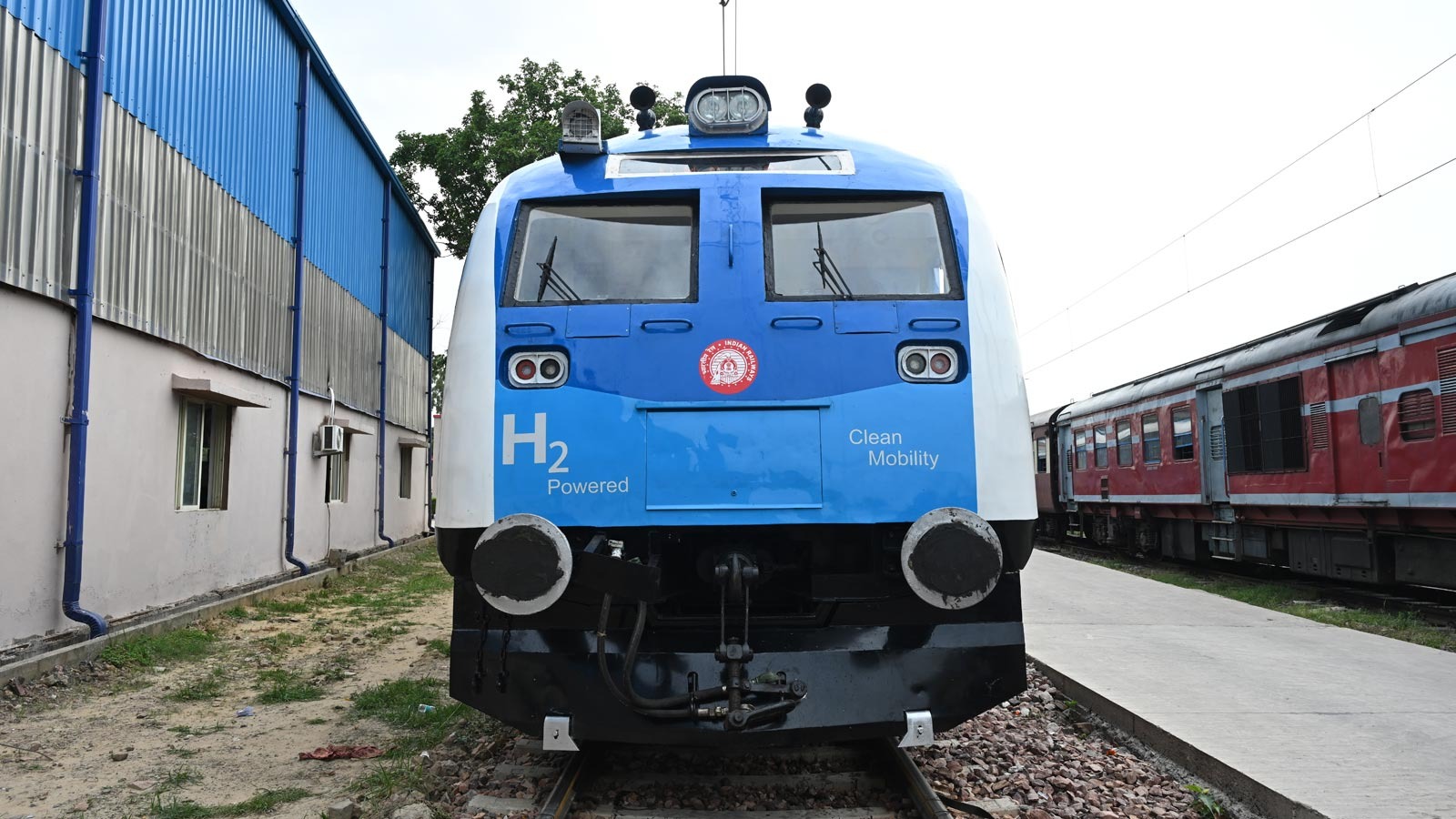
India's first indigenously developed hydrogen train has completed over 1,200 kilometers between Jind and Sonipat, replacing 3,200 litres of diesel exhaust with clean water vapour. Developed by Indian Railways, the 10-coach train uses onboard fuel cells to deliver zero-emission propulsion as trials prepare to expand toward Delhi.
NEW DELHI — India's first indigenously developed hydrogen-powered train has successfully completed its initial milestone of covering over 1,200 kilometers between Jind and Sonipat in Haryana, completely replacing the exhaust emissions of more than 3,200 litres of diesel with clean water vapour. Flagged off on July 17, 2026, near Delhi, the zero-emission train set marks a major technological breakthrough for Indian Railways as the country seeks to decarbonize its vast rail network.
The 10-coach hydrogen fuel-cell trainset, capable of carrying approximately 2,600 passengers at speeds up to 110 km/h, generates electricity onboard through an electrochemical reaction between hydrogen and atmospheric oxygen. Because the system operates without combustion, the only by-product released into the atmosphere is harmless water vapour and heat. Ministry officials confirmed that following the successful operational phase on the 89-kilometer Jind–Sonipat section, trials will soon expand onto the high-density Delhi route.
Onboard Fuel Cell Architecture and Safety Systems
The indigenous propulsion system represents a collaborated effort led by Indian Railways under the national Atmanirbhar Bharat initiative. The train configuration utilizes two specialized Hydrogen Driving Power Cars that deliver a combined output of 2,400 kW, integrated alongside high-capacity lithium iron phosphate (LiFePO₄) battery banks to manage peak acceleration and store regenerative braking energy.
To support ongoing operations, Indian Railways established its first dedicated green hydrogen storage and refuelling facility at Jind. Green hydrogen produced via water electrolysis using renewable power is stored at pressures up to 500 bar and dispensed directly to the train's onboard cylinders at 350 bar, maintaining a site storage capacity of approximately 3,000 kilograms. To guarantee operational safety, the train incorporates automated thermal sensors, optical flame detectors, and continuous continuous-ventilation leak management systems tied to emergency shut-off valves.
Expansion Plans under 'Hydrogen for Heritage'
The deployment on the Jind–Sonipat section serves as the operational prototype for Indian Railways' broader "Hydrogen for Heritage" project. The national plan aims to introduce 35 hydrogen-powered trains across ecologically sensitive mountain routes and non-electrified scenic corridors, including the UNESCO-listed Kalka-Shimla Railway.
By replacing conventional diesel locomotives on non-electrified branch lines, hydrogen fuel-cell technology offers a sustainable pathway toward Indian Railways' official commitment to become a Net-Zero carbon emitter by 2030. The successful 1,200-kilometer trial confirms that high-capacity passenger trains can operate reliably on clean hydrogen without compromising schedule adherence or passenger capacity.
Official Sources
According to press disclosures issued by the Press Information Bureau (PIB) and statements from the Ministry of Railways:
"Railways Minister Ashwini Vaishnaw stated that the successful deployment of India's first hydrogen train represents a landmark achievement for indigenous engineering. By replacing over 3,200 litres of diesel exhaust with harmless water vapour over its first 1,200 kilometres, Indian Railways has demonstrated a viable zero-emission alternative for non-electrified corridors."
Why It Matters
For Passengers & Communities: Eliminates localized diesel exhaust particulates, soot, and carbon monoxide around railway platforms and rural transit corridors.
For Energy Security: Directs transport demand toward domestic renewable energy and green hydrogen production under the National Green Hydrogen Mission, reducing national crude oil import reliance.
For Environmental Conservation: Prevents thousands of tons of greenhouse gas emissions annually across sensitive hill routes and non-electrified regional lines.
Key Facts at a Glance
Milestone Distance: Surpassed 1,200 km of seamless passenger operations on the Jind–Sonipat line.
Fuel Displacement: Replaced over 3,200 litres of diesel consumption with zero carbon tailpipe output.
Emission Profile: Emits only water vapour and heat through onboard proton-exchange membrane fuel cells.
Next Target: Operational expansion and trial runs on the higher-density Delhi suburban rail route.
Frequently Asked Questions (FAQ)
How does India's hydrogen train generate power without diesel?
The train uses onboard fuel cells where green hydrogen gas reacts electrochemically with oxygen drawn from the outside air, generating electricity to drive electric traction motors while producing only water vapour as a by-product.
Where does the hydrogen fuel train currently operate?
The train currently operates on the 89-kilometer Northern Railway section between Jind and Sonipat in Haryana, with upcoming trials planned on routes connecting to Delhi.
How much diesel fuel has the hydrogen train saved so far?
During its initial 1,200 kilometers of service, the train saved over 3,200 litres of conventional diesel fuel, eliminating equivalent tailpipe carbon emissions.
Source: Official press releases and technical briefs issued by the Press Information Bureau (PIB) and the Ministry of Railways under Release ID 2289319.