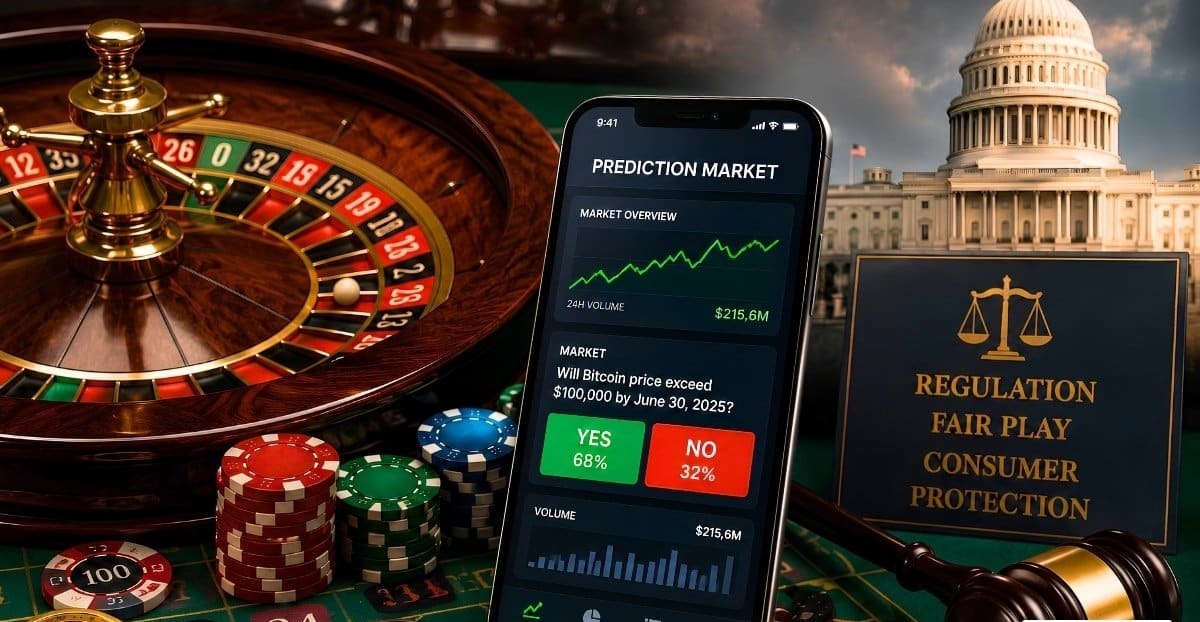
A coalition including the American Gaming Association and the Indian Gaming Association has urged the U.S. Senate to explicitly ban sports event contracts from prediction markets via the CLARITY Act. The groups argue these platforms bypass state laws, threaten tribal gaming, and cost states over $1 billion in taxes.
WASHINGTON, D.C. — June 24, 2026 — A powerful coalition of American gaming industry organizations, tribal groups, and hospitality labor unions has formally called on Congress to intervene against the rapid expansion of sports prediction markets. In a joint legislative appeal, the groups requested that federal lawmakers add strict exclusionary language to pending cryptocurrency market structure legislation that would explicitly prohibit event contracts tied to athletic competitions and casino-style gaming.
The lobbying effort represents a significant escalation in the ongoing regulatory and legal battles surrounding high-volume financial betting platforms. Traditional casino operators argue that prediction platforms are using loopholes to bypass established state consumer protections and tribal gaming monopolies under the guise of offering federally regulated financial instruments.
Lobbying the CLARITY Act for a Sports Betting Carve-Out
The coalition which includes the American Gaming Association (AGA), the Indian Gaming Association (IGA), and the Association of Gaming Equipment Manufacturers is targeting the Digital Asset Market Clarity (CLARITY) Act currently moving through the U.S. Senate. While the primary intent of the CLARITY Act is to divide regulatory enforcement duties over digital assets between federal agencies, the gaming lobby views the bill as the most practical legislative vehicle to enshrine a permanent sports-betting carve-out.
According to the joint letter obtained by congressional correspondents, the gaming groups argue that prediction markets have fueled an unauthorized gambling boom over the past 18 months without public voter consent or state-level legislative authorization.
The primary operators facing direct exposure from the potential legislative amendment are prominent financial event exchanges like Kalshi and Polymarket. Data from the Pew Research Center shows combined monthly global trading volume across these platforms exploded from less than $5 billion in September 2025 to over $24 billion in April 2026, with sports event contracts acting as a massive driver of liquidity. If Congress proceeds to keep sports out of prediction markets, platforms could lose up to 80% of their active transaction volume.
Jurisdictional Battles and Tax Revenue Erosion
A central pillar of the gaming industry's argument rests on state sovereignty and taxation infrastructure. Under the current system, legalized sportsbooks and tribal casinos pay substantial tax rates directly to state governments and local municipalities. The AGA estimates that state gaming authorities have lost approximately $1.08 billion in tax dollars since prediction markets began actively facilitating sports event contracts as mainstream alternatives.
The coalition heavily criticized the role of the Commodity Futures Trading Commission (CFTC), which currently oversees registered prediction exchanges. The letter asserts that the CFTC was never established to supervise gambling operations and completely lacks both the technical expertise and field infrastructure to police nationwide sports wagering markets safely.
The industry's push has found a key ally in Senator Maria Cantwell, ranking member of the Senate Commerce Committee, who has previously voiced sharp concerns about the impact of unregulated online platforms on tribal economic self-sufficiency. Tribal gaming operations supported over 680,000 domestic jobs in 2025, and industry leaders fear that decentralized, un-taxed alternatives directly undermine the local economies built around brick-and-mortar facilities.
Official Sources Section
The detailed policy demands and jurisdictional arguments highlighted by the coalition were compiled from official letters transmitted to leadership within the U.S. Senate, formal testimony records from the Senate Commerce Committee, and historical regulatory filings managed by the Commodity Futures Trading Commission.
Quote Section
"According to officials representing the joint coalition, the initiative is designed to reaffirm a basic regulatory principle: sports betting falls outside the federal derivatives remit and must be kept within the established state and tribal control systems that protect local jobs and public funding."
Why It Matters
For retail consumers and everyday sports fans, the outcome of this congressional debate will dictate how and where they can legally place wagers on athletic events. A total legislative ban on sports prediction markets would eliminate a highly liquid, low-fee trading alternative favored by tech-savvy bettors, shifting the entirety of online sports volume back into traditional state-licensed sportsbooks and casino applications.
Key Facts at a Glance
Legislative Target: The coalition wants an explicit amendment added to the pending Digital Asset Market Clarity (CLARITY) Act.
Coalition Members: Signed jointly by the American Gaming Association, the Indian Gaming Association, equipment manufacturers, and hospitality unions.
Financial Stakes: Sports event contracts currently comprise up to 80% of total trading volume on certain major prediction exchanges.
Estimated Tax Impact: Traditional gaming bodies claim state governments have missed out on over $1 billion in tax revenue due to prediction market diversions.
FAQ Section
Why do gaming groups want Congress to keep sports out of prediction markets?
Traditional gaming operators argue that prediction platforms are offering unregulated nationwide sports betting under the guise of financial products, which allows them to bypass state tax obligations and consumer safety rules.
How do prediction market platforms view sports event contracts?
Proponents and operators argue that these contracts represent an innovative form of information-based trading that improves price discovery and provides valuable public probability data on real-world outcomes.
What is the current position of the CFTC on this issue?
The CFTC has asserted jurisdiction over prediction markets, but has recently proposed targeted rules to limit or restrict specific event contracts that it deems contrary to the public interest or vulnerable to manipulation.
Source: American Gaming Association Official Portal, Commodity Futures Trading Commission, U.S. Senate Press Gallery