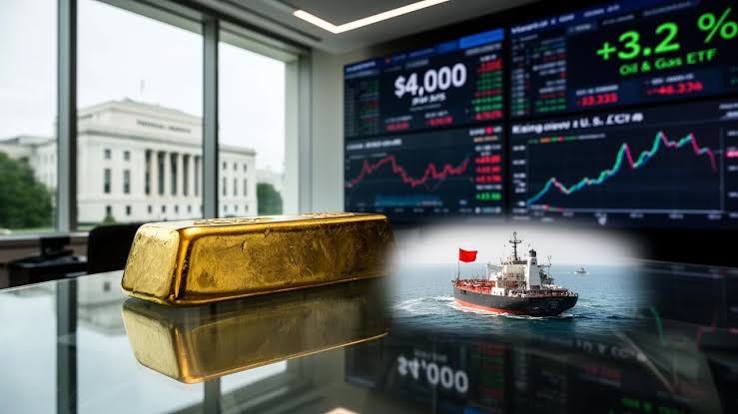
Spot gold held near the critical $4,000 per ounce support level on Tuesday, July 28, 2026, amid ongoing Middle East geopolitical tensions and market uncertainty surrounding the Federal Reserve’s upcoming policy decision. Investors balanced safe-haven demand against persistent inflation concerns and firming bond yields ahead of the central bank's rate outlook.
NEW YORK — Spot gold prices hovered near the key $4,000 per ounce threshold on Tuesday, July 28, 2026, as bullion markets consolidated following volatile trading sessions triggered by Middle East developments and shifting global interest rate expectations. According to commodities trading data from COMEX and spot market desks, gold traded in a narrow range between $4,000 and $4,090 per troy ounce. Market participants evaluated a temporary pause in regional hostilities alongside the Federal Open Market Committee (FOMC) two-day policy meeting concluding Wednesday.
Geopolitical Backdrop and Commodity Price Drivers
Precious metals experienced conflicting market forces as geopolitical risk premiums adjusted across global commodity trading desks. Over recent sessions, fluctuations in crude oil prices—driven by supply line concerns in the Middle East—stokers inflation fears, which directly impacts expectations for global monetary policy.
While safe-haven buying traditionally supports non-yielding assets during periods of heightened international tension, elevated energy prices can exacerbate headline inflation. This dynamic raises the likelihood of central banks maintaining tighter monetary stances for longer, presenting an opportunity cost headwind for non-interest-bearing bullion.
Central Bank Policy and Interest Rate Sensitivity
Financial markets remain heavily focused on the Federal Reserve's rate guidance. Institutional investors expect the central bank to maintain key policy rates at current levels while monitoring incoming labor and Personal Consumption Expenditures (PCE) price index data.
Analysts from major investment banking research groups note that gold remains sensitive to real interest rate expectations. Higher bond yields and a firm U.S. dollar tend to cap gains for precious metals, whereas any dovish monetary signals typically trigger buying interest across spot bullion markets.
Economic Impact on Investors, Central Banks, and Jewelry Markets
The stabilization of gold near the $4,000 level carries distinct financial implications across multiple global market segments:
For Institutional Investors: Asset managers continue utilizing gold allocations as a structural hedge against macroeconomic tail risk and currency volatility.
For Central Banks: Sovereign reserve accumulation remains elevated, with major central banks maintaining structural allocations to foreign bullion reserves.
For Retail Consumers and Jewelers: High baseline gold prices continue to temper physical jewelry volume demand in major Asian consumer markets, shifting consumer focus toward investment bars and coins.
Official Sources Section
According to official market reports, exchange disclosures, and commodity settlement updates:
Quote Section
According to official commodity updates and institutional market analysis:
"According to officials, gold prices maintained trading near $4,000 an ounce as market participants balanced lingering Middle East geopolitical risks against interest rate expectations ahead of the Federal Reserve's policy announcement."
Why It Matters
Gold serves as a barometer for global economic stability and monetary expectations. When gold consolidates near historical psychological levels like $4,000 per ounce, it highlights broader market anxiety over persistent inflation, sovereign debt dynamics, and potential geopolitical disruptions to supply chains.
Key Facts at a Glance
Trading Threshold: Gold prices maintained support near the $4,000 per troy ounce floor.
Macro Catalyst: Investors are awaiting the Federal Open Market Committee (FOMC) interest rate decision.
Geopolitical Influence: Middle East risk premiums and crude oil price fluctuations continue to impact inflation expectations.
Market Outlook: Bullion performance remains tied to Treasury yields and U.S. dollar trends.
Frequently Asked Questions (FAQ)
Why are gold prices hovering near $4,000 an ounce?
Gold prices are holding near $4,000 as investors weigh safe-haven demand driven by Middle East geopolitical risks against uncertainty regarding Federal Reserve interest rate policy.
How do Federal Reserve interest rate decisions affect gold?
Gold does not yield interest. When interest rates remain high, alternative yields on government bonds become more attractive, putting pressure on gold prices. Lower rates tend to boost gold's appeal.
What role do Middle East tensions play in gold market prices?
Geopolitical tensions usually increase demand for gold as a traditional safe-haven asset. However, if conflicts raise oil prices and fuel inflation, expected rate hikes can limit gold's upward momentum.
Where can traders verify live commodity price movements?
Official settlement prices and trading statistics are published daily by regulated exchanges like CME Group and international market data clearinghouses.
Source: Federal Reserve Board, Commodity Futures Trading Commission (CFTC), CME Group